The fundamental trade-off when scaling catalyst testing is a zero-sum game between experimental throughput and process control fidelity. As you move from high-throughput screening to larger pilot reactors, you sacrifice the ability to rapidly test hundreds of catalysts for the power to generate definitive, scalable engineering data for a single formulation. The core challenge is no longer about identifying candidates but about replicating the exact physical and chemical environment of a commercial reactor to ensure your data is predictive, not just indicative.
The scaling journey forces a strategic pivot: you must deliberately trade statistical breadth for operational depth. The data from a 250-sample screen is a blurry snapshot of relative performance, while data from a 1-reactor pilot plant is a high-definition portrait of a single catalyst's true potential, governed by precise heat, mass, and fluid dynamics.
The Inverse Relationship Between Throughput and Control
The primary reference correctly identifies that the number of parallel samples is the central variable dictating data quality. This isn't just about controlling knobs; it's about whether the data you collect has any physical meaning for scale-up.
The High-Throughput Screening Phase: A Necessary Blur
In primary screening with over 250 parallel samples, the goal is speed and breadth. The trade-off is that the reactor environment for each sample becomes poorly defined.
- Poorly Defined Hydrodynamics: Space velocity and feed-catalyst interaction are not controlled independently. The flow paths, local temperatures, and concentration gradients within a tiny, densely packed well are essentially unknown and inconsistent across the array.
- Relative, Not Absolute, Data: This makes the resulting data a "rough assessment of relative performance." You can rank catalysts accurately, but you cannot extract intrinsic kinetic parameters or predict performance in a different, well-defined reactor. The data is comparative, not predictive.
The Pilot-Scale Phase: Accuracy is Everything
When you scale down to 1-2 pilot-scale reactors, you gain exhaustive control. The system is designed to give you data that mirrors a full-scale plant.
- Decoupled, Independent Control: You can now independently set and verify temperature, pressure, and Weight Hourly Space Velocity (WHSV) for each reactor unit. This allows you to isolate kinetic effects from physical transport effects.
- Defined Hydrodynamics: Flow patterns are engineered to be known and predictable, moving from a laminar plug flow to a well-characterized continuous stirred-tank (CSTR) model. This allows for precise mathematical modeling of the reactor.
From Relative Ranking to Absolute Quantification
The deep need being addressed here is not just "getting data," but getting data with a specific, actionable purpose. The table below illustrates the strategic shift in the data's role.
| High-Throughput Screening | Pilot-Scale Testing | |
|---|---|---|
| Primary Goal | Candidate selection | Process validation |
| Sample Count | >250 | 1-2 |
| Data Type | Relative ranking | Kinetic & performance parameters |
| Process Control | Poorly defined, coupled | Precise, independent |
| Scale-up Predictability | Low | High |
The Hidden Physics: Leaving the Kinetic Regime
The most critical process control trade-off you must manage is not just about measurement, but about the physics governing the reaction itself. The deep need is to ensure the catalyst's true performance is what you're measuring, not a hidden physical limitation.
When Heat and Mass Transfer Lie to You
A reaction scaled up poorly can leave the kinetic regime and enter a mass-transfer-limited regime. Your thermocouples and flow meters might show perfect stability, but the catalyst is actually starved of reactants or smothered by its own heat.
- The Gas-Liquid Problem: The supplementary references state the scale-up strategy perfectly: the dissolved gas concentration in the pilot plant must match the lab ([H2]plant ≈ [H2]lab ≈ [H2]sat). If you fail to match the mass transfer coefficient (kLa), the dissolved gas concentration plummets away from saturation.
- The Consequence of "Gas Starvation": In this starved state, reaction kinetics change uncontrollably. Your measured rate plummets, and product selectivity shifts. You haven't learned that the catalyst is bad; you've only learned that your reactor can't deliver gas fast enough. This is a failure of process control, not chemistry.
The Solution: Match the kLa
Measuring and matching the volumetric mass transfer coefficient (kLa) is therefore a fundamental, non-negotiable control step. It's the bridge that connects the fluid physics of your bench-scale vial to your pilot-scale pipe. Controlling temperature and pressure is useless if the fundamental step of dissolving gas into the liquid phase is not replicated.
Understanding the Trade-offs: Pitfalls Beyond Performance
Process control trade-offs extend beyond catalytic performance data into the operational and safety realities that determine if a pilot plant can even operate.
The Safety Performance Trade-off
The most aggressive catalysts are often the most hazardous. A process safety assessment, as the supplemental reference emphasizes, is a non-negotiable process control function at the pilot scale. You must trade expediency for a meticulous evaluation of:
- Reaction Hazards: The impact of mixing, self-heating, and gas evolution potential, which are negligible in a microliter screen but catastrophic at scale.
- Thermal Stability: The stability of intermediates and reagents at larger volumes, where surface-to-volume ratios are lower and heat dissipation is slower.
- Physical Hazards: The new introduction of risks like dust explosions and electrostatic discharge when handling larger quantities of powders and flowing solvents. The control system must now manage safety interlocks and emergency quenching, adding a layer of complexity absent in the screening phase.
Making the Right Choice for Your Goal
The "right" trade-off is entirely defined by your objective. You cannot optimize for discovery and validation simultaneously.
After a brief introductory sentence, use a bulleted list to provide specific recommendations based on different user goals.
- If your primary focus is rapid discovery and mapping a vast parameter space: Accept the loss of process control. Use high-throughput screening to generate relative rankings cheaply and quickly, understanding that the data cannot be used for rigorous scale-up calculations.
- If your primary focus is generating intrinsic kinetic data for a reactor model: Reject parallelization. Opt for a single, highly instrumented lab or pilot reactor where you can independently control and measure temperature, concentration, and space velocity without interference from neighboring samples.
- If your primary focus is de-risking a specific, chosen catalyst for commercialization: Your only path is the pilot scale. Focus all your process control effort on replicating the commercial-scale heat and mass transfer environment, matching the kLa, and performing a full process safety assessment to establish safe operating limits.
The masterful scaler is not the one with the most advanced reactor, but the one who intentionally chooses which trade-off to make at each stage, knowing what data to trust and what data to throw away.
Summary Table:
| Phase | Throughput | Control Fidelity | Main Objective |
|---|---|---|---|
| High-Throughput Screening | High (>250 samples) | Low (coupled parameters) | Relative catalyst ranking |
| Pilot-Scale Testing | Low (1-2 reactors) | High (independent control, kLa matching) | Kinetic validation & process scale-up |
Scale Up Your Chemical Engineering Research with LABPARK
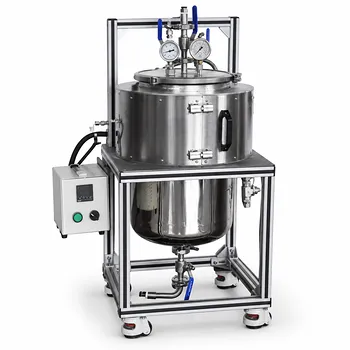
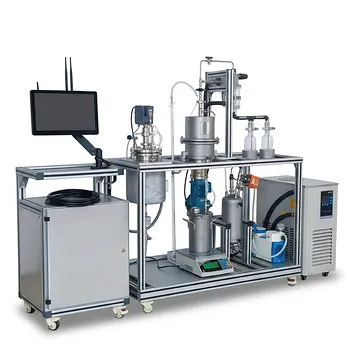
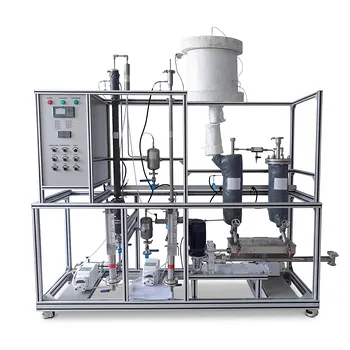
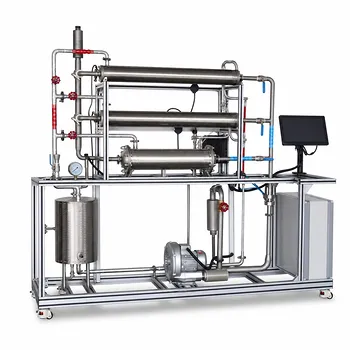
Transitioning from lab-scale catalyst screening to pilot-scale validation requires reliable, high-fidelity equipment. LABPARK provides premium Educational and Vocational Unit Operations Pilot Plants in chemical engineering, bioprocess & biotech, and environmental & water treatment.
Designed specifically for universities, research institutes, and enterprises, our pilot plants help you achieve precise process control, accurate mass transfer replication, and safe operations.
Ready to optimize your scale-up process? Contact our experts today to find the ideal pilot plant solution for your lab!
Related Products
- Methanol Synthesis and Catalyst Performance Evaluation Educational Unit Operations Pilot Plant
- Fixed-Bed Chemical Reaction and Gas Dust Tar Removal Unit Operations Pilot Plant
- Multi-Reactor Educational Pilot Plant for Reaction Engineering Unit Operations
- Multi Functional Catalytic Reaction and Reactor Evaluation Educational Unit Operations Pilot Plant
- Fixed Bed Gas Solid Catalytic Reaction Educational Pilot Plant
People Also Ask
- Why is a purge system necessary when operating a gas recirculation loop in a methanol synthesis pilot plant? (Guide)
- How do temp & pressure affect methanol synthesis pilot plants? Optimize equilibrium and catalyst performance.
- Why do modern methanol pilot plants operate at lower pressures? Catalyst & Feed Requirements Explained
- What are the operational requirements for catalyst activation? Safe Methanol Pilot Plant Operation
- Why Compare Predicted and Experimental Excess Enthalpy? Key to Accurate Pilot Plant Scale-up