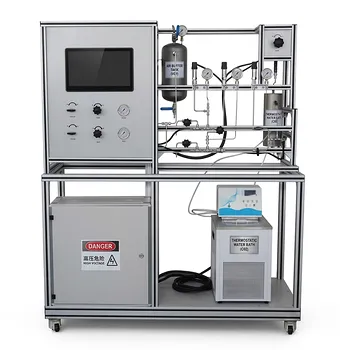
Adiabatic fixed-bed reactors with periodic flow reversal (RPFR) are a powerful educational tool for teaching transient process control, thermal wave management, and the dynamics of autothermal operation. Students learn to program and optimize automated valve switching sequences that exploit the reactor’s own heat capacity to preheat cold feed, eliminating traditional feed-effluent heat exchangers. This setup demonstrates how to maintain a stable, oscillating temperature profile where the catalyst mid-zone stays above the ignition temperature — a critical lesson in managing weakly exothermic reactions and energy integration.
An RPFR pilot plant transforms a fixed-bed reactor from a steady-state device into a dynamic, self-sustaining thermal system. Its primary teaching value lies in showing how timing-based flow manipulation can replace hardware-based heat exchange, forcing students to master time-dependent temperature control, thermal front propagation, and the delicate balance between reaction kinetics and heat storage.
The Unique Dynamics of Flow Reversal Reactors
An RPFR operates on a fundamentally different principle than a continuous, steady-state reactor. Instead of continuously feeding reactants in one direction and removing heat through an external exchanger, it uses automated switching valves to periodically reverse the flow direction. This creates a traveling thermal wave that stores and recuperates heat within the catalyst and inert packing.
How the Thermal Flywheel Works
The reactor bed acts as a thermal flywheel. During the forward flow period, the exothermic reaction at the center of the bed heats the downstream portion of the packing. When the flow reverses, the incoming cold feed passes through this hot section first, picking up stored heat and reaching the reaction temperature exactly where it’s needed.
This self-preheating eliminates the need for a feed-effluent heat exchanger. The system demonstrates how transient heat integration can be more efficient and equipment-light than continuous methods for certain reaction classes.
The Oscillating Temperature Profile
Unlike a traditional adiabatic bed that sees a steady temperature gradient, an RPFR develops a symmetric, oscillating temperature profile. The middle zone stays hot and above the ignition temperature, while the ends cyclically heat and cool. Students learn to monitor and control these moving temperature peaks, ensuring the reaction never extinguishes.
Key Process Control Concepts Directly Illustrated
The RPFR pilot plant is a living lab for several advanced control ideas that are difficult to demonstrate on a standard steady-state unit. The core lessons cluster around transient operation, logic sequencing, and the interplay of reaction and heat storage.
1. Time-Based Sequencing Logic
The heart of the reactor’s control is the valve switching program. Students must design the logic that triggers the reversal — typically based on a timer, a temperature setpoint at the reactor exit, or the position of the thermal front. This teaches discrete event control, state machines, and the importance of dead-time management in a physical system.
Automated switching valves need precise synchronization; a lag between the closure of one set and the opening of the reverse set can cause pressure shocks or flow disturbances. This makes the RPFR an excellent platform for learning sequence-of-events programming and interlock safety logic.
2. Ignition Temperature and Autothermal Operation
Maintaining the catalyst above its ignition temperature is the central control challenge. If the thermal wave shifts too far toward one end due to a flow imbalance or a disturbance, the cold feed can quench the reaction. Students learn to correlate reaction extinction with the position of the temperature peak and to design reversal strategies that keep the hot zone bounded.
This links directly to the concept of autothermal operation — the reactor’s ability to sustain itself without external heat input once started. The start-up procedure (heating the bed to ignition, then switching to cyclic flow) is itself a rich control exercise.
3. Thermal Front Propagation and Dispersion
The moving temperature bands are not sharp steps; they spread out due to thermal conduction and fluid mixing. Students observe how axial dispersion and heat transfer coefficients affect the wave broadening. Controlling the reversal frequency balances the benefit of keeping the hot zone tight against the cost of more frequent valve actuation.
By instrumenting the bed with multiple thermocouples along its length, the pilot plant teaches distributed parameter system monitoring and the interpretation of spatial temperature data in real time.
4. Feed Flow and Material Balance Control
Even in a cyclic reactor, the overall material balance must remain stable. As the supplementary reference notes, the main feed flow regulator typically establishes that balance. Students learn to integrate a mass flow controller on the feed, ensuring that the total throughput is consistent despite the periodic reversals. Disturbances in feed composition or flow rate directly shift the thermal front, so feed-forward or feedback compensation strategies can be tested.
Contrasting Adiabatic RPFR with Continuous Heat Exchange Reactors
Comparing an RPFR to a conventional shell-and-tube or jacketed reactor highlights fundamentally different control philosophies.
Steady-State vs. Transient Temperature Management
In a continuous heat exchange reactor, temperature control is achieved by manipulating utility flows (steam, cooling water) or bypass streams, as described in the supplementary reference. This is a real-time, steady-state feedback loop. An RPFR shifts the control lever from a utility valve to a time-based reversal strategy; there is no continuous cooling or heating fluid. The only external actuators are the switching valves.
This contrast forces students to think beyond the typical single-loop temperature controller and to embrace dynamic, cycle-averaged control.
The Single Control Valve Rule in Context
The supplementary references state that only one control valve should be installed on a process stream between unit operations to avoid competing loops. In an RPFR, the reversal valves themselves are on-off devices, not modulating control valves. However, the principle still applies to the feed system: a single flow control valve upstream of the switching manifold sets the total feed, maintaining hydraulic stability without fighting another controller. This is a perfect practical example of the rule.
Understanding the Trade-offs and Limitations
An RPFR pilot plant is an exceptional teaching tool, but it also teaches what it cannot do — a crucial lesson for any process control engineer.
Not Suitable for Highly Exothermic Reactions
The adiabatic nature of the bed means that without careful control, a highly exothermic reaction can cause a dangerous thermal runaway. The RPFR’s self-heating mechanism works best with weakly exothermic reactions like VOC oxidation or SO₂ oxidation. This teaches students to match reactor configuration to reaction thermodynamics.
Valve Wear and Maintenance as a Control Constraint
Frequent switching stresses the valve actuators and seats. The reversal frequency is not just a thermal optimization variable; it is a mechanical reliability constraint. Students learn that control strategy must account for equipment longevity, a real-world lesson absent from many academic simulations.
Start-Up and Shutdown Complexity
Bringing the bed from ambient to a uniform ignition temperature requires external heating (e.g., electrical preheaters) before cyclic operation can begin. The control sequence for a safe and efficient start-up — ramping temperature, managing flow, and switching to reversal mode — is an entire module on procedural automation and state-based control.
How to Build an RPFR Control Curriculum
The deep need behind the question is likely about designing a teaching module. The reactor becomes a framework for progressive learning, moving from basic principles to advanced optimization.
From Manual Switching to Automated Logic
Start by having students operate the reversal valves manually based on temperature readouts to develop an intuition for thermal lag. Then, let them program a PLC or DCS to automate the switching using timers. Finally, introduce closed-loop, temperature-triggered reversal. Each stage builds a deeper understanding.
Integrating Process Control Theory
Map the RPFR to standard control concepts:
- System identification: Step-test the thermal response to find a dynamic model.
- Cycle-to-cycle feedback control: Adjust the switching period or flow rate based on mid-bed temperature trends.
- Fault detection: Use the distributed thermocouples to diagnose catalyst deactivation, flow maldistribution, or sensor drift.
The reactor becomes a capstone project that ties together reaction engineering, heat transfer, and process control.
For educational and vocational training, an RPFR pilot plant is far more than a reactor. It is a platform for teaching the control of transient, distributed, and self-sustaining systems — skills directly transferable to modern processes like regenerative thermal oxidizers, energy storage, and autothermal reforming.
If your primary focus is building foundational control skills: Use the RPFR to teach timing logic, valve sequencing, and the fundamental difference between steady-state and transient process control.
If your primary focus is advanced thermal and energy integration: Emphasize thermal front monitoring, ignition temperature management, and the economic trade-offs of eliminating feed-effluent heat exchangers.
If your primary focus is industrial relevance: Frame the RPFR as a scaled-down version of regenerative thermal oxidizers and autothermal reactors, linking the pilot plant directly to real-world applications.
An RPFR reactor turns a simple fixed-bed into a living control problem — one that teaches the irreplaceable lesson that in some processes, the best heat exchanger is the process itself.
Summary Table:
| Process Control Concept | Core Control Challenge | Educational Value & Learning Outcome |
|---|---|---|
| Time-Based Sequencing | Synchronizing valve switching to prevent pressure shocks | Master discrete event control & safety interlock logic |
| Autothermal Operation | Maintaining catalyst bed above ignition temperature | Learn to sustain reactions without external heat input |
| Thermal Wave Management | Controlling moving temperature peaks & front dispersion | Understand transient heat integration & spatial data |
| Flow & Mass Balance | Regulating feed flow during periodic reversals | Apply the single control valve rule in cyclic systems |
Elevate Your Engineering Curriculum with LABPARK
Ready to bring advanced process control to life in your lab? LABPARK provides premium Educational and Vocational Unit Operations Pilot Plants in chemical engineering, bioprocess & biotech, and environmental & water treatment. Designed specifically for universities, research institutes, and enterprises, our pilot plants—including advanced systems like the RPFR—give students and researchers hands-on experience with real-world industry dynamics.
Contact our engineering experts today to customize your pilot plant solution!
Related Products
- Multi-Reactor Educational Pilot Plant for Reaction Engineering Unit Operations
- Fixed Bed Gas Solid Catalytic Reaction Educational Pilot Plant
- Multi Functional Catalytic Reaction and Reactor Evaluation Educational Unit Operations Pilot Plant
- Fixed-Bed Chemical Reaction and Gas Dust Tar Removal Unit Operations Pilot Plant
- Throttling Effect Determination Educational Unit Operations Pilot Plant
People Also Ask
- How do reactor pilot plants define QbD design space? Master chemical process scale-up.
- When configuring a reactor unit operations pilot plant for highly exothermic reactions, how to prevent thermal runaway?
- How do metal ion-catalyzed reaction mechanisms inform chemical engineering pilot plant design? From kinetics to scale-up
- What role do educational pilot plants play in scaling green chemistry? Bridging the Lab-to-Industry Gap
- What are the barriers to process intensification & how do pilot plants help?