Monitoring the key kinetic parameters—exchange current densities and open-circuit potentials—of both copper deposition and hydrogen evolution is the direct answer.
These fundamental values define the separation between the two reactions, dictate the usable potential window, and allow you to predict whether the desirable limiting-current plateau of copper deposition will remain unobscured or be corrupted by parasitic gas bubbles.
The single most telling parameter is $\Delta U_s$, the difference in reference potentials between the two reactions adjusted for their kinetic terms. A large $\Delta U_s$ creates a long, clear limiting-current plateau for copper, meaning the side reaction is pushed to far more negative potentials and current efficiency stays high. Monitoring this relationship—through exchange current densities, open-circuit potentials, and the resulting plateau length—lets researchers and students quantify exactly how much hydrogen evolution is undermining their pilot plant’s performance.
The Kinetic Landscape: Why These Parameters Matter
When copper ions are reduced at a cathode, the applied potential also invites the reduction of protons to hydrogen gas. The impact of this side reaction is not a fixed penalty; it depends on how far apart the two reactions sit on the potential axis and how easily each one “takes off” kinetically.
Exchange Current Density ($i_0$) Sets the Starting Gate
The exchange current density is the intrinsic rate at which a reaction proceeds at its equilibrium potential. For hydrogen evolution on a given electrode material, $i_{0,H_2}$ can vary by orders of magnitude.
A very small $i_{0,H_2}$ means the hydrogen reaction requires a substantial overpotential before any significant current flows, effectively keeping it dormant during copper plating.
Open-Circuit Potential ($E_{oc}$) Defines the Playing Field
The open-circuit (equilibrium) potential of each reaction determines its position on the voltage scale. Copper deposition’s standard potential is $+0.34,\text{V}$ vs. SHE, while hydrogen evolution sits at $0,\text{V}$ vs. SHE, but real conditions—pH, concentration, temperature—shift these values.
The difference in these potentials, before kinetics even enter, sets the baseline separation. A more negative $E_{oc}$ for hydrogen (due to, say, a high-pH electrolyte) widens the gap.
$\Delta U_s$: The Unified Metric That Predicts Interference
Combining both effects leads to $\Delta U_s$, the potential difference between the two reactions’ reference potentials, corrected for their kinetic parameters.
It is essentially the voltage range where the main reaction’s current rises from nothing to its transport-limited maximum, while the side reaction’s current remains negligible. A large $\Delta U_s$ means the copper deposition can reach its full mass-transfer-limited rate before the hydrogen wave begins to overlap.
Translating Theory into Pilot Plant Measurements
In an educational or research pilot plant, you don’t just calculate these parameters from tables—you measure them under the actual operating conditions and watch how the current–potential curves evolve.
Map the Full Polarization Curve of the Working Electrode
The most direct diagnostic is a slow-scan linear sweep voltammetry experiment that spans from the open-circuit potential of the copper system down to potentials where hydrogen evolution dominates.
Key features to identify:
- The onset potential of copper reduction.
- The limiting-current plateau where copper ion mass transport caps the current.
- The potential at which the current rises again due to hydrogen evolution.
If the hydrogen rise begins well before the copper plateau has truly flattened, the side reaction is already eating into your efficiency.
Quantify the Length of the Limiting-Current Plateau
The length of the limiting-current plateau (expressed in volts) is a practical, visual proxy for $\Delta U_s$.
A long, flat plateau signals that the side reaction’s exchange current density is low or its equilibrium potential is sufficiently negative, so copper plating can proceed at maximum mass-transfer efficiency with minimal hydrogen co-generation.
Directly Measure Current Efficiency
While not a primary kinetic parameter, the current efficiency is the ultimate experimental verification.
Compare the actual mass of copper deposited (weighed after a timed run) to the mass theoretically expected from Faraday’s law:
[ \text{CE%} = \frac{m_{\text{actual}}}{m_{\text{theoretical}}} \times 100 ]
A value noticeably below 100% quantifies the loss to side reactions, and monitoring it as a function of applied potential tells you exactly where hydrogen begins to interfere.
Monitor Off-Gas Composition or Rate
In a pilot plant with a sealed cell, you can directly measure the volume or composition of evolved gas using a flow meter or a small gas sensor.
A sudden increase in the hydrogen fraction at more negative potentials pinpoints the exact operating point where the side reaction becomes macroscopic, even if the current efficiency hasn’t yet dropped dramatically.
Understanding the Trade-offs and Practical Pitfalls
Interpretation of these parameters is not always straightforward. Real systems introduce complications that can mislead a superficial analysis.
The $\Delta U_s$ Calculation Assumes Ideal Kinetics
The simplified $\Delta U_s$ concept works best when both reactions follow simple Tafel behavior and mass-transport limitations are minimal for the side reaction.
In reality, hydrogen evolution can be strongly affected by bubble formation, surface coverage, or local pH changes at the electrode, making $i_{0,H_2}$ appear artificially altered and reducing the clarity of the plateau.
Mass-Transfer Effects Can Mimic Kinetic Interference
If the copper limiting-current plateau appears shorter than expected, it may not be due to a small $\Delta U_s$ but to poor mass transport of copper ions.
Low flow velocity or a depleted bulk concentration makes the plateau current lower and the transition to hydrogen evolution steeper. Always cross-check by varying the flow rate: if the plateau lengthens with higher velocity, the culprit is mass transfer, not an intrinsically close $E_{oc}$ separation.
Off-Gas Measurements Must Account for Dissolution
Hydrogen is sparingly soluble in aqueous electrolytes. A gas sensor in the headspace captures only the fraction that nucleated and detached as bubbles.
Some dissolved hydrogen may exit with the electrolyte or re‑oxidize at the anode, underestimating the true faradaic loss. For precise kinetic studies, a combination of gas collection and current efficiency calculation is more robust.
Making the Right Choice for Your Pilot Plant Goal
How you prioritize these parameters depends on whether you’re optimizing process efficiency, studying reaction fundamentals, or teaching electrochemical engineering concepts.
- If your primary focus is demonstrating clean kinetic separation: Calculate $\Delta U_s$ from measured $E_{oc}$ and $i_0$ values, and present the polarization curve to highlight the long, undisturbed copper plateau. The visual impact is powerful for understanding why some electrode materials work better than others.
- If your primary focus is quantifying energy losses and process inefficiency: Directly track the current efficiency at each operating potential and measure the hydrogen gas flow. This connects the abstract kinetic parameters to tangible performance metrics like power consumption per kilogram of copper.
- If your primary focus is teaching the impact of operating conditions: Vary the flow velocity or electrolyte pH while monitoring the length of the limiting-current plateau. This shows students how $\Delta U_s$ can be tuned in practice by shifting mass transport or the side reaction’s equilibrium potential.
By anchoring all observations to the kinetic fundamentals embodied in $\Delta U_s$, you transform a simple copper plating experiment into a rigorous investigation of process selectivity that will serve as a lasting mental model for any electrochemical system.
Summary Table:
| Key Parameter | Description | Practical Significance |
|---|---|---|
| Exchange Current Density ($i_0$) | Intrinsic reaction rate at equilibrium | Determines the onset of the side reaction. |
| Open-Circuit Potential ($E_{oc}$) | Equilibrium potential of the reaction | Defines the baseline voltage separation. |
| Potential Difference ($\Delta U_s$) | Kinetic-corrected voltage difference | Predicts the length of the limiting-current plateau. |
| Current Efficiency (CE%) | Mass-based ratio vs. Faraday's law | Quantifies actual material/energy loss to side reactions. |
| Off-Gas Rate | Volume/composition of evolved $H_2$ | Pinpoints the onset of macroscopic gas evolution. |
Elevate Your Chemical Engineering Labs with LABPARK
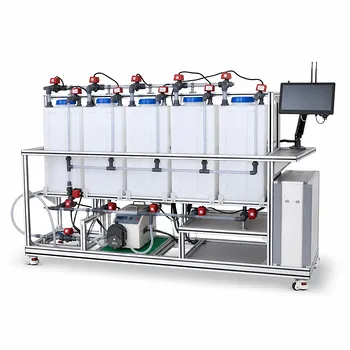
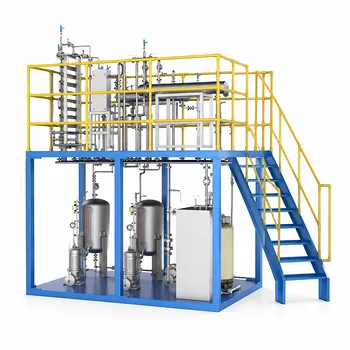
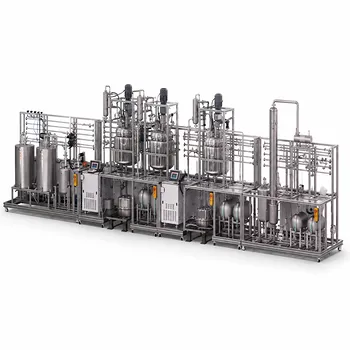
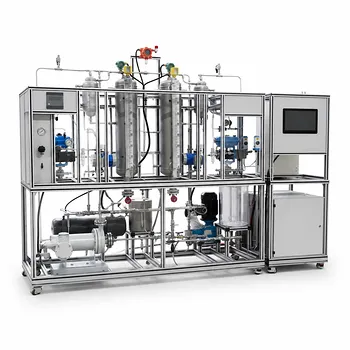
Ready to bring advanced electrochemical concepts to life? LABPARK provides premium Educational and Vocational Unit Operations Pilot Plants in chemical engineering, bioprocess & biotech, and environmental & water treatment.
Designed for universities, research institutes, and enterprises, our pilot plants empower students and researchers to analyze real-world kinetic parameters and optimize process efficiency.
Contact our specialists today to find the ideal pilot plant system for your facility!
Related Products
- Electrochemical Water Treatment Educational Unit Operations Pilot Plant
- Multi Pump Fluid Transport Process Piping Unit Operations Training Pilot Plant
- Multi-Reactor Educational Pilot Plant for Reaction Engineering Unit Operations
- Electrolytic Hydrogen Production Educational Unit Operations Pilot Plant
- Multi-Modal Distillation Unit Operations Training Pilot Plant
People Also Ask
- What design features do educational electrochemical pilot plants utilize to manage gas liberation and water loss?
- How can unit operations pilot plants show lead-acid concentration vs state of charge? Real-time monitoring guide.
- How do educational electrochemical pilot plants scale up electrolysis? Master industrial engineering.
- How to Estimate Sulfate in Water Treatment Pilot Plant Deposits: Gravimetric Guide
- How can foaming be managed during steam generation experiments in water treatment unit operations pilot plants? Tips