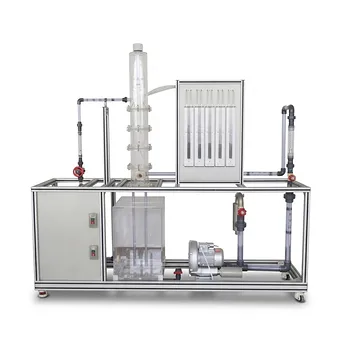
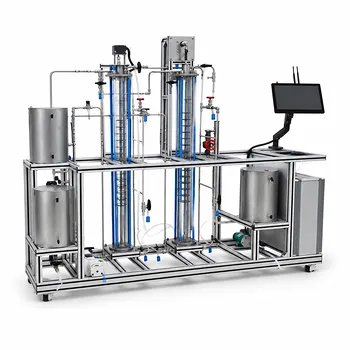
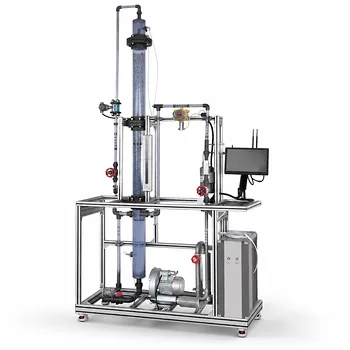
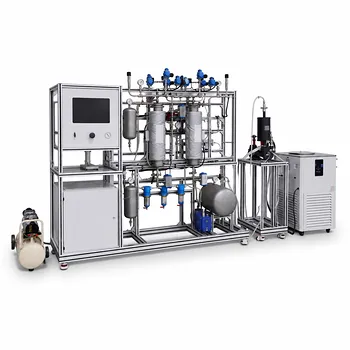
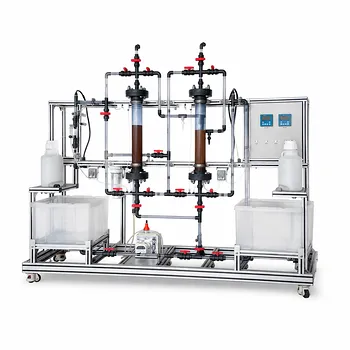
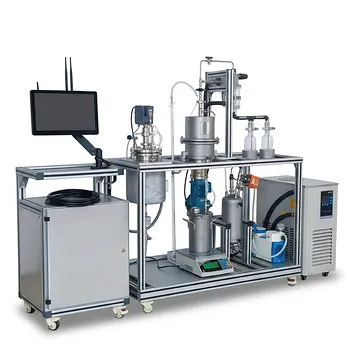
Mastering gas-liquid mass transfer in a bubble column pilot plant begins with a handful of critical parameters. The column diameter, gas throughput rate, liquid viscosity, and gas sparger design directly govern the gas holdup and the volumetric mass transfer coefficient (kLa). For bioprocess and chemical engineering training, systematically manipulating these variables lets students observe how they shape bubble size, interfacial area, and oxygen transfer – the very foundation of rational scale‑up.
Gas holdup and kLa are not isolated numbers; they are the integrated response to how column geometry, fluid properties, and operating conditions define the bubble population. In a training pilot plant, each parameter becomes a teaching tool that links hydrodynamics, dimensionless correlations, and practical reactor design.
The Controlling Levers: Key Parameters in a Bubble Column
Column Diameter: The Scale‑Dependent Variable
Column diameter determines whether hydrodynamics are dominated by wall effects or fully developed turbulence.
For columns below ~0.60 m, the diameter directly influences the Bond, Galileo, and Froude numbers, meaning gas holdup and kLa change appreciably with column size.
Once the column diameter exceeds 0.60 m, the effect saturates – correlations such as those by Akita and Yoshida show the diameter term can be fixed at 0.60 m without significant error.
In a training context, a small‑diameter pilot column (e.g., 0.15 m) makes these scaling effects tangible, while larger columns simulate industrial behavior where diameter sensitivity disappears.
Gas Throughput Rate: Driving the Flow Regime
Superficial gas velocity (gas volumetric flow rate divided by cross‑sectional area) sets the flow regime and directly raises gas holdup.
At low velocities, bubbly flow prevails with uniform small bubbles and a nearly linear increase in holdup.
Pushing the gas rate too high triggers churn‑turbulent or slug flow, where large bubbles rise rapidly, reducing gas residence time and potentially collapsing mass transfer efficiency.
Training pilots allow students to record the pressure drop along the column, identify the flow regime transition, and plot the corresponding change in kLa.
Liquid Properties: Viscosity, Surface Tension, and Density
Liquid viscosity is the dominant physical property for bioprocess training.
High viscosity, common in dense microbial cultures or non‑Newtonian fermentation broths, suppresses bubble break‑up and promotes coalescence.
The result is larger bubbles, lower gas holdup, and a reduced interfacial area – the kLa plummets.
Surface tension affects initial bubble size at the sparger, while density differences drive buoyancy and liquid circulation; both are captured in the dimensionless Sherwood (Sh), Grashof (Gr), and Schmidt (Sc) numbers that students use to calculate mass transfer dynamics.
Sparger Design: Engineering the Initial Bubble Size
The sparger (or static mixers) determines the primary bubble size entering the column.
Fine‑pore spargers produce a dense swarm of small bubbles, boosting interfacial area and early holdup, but can coalesce rapidly if the liquid promotes it.
Sintered metal, orifice plates, or porous membranes each give a distinct bubble size distribution – a valuable comparison for laboratory exercises.
When static mixers are used in‑line, they redisperse the gas phase, providing another lever to maintain high mass transfer even in coalescing systems.
Additional Operational Variables: Temperature and Liquid Height
Temperature alters liquid viscosity, the diffusion coefficient of the solute (e.g., oxygen), and gas solubility, often increasing kLa but reducing the driving force for absorption.
Liquid fill level (static liquid height) changes the hydrostatic pressure profile.
A taller column compresses bubbles at the bottom, reducing their volume and the apparent gas holdup measured by pressure drop methods; this must be accounted for in kLa calculations.
In training, students can run the column at different fill levels to see how the mean bubble residence time and holdup shift.
Understanding the Trade‑offs and Practical Pitfalls
The Coalescence Challenge in High‑Viscosity Broths
When students simulate a viscous fermentation broth (e.g., mycelial culture), they quickly notice a critical trade‑off:
Raising the gas flow rate may restore some holdup, but it also increases bubble collision frequency, exacerbating coalescence and often failing to recover kLa linearly.
The remedy is not just more gas but a sparger design that generates smaller initial bubbles or the inclusion of internal static mixers to constantly break‑up the gas phase.
This exercise teaches that biological rheology can override simple hydrodynamic expectations.
The Diameter Threshold: When Geometry Stops Mattering
The 0.60 m rule simplifies scale‑up only if applied correctly.
A student scaling data from a 0.15 m pilot column to a 2 m industrial vessel using a correlation that assumes a fixed 0.60 m diameter will underpredict kLa because the small‑column wall effects artificially enhance mixing.
The correct approach in training is to use the full diameter‑dependent correlation for small columns and then switch to the constant 0.60 m value for design.
This teaches critical thinking about when a geometric parameter truly stops influencing performance.
Flow Regime Transitions: From Bubbly to Slugging
Pushing gas velocity beyond the homogeneous bubbly regime can drive the column into slug flow, particularly in small‑diameter pilots.
Slugs – bullet‑shaped bubbles spanning the column – provide poor interfacial area and cause violent liquid oscillations, damaging shear‑sensitive cells in bioprocesses.
Training pilots equipped with differential pressure transducers let students identify the regime transition point and understand that the highest kLa is not always achieved at the maximum gas throughput – a subtle but essential insight for biological scale‑up.
Making the Right Choice for Your Training Goals
The ideal parameter set for your bubble column pilot plant depends entirely on the educational objective you want to highlight.
- If your primary focus is fundamental hydrodynamics and flow mapping: Use a small‑diameter column (below 0.15 m) where wall effects are strong, and vary gas velocity systematically across flow regimes to observe holdup vs. velocity non‑linearities and pressure drop signatures.
- If your primary focus is bioprocess scale‑up and oxygen transfer optimization: Choose a column with a diameter close to (or above) 0.60 m, or apply diameter corrections, and concentrate on liquid viscosity and sparger design to mimic real fermentation conditions, measuring kLa under realistic broth properties.
- If your primary focus is bridging theory with hands‑on reactor design: Incorporate dimensionless analysis (Sh, Gr, Sc) alongside direct measurement of bubble size distribution and gas holdup, so students can validate the Sh = 2.0 + … equation for small bubbles and see how coalescence breaks the simple models.
- If your primary focus is troubleshooting industrial bioreactors: Include a static mixer option and a non‑Newtonian simulant (e.g., carboxymethyl cellulose) to demonstrate how draft tubes and inline redispersion recover kLa in viscous, coalescing systems.
By turning each physical and operational parameter into a controlled variable, your pilot plant becomes far more than a column of bubbles – it becomes a precise, diagnostic tool for mastering gas‑liquid mass transfer in every bioprocess and chemical engineering curriculum.
Summary Table:
| Key Parameter | Impact on Gas Holdup & $k_L a$ | Educational & Training Value |
|---|---|---|
| Column Diameter | Governs scaling & wall effects; impact stabilizes above 0.60 m. | Teaches dimensional analysis and scale-up thresholds. |
| Superficial Gas Velocity | Dictates flow regimes (bubbly vs. churn-turbulent/slug flow). | Demonstrates regime transition identification via pressure drop. |
| Liquid Viscosity | High viscosity promotes bubble coalescence, lowering $k_L a$. | Simulates realistic non-Newtonian fermentation broths. |
| Sparger Design | Sets initial bubble size distribution and interfacial area. | Compares performance of sintered metals, orifices, or static mixers. |
Elevate Your Engineering Curriculum with LABPARK Pilot Plants
Looking to bridge the gap between theoretical transport phenomena and practical reactor design? LABPARK provides state-of-the-art Educational and Vocational Unit Operations Pilot Plants in chemical engineering, bioprocess & biotech, and environmental & water treatment.
Our custom-engineered bubble column pilot plants enable universities, research institutes, and enterprises to deliver hands-on training on gas-liquid mass transfer, flow regime transitions, and scale-up dynamics.
Ready to enhance your laboratory training capabilities? Contact us today to discuss your customized pilot plant solution.
Related Products
- Plate Column Hydrodynamics Tray Demonstration Educational Pilot Plant
- Comprehensive Liquid-Liquid Extraction Pilot Plant for Engineering Education
- Absorption and Desorption Educational Unit Operations Pilot Plant
- Packed Bed Absorption Educational Unit Operations Pilot Plant
- Multi-Functional Special Distillation Educational Pilot Plant
People Also Ask
- How to update chemometric calibration models in pilot plants? Best practices for process engineers.
- How can educational pilot plants be used to teach process safety and risk assessment in chemical engineering curricula?
- Why Correct Sig Figs & Rounding Matter in Educational Pilot Plants: Ensure Data Accuracy
- How does nuclear yield inefficiency translate to chemical engineering education? Optimize kinetics with pilot plants.
- Why Calculate Sieve Tray Pressure Drop? Optimize Distillation Pilot Plant Performance