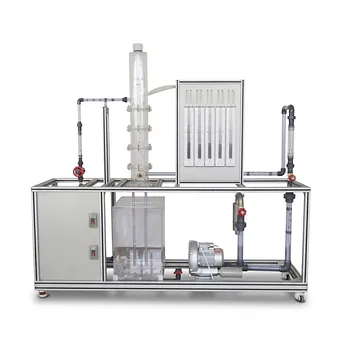
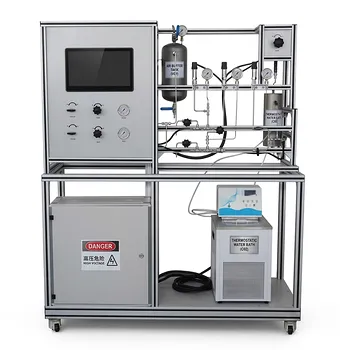
Conductivity sensors are the unsung heroes of educational pilot plants, transforming an abstract electrical measurement into a tangible window for students. By integrating industrial-grade conductivity transmitters—typically with platinum or graphite electrodes—directly into process piping, these plants allow students to perform real-time solution analysis and build automated feedback control loops. The measured conductivity becomes a live proxy for ion concentration, teaching core principles of analytical chemistry and process engineering simultaneously.
Educational pilot plants don’t just measure conductivity; they embed the sensor into control strategies, forcing students to grapple with the same process analytical technology (PAT) and continuous verification challenges found in modern industry. The result is a hands-on lesson that fuses electrolyte chemistry, loop tuning, and critical thinking about what conductivity can—and cannot—tell you.
Real-Time Monitoring: The Foundation of Solution Analysis
Before a student can control a process, they must see it. Inline conductivity meters make the invisible dance of ions visible.
Visualizing Ion Concentration Changes
As a reaction progresses, a membrane filters, or an ion exchange bed saturates, the conductivity reading shifts instantly. Students watch a digital display or trend line rise or fall, linking the abstract concept of ionic strength to a real, physical signal. This direct observation cements the relationship between dissolved species and solution behavior.
The Classic Experiment: Determining Electrolyte Type
Analytical chemistry comes alive when a pilot plant is used for more than just production. Students can inject a coordination compound like ( [\text{Co}(\text{NH}_3)_6]\text{Cl}_3 ) at a known concentration, then measure its molar conductivity (( \Lambda_m )). At ( 1.0 \times 10^{-3} \text{ mol}\cdot\text{L}^{-1} ) and 298 K, a reading in the range of ( 0.0408 \text{–} 0.0435 \text{ S}\cdot\text{m}^2\cdot\text{mol}^{-1} ) identifies it as a 4‑ion electrolyte. This single data point confirms the number of dissociating ions, teaching students how conductivity probes function as a speciation tool, not just a process meter.
From Lab Curiosity to Process Variable
In an educational setting, the teaching moment shifts when the conductivity signal is integrated into a data historian. Students log the trend, export it, and perform calculations. They see how a simple electrical measurement becomes a critical quality attribute for product consistency, exactly as it does in water treatment, chemical synthesis, and pharmaceutical manufacturing.
Closing the Loop: Teaching Process Control with Conductivity
The real pedagogical leap happens when the conductivity signal is not just watched, but used to command the plant.
Setting Thresholds and Triggering Actions
Students configure the conductivity transmitter’s relay outputs or feed its 4‑20 mA signal into a programmable logic controller (PLC). They then write logic: “If conductivity drops below 50 µS/cm, open the product valve.” This teaches discrete control and the immediate consequences of sensor placement and setpoint selection.
Tuning a PID Controller with Conductivity Feedback
More advanced exercises replace simple on/off rules with a proportional-integral-derivative (PID) controller. A target conductivity setpoint is given, and students must tune the gains to have an automated valve adjust a reagent feed or a diluent flow. They learn about lag times, dead bands, and oscillation—all while watching a real liquid process respond.
Mimicking PAT and Continuous Verification
This integration directly mirrors the Process Analytical Technology (PAT) framework promoted by regulatory bodies for continuous manufacturing. Instead of testing a final sample, the pilot plant is configured for continuous process verification where the conductivity trend itself acts as proof of control. Students leave knowing that reducing end‑product testing is not an abstract goal, but a reality built on reliable inline sensors and thoughtful loop design.
The Temperature Compensation Lesson
No conductivity lesson is complete without addressing the variable that confounds every beginner: temperature.
Why a Cold Solution Reads Differently
Ionic mobility increases with temperature. A solution that reads 15 µS/cm at 15°C might read 25 µS/cm at 25°C, even with identical ion concentrations. Educational pilot plants often include a jacketed vessel or a temperature probe next to the conductivity cell to make this error visible. Students measure the difference before and after compensation, internalizing why industrial instruments always reference values to a standard temperature like 25°C.
Configuring Automatic vs. Manual Compensation
Students then dive into the instrument menu to configure the temperature coefficient (typically 2% per °C for many aqueous salt solutions). They learn when automatic compensation is valid and when, for complex solutions with non‑linear temperature responses, manual correction is necessary. This builds the critical habit of questioning default instrument settings.
Understanding the Trade-offs and Pitfalls
A trustworthy technical advisor must also make the limitations clear. Conductivity is powerful, but it can mislead.
When Conductivity Misleads You
Conductivity is a bulk, non‑specific measurement. It cannot distinguish between a benign salt spike and a contaminant ingress if both produce similar ionic strength. In mixtures, non‑linear relationships at high concentrations mean a small ion change can cause a disproportionately large signal swing, or vice versa. Students must pair conductivity with pH, spectroscopy, or periodic lab samples to interpret data correctly.
Sensor Maintenance and Fouling
The sensor itself is a weak point. Electrode surfaces can become coated with organic films or scale, drifting the cell constant and delivering erroneous readings. Educational pilot plants that run for days without cleaning teach students that sensor health is a process parameter—if the transmitter diagnostics flag a fault, the control loop must respond or risk making bad decisions.
Over-reliance on a Single Parameter
The most important lesson is that a well‑designed control strategy never bets the entire process on one sensor. Conductivity is a fast, robust indicator, but it must be part of a multi‑attribute strategy. This teaches the backbone of risk‑based thinking in process engineering.
Making the Right Choice for Your Educational Goals
To apply these insights, align the pilot plant exercise with what you truly need to learn.
- If your primary focus is teaching chemical analysis: Use well‑defined experiments like molar conductivity determination of coordination compounds. Let students calculate ion counts and compare with theory to understand electrolyte behavior.
- If your primary focus is industrial process control: Build closed‑loop systems where conductivity triggers a valve or modulates a pump. Spend time on PID tuning and documentation, mirroring PAT‑enabled continuous verification.
- If your primary focus is instrumentation and sensor skills: Dedicate sessions to calibration, cell‑constant verification, and troubleshooting temperature compensation. Make sensor fouling a planned event to teach diagnostics and maintenance protocols.
An educational pilot plant is a safe sandbox, but its true value lies in how it teaches you to trust—and wisely question—the signals that keep a process alive.
Summary Table:
| Teaching Focus | Key Concept | Practical Application |
|---|---|---|
| Solution Analysis | Ion concentration & electrolyte types | Molar conductivity calculation |
| Process Control | PID loop tuning & threshold relays | Continuous verification (PAT) |
| Instrumentation | Temp compensation & sensor fouling | Calibration & diagnostics |
Bring Industrial-Grade Process Control to Your Lab
LABPARK provides state-of-the-art Educational and Vocational Unit Operations Pilot Plants in chemical engineering, bioprocess & biotech, and environmental & water treatment. We help universities, research institutes, and enterprises bridge the gap between academic theory and real-world industrial practice.
Ready to elevate your engineering curriculum or training facility? Contact LABPARK today to customize a pilot plant tailored to your educational goals!
Related Products
- Multi-Reactor Educational Pilot Plant for Reaction Engineering Unit Operations
- Multi-Functional Special Distillation Educational Pilot Plant
- Multi-Functional Membrane Separation Educational Pilot Plant for Unit Operations Lab
- Micro-Scale Gas-Solid Catalytic Reaction Educational Pilot Plant
- High-Gravity Emulsification and Mass Transfer Educational Pilot Plant
People Also Ask
- How do reactor pilot plants define QbD design space? Master chemical process scale-up.
- When configuring a reactor unit operations pilot plant for highly exothermic reactions, how to prevent thermal runaway?
- How do metal ion-catalyzed reaction mechanisms inform chemical engineering pilot plant design? From kinetics to scale-up
- What role do educational pilot plants play in scaling green chemistry? Bridging the Lab-to-Industry Gap
- What are the barriers to process intensification & how do pilot plants help?