Mixing is the silent variable that can sabotage a successful scale-up. When you move a reaction from a beaker to a pilot plant reactor, the most immediate and impactful change is a dramatic increase in blend time—from about 1–2 seconds in a well-stirred lab flask to 30 seconds or more in a larger vessel. This slower mixing creates localized zones of high reagent concentration, which trigger unwanted side reactions, reduce selectivity, and compromise product purity. The good news is that you can pre-evaluate this risk directly in your existing laboratory using simple comparative experiments and a key dimensionless number.
The core challenge of scale-up is that excellent mixing in the lab can mask a reaction’s true sensitivity to concentration gradients. By intentionally running “bad” mixing experiments and calculating the Damköhler number, you can expose these hidden vulnerabilities before they become costly problems in your pilot plant.
The Hidden Assumption of Instant Mixing
In a small round-bottom flask, magnetic stirring or an overhead impeller can homogenize the contents almost instantly. This nearly perfect mixing is an assumption that many bench chemists don’t even realize they are making.
At pilot scale, that assumption breaks down completely.
How Blend Time Increases with Vessel Size
The characteristic blend time (the time required to achieve uniform composition) scales with vessel volume and impeller design. In the lab you might see blend times of 1–2 seconds, while a 100-liter pilot reactor can easily have blend times of 30 seconds or longer.
These extra seconds aren’t just a waiting game—they are a chemical window during which a freshly added reagent remains highly concentrated in one spot.
The Real Culprit: Localized Concentration Gradients
When a reactive species is added slowly to a well-mixed system, it is diluted before it can accumulate. But with slow mixing, that reagent forms a high-concentration plume near the addition point.
If your reaction has rapid, competitive pathways, this plume promotes the fastest (often undesired) side reaction. The result is lower selectivity, more impurities, and a product quality that doesn’t match the lab benchmark.
Pre-Evaluating Mixing Sensitivity in the Lab
You don’t need a pilot plant to discover that your chemistry is mixing-sensitive. The primary reference outlines two powerful, low-cost approaches that can be performed with standard laboratory glassware.
The Side-by-Side Comparative Experiment
Set up two identical reaction runs, changing only the mixing and addition conditions:
- Well-mixed, slow addition: Add the reagent dropwise into a vigorously stirred solution, ensuring immediate dilution.
- Poorly mixed, fast addition: Dump the same quantity of reagent quickly into a flask with minimal agitation (e.g., a barely moving stir bar).
A significant difference in product selectivity, impurity profile, or yield between the two runs is a red flag. It directly demonstrates that your reaction outcome depends on mixing quality—a dependency that will be amplified at scale.
The Damköhler Number: A Theoretical Litmus Test
For a more predictive approach, calculate the dimensionless Damköhler number (Da):
[ Da = \frac{\text{Characteristic mixing timescale}}{\text{Characteristic reaction timescale}} ]
In practice, you can use the blend time as the mixing timescale and the half-life or reaction time of the fastest relevant step as the reaction timescale.
- Da >> 1: Mixing is much slower than reaction. The chemistry is extremely mixing-sensitive (e.g., acid-base neutralizations, rapid precipitations). You will likely face selectivity issues at scale unless mixing is dramatically improved.
- Da << 1: Mixing is faster than the reaction. The system is forgiving; scale-up can proceed with less worry about concentration gradients.
Beyond Blend Time: Additional Challenges at Pilot Scale
The primary reference correctly identifies blend time as the central issue, but the supplementary references reveal a wider landscape of mixing-related pitfalls that intensify when moving to a pilot plant.
The Trade-Off You Can’t Avoid: Which Parameter Do You Scale?
When scaling up, you cannot simultaneously keep tip speed, rotational speed, power per volume, and Reynolds number all constant. This physical reality means some aspect of mixing will inevitably change.
For example, keeping power per volume constant might require a lower impeller speed, which can reduce turbulence and compromise solids suspension or gas dispersion. This leads to poor mass transfer (lower kLa) and insufficient contact between phases.
Heterogeneous Reactions: When One Phase Isn’t Enough
If your lab development used a homogeneous solution, scaling to a heterogeneous system (gas-liquid, liquid-liquid, solid-liquid) introduces an entirely new set of demands.
A reactor designed for simple blending may fail to adequately suspend solids, disperse a gas, or create the fine droplets needed for fast liquid-liquid mass transfer. Pilot plant studies with adjustable impeller designs, baffles, and feed ports are essential to evaluate how phase contact and reaction kinetics depend on agitation.
Polymerization: When Heat and Mixing Conspire Against You
The supplementary references highlight that in stirred-tank polymerization reactors, the impeller governs everything. Poor mixing at scale leads to hot spots, runaway reactions, or uneven molecular weight distribution.
Heat removal becomes a co-challenge: if mixing cannot distribute the temperature evenly, local overheating can alter the reaction rate and product quality in ways that bench-scale water baths never reveal.
Understanding the Trade-offs
Being an objective advisor means acknowledging that pre-evaluation methods have their own limitations and that no single test will fully predict pilot plant behavior.
Lab “Poor Mixing” Isn’t the Same as Real-World Poor Mixing
The side-by-side lab test is a qualitative indicator, not a perfect scale-down model. In a real pilot vessel, turbulent eddies, feed pipe positioning, and impeller-vortex interactions create concentration patterns that a sluggish stir bar cannot replicate. Use the test to flag risks, not to quantify exact impurity levels.
The Da Number Assumes Timescales You Might Not Know
Calculating Da requires an estimate of the reaction timescale. For complex, multi-step pathways, the effective reaction time may be unclear. Rapid quenching or in-situ analytics (as noted in the supplementary references) become critical to capturing true kinetic data under reaction conditions.
Steady-State Assumptions Can Fail at Industrial Scale
At larger scales, with fast reactive mixing and complex nozzle-impeller interactions, the system may require unsteady-state simulations and specialized drag models. Pilot plant data thus becomes irreplaceable for calibrating predictive models.
Making the Right Choice for Your Scale-Up Strategy
Your laboratory pre-evaluation should steer the entire scale-up decision, not just warn you of problems. Tailor your approach to your primary concern.
- If your primary focus is product purity and selectivity: Run the comparative mixing tests early, and calculate Da for the fastest possible side reaction. If Da > 1, invest heavily in pilot-scale agitation design or consider alternative reactor configurations (e.g., continuous flow) that reduce blend times.
- If your primary focus is a heterogeneous reaction (gas-liquid or solid-liquid): Do not rely on bond times alone. Use a modular pilot reactor to directly measure solids suspension (Njs), gas hold-up, and kLa under scalable conditions. Adjust impeller type and baffle geometry based on that data.
- If your primary focus is heat-sensitive or polymerization chemistry: Double-check that your pilot plant can provide adequate heat transfer surface and uniform temperature distribution. Poor mixing here is a safety as well as a quality issue—run thermal mapping experiments as part of your scale-up evaluation.
- If your primary focus is modeling and simulation: Use laboratory kinetic data only after confirming that the reaction is not mixing-limited (Da < 1). If it is, incorporate mass transfer terms and validate them against pilot-scale experimental results before trusting a full-scale design.
Proactive, informed evaluation of mixing challenges transforms scale-up from a risky gamble into a controlled, scientific progression.
Summary Table:
| Scale-Up Challenge | Impact on Reaction | Lab Evaluation Method |
|---|---|---|
| Increased Blend Time | Localized concentration gradients & impurities | Side-by-side comparative experiment |
| Mixing Sensitivity | Selectivity loss | Damköhler number (Da) calculation |
| Phase Contact Issues | Poor mass transfer in heterogeneous systems | Modular pilot trials (solids, gas, liquid) |
| Heat Distribution | Hot spots and thermal runaways | Thermal mapping & agitation adjustment |
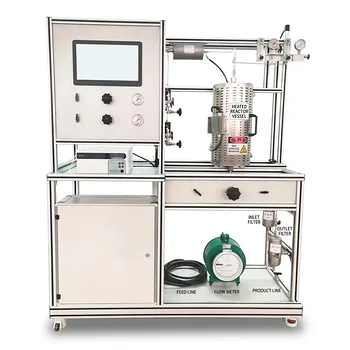
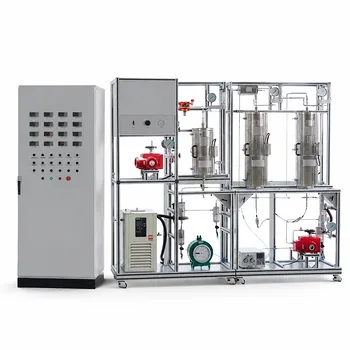
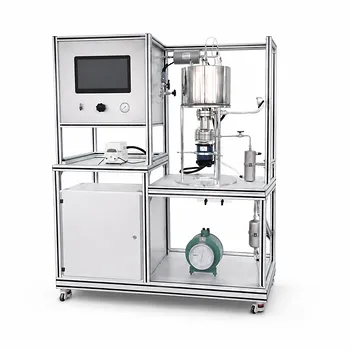
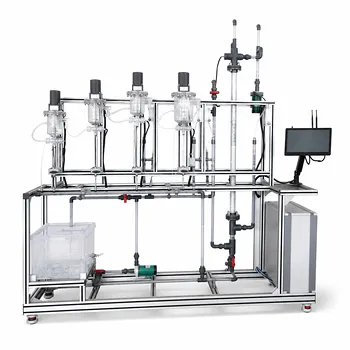
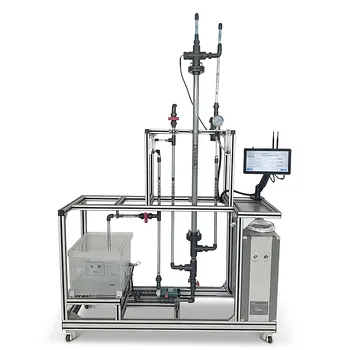
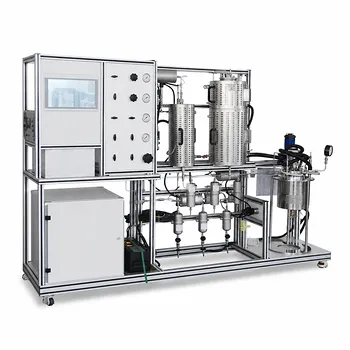
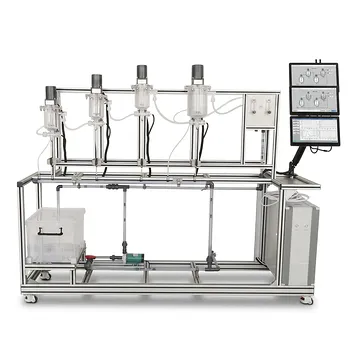
Transitioning reactions from the lab to a pilot scale requires robust equipment designed to handle complex mixing and mass transfer challenges. LABPARK provides premium Educational and Vocational Unit Operations Pilot Plants in chemical engineering, bioprocess & biotech, and environmental & water treatment. Designed specifically for universities, research institutes, and enterprises, our pilot plants enable accurate scale-up modeling and process optimization.
Ready to eliminate mixing bottlenecks and scale up with confidence? Contact our engineering experts today to find the perfect pilot plant solution for your facility!
Related Products
- Fixed-Bed Chemical Reaction and Gas Dust Tar Removal Unit Operations Pilot Plant
- Fluidized Bed Gas Solid Catalytic Reaction Educational Pilot Plant
- Fixed Bed Gas Solid Catalytic Reaction Educational Pilot Plant
- 100L Continuous Loop Hydrogenation Educational Unit Operations Pilot Plant
- Multi-Reactor Educational Pilot Plant for Reaction Engineering Unit Operations
People Also Ask
- When to transition from PID to adaptive control in pilot plants? Key process indicators.
- How do deviations in estimating latent heat impact pilot plant thermal systems? Avoid hardware mis-sizing.
- Why Compare Predicted and Experimental Excess Enthalpy? Key to Accurate Pilot Plant Scale-up
- How to study gasification in pilot plants? Compare exit gas composition & efficiency
- Why Use PTFE & Hastelloy in Chemical Pilot Plants? Prevent Corrosion & Ensure Safety