For high-viscosity drops, breakage isn’t just about overcoming surface tension—it’s about overpowering the drop’s own stubborn internal resistance. In a stirred tank reactor, turbulent eddies from the impeller must deliver enough stress to simultaneously defeat interfacial tension and the viscous stresses that build up inside the droplet as it deforms. This dual stabilization mechanism means that in pilot plants, controlling drop size directly hinges on understanding how viscosity, agitation speed, and shear forces interact—not just during steady-state operation, but as material properties evolve.
The defining shift with viscous dispersed phases is that the droplet itself becomes a structural barrier to breakage. Pilot plant control must therefore treat agitation as a force that must exceed a moving target—one shaped by both formulation chemistry and the dynamic viscosity profile of the process.
The Physics of Drop Breakage in Viscous Dispersions
Turbulent Stresses as the Breaking Force
In stirred tanks, the continuous phase’s turbulent motion creates local pressure and shear fluctuations. These turbulent stresses act on droplets, attempting to stretch and rupture them. The stronger the turbulence, the smaller the eddies that can effectively attack the drop.
For low-viscosity systems, this is a straightforward fight against interfacial tension. But when the dispersed phase is viscous, the drop responds very differently.
The Dual Stabilizing Forces: Interfacial Tension and Internal Viscosity
Interfacial tension still works to minimize surface area and restore spherical shape. However, a viscous drop also develops internal viscous stresses as it deforms.
These stresses arise because the fluid inside the drop resists the rapid shape changes forced by turbulent eddies. The higher the dispersed-phase viscosity, the more “structural” the drop becomes—acting almost like a soft solid that must be mechanically yielded.
The Breakage Criterion: A Balancing Act
Breakage occurs only when the turbulent stress exceeds the sum of both stabilizing forces: interfacial stress + internal viscous stress. This isn’t an additive luxury; it’s a physical requirement.
If the turbulent stress only beats interfacial tension but not the viscous resistance, the drop will oscillate and stretch but won’t fragment. This threshold shift is the central mechanism governing droplet size in high-viscosity dispersions.
Implications for Process Control in Pilot Plants
Agitation Speed and Impeller Selection
Pilot plant runs are the proving ground where this physics meets reality. Agitation speed is the primary lever for generating turbulent stress. Because viscous drops demand higher stress to break, you’ll often need higher impeller speeds or more aggressive high-shear impellers (like sawtooth or rotor‑stator designs) compared to a low-viscosity recipe.
But the solution isn’t simply “more speed.” The impeller’s power dissipation profile determines the distribution of eddy sizes. You need eddies small enough—and energetic enough—to act on the viscous droplets effectively.
Viscosity Changes During Operation
This is where pilot plant control gets challenged. Many processes, such as suspension polymerization, see the dispersed-phase viscosity climb dramatically as conversion proceeds. The breakage threshold therefore rises continuously.
An agitation speed that initially produces the right drop size may become utterly incapable of breaking droplets later, leading to runaway coalescence and an off-spec size distribution. Conversely, early-stage over-shearing can create fines that persist for the entire batch. Process control must either ramp agitation speed over time or be designed around the most demanding (highest viscosity) stage.
Predicting Drop Size Distributions
Pilot plant studies use these mechanisms to build predictive models. By measuring turbulence intensity (through power numbers and tip speeds) and characterizing the viscous resistance (via rheology of the dispersed phase), engineers can forecast the equilibrium drop size.
This turns agitation from a guesswork variable into a calculated parameter. For pilot plants, that directly shortens development cycles and enables a more rational scale-up path.
Understanding the Trade-offs
Over-shearing and Energy Costs
The need to shatter viscous drops invites a classic trade-off: higher shear versus product quality. Excessive agitation can generate extremely fine droplets or even damage shear-sensitive ingredients. In a pilot plant, finding that sweet spot—enough stress to break but not so much that you create off-target particle sizes or waste energy—is essential.
Energy consumption also scales with impeller speed cubed. Pouring in extra power just to guarantee breakage is economically and thermally expensive, especially when moving to production scale.
Stability versus Breakage Sensitivity
A high internal viscosity doesn’t just resist breakage; it also retards coalescence. So while you may need more energy to create the dispersion, the resulting drops can be remarkably stable once formed. This can reduce the need for surfactants, but the control strategy must still account for the delicate balance between breakage and coalescence across the vessel’s different zones.
Making the Right Choice for Your Pilot Plant Goal
Your control philosophy must align with the specific process objectives. Use these priorities to guide decision-making:
- If your primary focus is a precise, narrow drop size distribution: Characterize the dispersed-phase viscosity across the entire process window and map it against your impeller’s turbulent energy spectrum. Match the maximum viscosity with the smallest competent eddy size needed.
- If your primary focus is minimizing energy consumption: Opt for a high-shear impeller in a high-circulation geometry. This concentrates power where it’s most effective—right at the droplet—rather than dissipating it through bulk turbulence alone.
- If your primary focus is reliable scale-up: Anchor your pilot study in constant power per mass (P/V) or tip speed criteria, but validate against the changing viscous breakage threshold. A scale-up that ignores increasing viscosity effects will almost certainly under-deliver at production scale.
Deep control over viscous drop breakage transforms your pilot plant from a trial-and-error test bed into a rational design tool—one where the final dispersion is engineered, not just discovered.
Summary Table:
| Parameter | Low-Viscosity Dispersions | High-Viscosity Dispersions |
|---|---|---|
| Stabilizing Force | Interfacial tension | Interfacial tension + Internal viscous stress |
| Breakage Criterion | Turbulent stress > Interfacial tension | Turbulent stress > Sum of both stabilizing forces |
| Agitation Needed | Standard speeds & impellers | High-shear impellers & higher speeds |
| Process Control | Steady-state agitation | Dynamic agitation ramping / High-shear design |
Optimize Your Process Control and Scale-Up with LABPARK
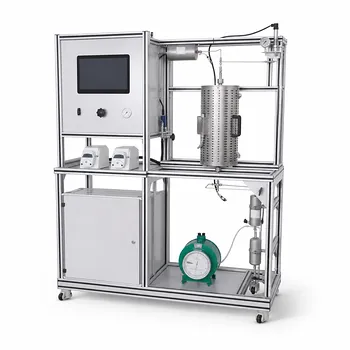
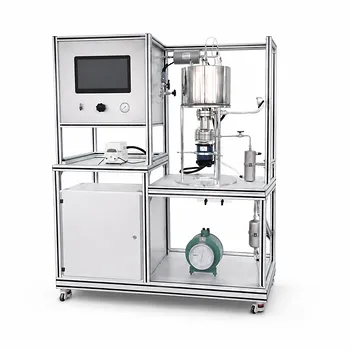
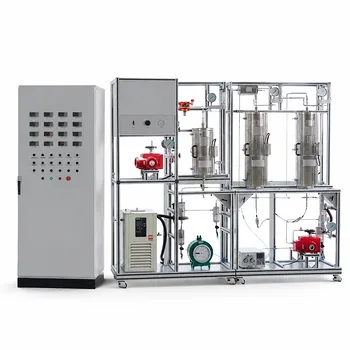
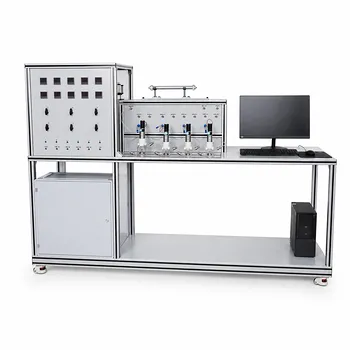
Transitioning complex fluid dynamics from lab research to pilot-scale production requires precise control. LABPARK provides advanced Educational and Vocational Unit Operations Pilot Plants in chemical engineering, bioprocess & biotech, and environmental & water treatment.
Designed specifically for universities, research institutes, and enterprises, our systems empower you to accurately model dynamic viscosity changes, optimize agitation profiles, and ensure reliable scale-up.
Ready to elevate your research and process development? Contact our engineering experts today to find the perfect pilot plant solution for your facility.
Related Products
- Multi-Reactor Educational Pilot Plant for Reaction Engineering Unit Operations
- Multi-Stage Stirred Tanks in Series Residence Time Distribution and Mixing Performance Determination Educational Pilot Plant
- Multi Functional Catalytic Reaction and Reactor Evaluation Educational Unit Operations Pilot Plant
- Ethylbenzene Dehydrogenation Educational Unit Operations Pilot Plant
- 100L Continuous Loop Hydrogenation Educational Unit Operations Pilot Plant
People Also Ask
- What role do educational pilot plants play in scaling green chemistry? Bridging the Lab-to-Industry Gap
- How do educational pilot plants teach scale-up? Bridge the gap to commercial manufacturing.
- How do educational unit operations pilot plants address safety and waste management when scaling up?
- How do educational unit operations pilot plants bridge theory and design? Bridge the Engineering Gap
- Why Compare Predicted and Experimental Excess Enthalpy? Key to Accurate Pilot Plant Scale-up