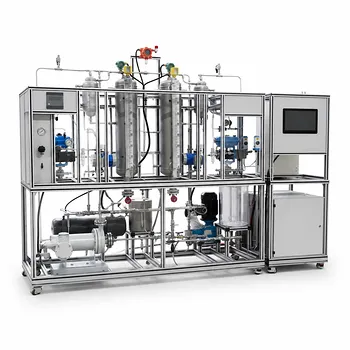
For acidic carbonylation pilot plants, the non-negotiable material choices are titanium and Hastelloy C.
These two alloys are the industry standards for any wetted surface—reactors, piping, flash vessels, and distillation components—that contacts the highly corrosive, halide-promoted reaction medium. Titanium is the most commonly employed metal at pilot scale, offering an unrivaled balance of absolute corrosion resistance and fabricability for hydrogen iodide environments.
Carbonylation processes use aggressive halide promoters like hydrogen iodide, which creates a corrosive liquid phase that rapidly destroys conventional stainless steels. Only two proven families of metallic materials can reliably prevent equipment failure and safety incidents in this service: unalloyed titanium and the nickel-chromium-molybdenum alloy Hastelloy C. Choosing anything else guarantees perforation, product contamination, or catastrophic loss of containment.
Why Carbonylation Chemistries Demand Specialized Alloys
Acid-catalyzed carbonylation—such as the synthesis of acetic acid or propionic acid—presents a corrosion challenge that standard materials of construction simply cannot survive. Understanding the root cause is the key to preventing pilot plant disasters.
The Hidden Aggressor: Hydrogen Iodide Promoter
The reaction itself might seem mild. Carbon monoxide insertion into an alcohol is catalyzed by a precious metal complex and an iodide promoter.
That promoter is the source of the threat. Hydrogen iodide (HI) dissociates in the solution, creating a highly acidic, halide-rich environment that initiates localized attack on metal surfaces. Even when the bulk process temperature is moderate, the combination of low pH and aggressive halide ions drives rapid pitting and crevice corrosion in ordinary stainless steels.
The Failure Mode: Halide-Induced Pitting and Stress Cracking
In this service, corrosion does not manifest as uniform wall thinning. Instead, hydrogen iodide triggers a dangerous, localized attack. The halide ions penetrate the passive oxide layer of stainless steels, creating deep pits that quickly breach vessel walls.
Moreover, the presence of tensile stress from pressure or thermal cycling can lead to chloride-equivalent stress corrosion cracking initiated by the iodide ions. This failure mode is swift and unpredictable in alloys like 304 or 316 stainless steel, making them entirely unsuitable for any wetted component in the pilot plant.
The Two Proven Industry-Standard Materials
To contain carbonylation chemistries safely, pilot plant equipment must be fabricated from one of two metallic families that can truly resist halide attack. All other options—including glass-lined steel and high-molybdenum stainless steels—are either chemically incompatible or economically impractical for these specific conditions.
Titanium: The Pilot Plant Workhorse
Unalloyed titanium is the most commonly utilized material in pilot-scale carbonylation systems. Its dominance stems from a single, powerful property: it forms an incredibly tenacious, self-healing passive oxide film (TiO₂) that resists attack by acidic halide solutions.
This oxide layer remains stable across the entire operating window of a typical carbonylation pilot plant. Even if mechanical scratching occurs, the film instantly reforms in the presence of even trace amounts of oxygen or water. For researchers and operators, this means titanium equipment provides reliable, long-term protection without the need for complex passivation procedures during normal runs.
Hastelloy C: The Robust Nickel Alloy
Hastelloy C (UNS N10276 or similar) is the essential backup material where titanium may face fabrication or economic constraints. It is a nickel-chromium-molybdenum alloy engineered specifically for wet, oxidizing, and halide-containing environments.
The high molybdenum content (15-17%) imparts exceptional resistance to pitting corrosion, while the chromium provides a broad passive range in acidic solutions. In a carbonylation pilot plant, Hastelloy C components are frequently specified for higher-pressure reactor bodies or complex heat exchanger surfaces where titanium’s lower modulus of elasticity might complicate engineering design.
Understanding the Trade-offs
An honest technical assessment demands that we acknowledge the limitations and practical considerations of these materials. No solution is perfect; the choice between them always involves a compromise between corrosion resistance, cost, and mechanical suitability.
The Cost and Lead-Time Cascade
Titanium, while not as exotic as some other refractory metals, is still significantly more expensive than stainless steel. Fabrication requires specialized welding techniques with an inert gas back-purge to prevent embrittlement.
Hastelloy C is even more expensive on a per-kilogram basis and often has longer mill lead times. For a pilot plant manager on a tight budget, this can drive decisions toward maximizing the titanium content for large vessels and reserving Hastelloy C for only the most critical, highly-stressed components.
Where Even Titanium Might Not Be Enough
While titanium and Hastelloy C cover 99% of carbonylation pilot plant scenarios, extremely aggressive conditions can push operational limits. If a process operates with completely anhydrous, boiling HI solutions at temperatures exceeding 200°C, the protective oxide film on titanium can destabilize.
In these rare edge cases—and only after rigorous materials testing—tantalum might be considered for internal linings or repair sleeves. Tantalum exhibits a glass-like inertness to almost all acids except hydrofluoric acid, but its extreme cost and density mean it is never a first-line choice for pilot plant construction.
The Inherent Danger of the “Small Stainless Steel Test Part”
A catastrophic error in pilot plant operations arises from inserting standard stainless steel thermowells, sampling bombs, or gaskets into an otherwise corrosion-resistant system. Even a single 316L fitting exposed to the carbonylation liquid will pit within hours. The corrosion products then poison the catalyst and contaminate the entire product stream. Therefore, all wetted auxiliary components must adhere to the same titanium or Hastelloy C specification, no exceptions.
Making the Right Choice for Your Goal
Selecting the metallurgy for a new or retrofitted carbonylation pilot plant should be driven by your primary operational priority. Use these guidelines to translate the materials knowledge into a concrete specification.
- If your primary focus is maximizing uptime and safety with a proven solution: Design every wetted component—reactor, flash drum, condenser, and all transfer lines—from commercially pure titanium. It is the lowest-risk path for most academic and industrial pilot units.
- If your primary focus is structural integrity under high mechanical loads or pressures: Specify Hastelloy C for the pressure boundary components, such as the high-pressure reactor body and agitated shaft, while using titanium for less-stressed internals and piping.
- If your primary focus is demonstrating an “extreme process condition” for scale-up research: Conduct a coupon exposure test for both titanium and Hastelloy C in your exact reaction mixture before constructing the plant. Only then evaluate if a tantalum-lined section is warranted for the hottest, most concentrated zone.
Choosing the correct alloy is not about cost optimization—it is about ensuring that the entire pilot plant remains a safe, leak-free, and data-rich research tool for the life of the carbonylation project.
Summary Table:
| Material | Key Advantages | Best Use Case | Limitations |
|---|---|---|---|
| Titanium | Self-healing oxide film (TiO₂), excellent HI resistance | General wetted parts, piping, reactors | Destabilizes in anhydrous HI >200°C |
| Hastelloy C | High strength, pitting/crevice corrosion resistance | High-pressure vessels, agitated shafts | High cost, longer fabrication lead times |
| Tantalum | Near-complete chemical inertness (glass-like) | Extreme temperature/anhydrous HI zones | Very high cost, difficult to fabricate |
Build Safe, Corrosion-Resistant Pilot Plants with LABPARK
Are you planning a new chemical engineering project? LABPARK provides premium Educational and Vocational Unit Operations Pilot Plants in chemical engineering, bioprocess & biotech, and environmental & water treatment for universities, research institutes, and enterprises. Designed to meet the most stringent safety and material standards, our systems ensure long-term reliability and zero contamination.
Don't risk catastrophic failures with substandard materials. Contact our pilot plant experts today to discuss your custom alloy requirements and scale up your research safely!
Related Products
- Carbon Material Thermal Pretreatment Multiphase Separation Educational Pilot Plant
- Carbon Dioxide Hydrogenation Methanol Synthesis Educational Unit Operations Pilot Plant
- Multi-Functional Special Distillation Educational Pilot Plant
- Methane Cracking Educational Unit Operations Pilot Plant
- Carbon Dioxide Hydrogen Methanol Synthesis Educational Unit Operations Pilot Plant
People Also Ask
- What challenges do gravity transitions present for pressure control in multiphase separation pilot plants?
- How does steady-state multiplicity affect the operation and safety of exothermic reactions within a CSTR pilot plant? - Guide
- Why is temperature regulation via a cooling jacket a critical feature in CSTR pilot plants used for laboratory training?
- What parameters to monitor transitioning from Batch to CSTR? Master Pilot Plant Setup
- How to select the right unit operations pilot plant for liquid separation? A complete guide.