The Thiele modulus and the Biot numbers for mass and heat act as diagnostic fingerprints for a catalytic fixed-bed reactor. They reveal whether the reaction rate is dictated by intrinsic kinetics, stifled by internal pore diffusion, or throttled by external film resistances. In a pilot plant, measuring and interpreting these numbers allows operators and researchers to predict conversion efficiency, map thermal stability boundaries, and de-risk the scale-up to industrial dimensions.
The Thiele modulus (ϕ) compares the speed of reaction to the speed of diffusion inside the catalyst pellet, while the mass and heat Biot numbers (Bi_m, Bi_h) compare external boundary‑layer transport rates to those inside the pellet. Together they define the reactor’s limiting regime, guiding decisions on catalyst size, shape, and operating conditions – and crucially, warning of thermal runaway and multiple steady states.
The Diagnostic Power of Dimensionless Numbers
From Pilot‑Plant Observation to Physical Insight
A fixed‑bed pilot reactor often shows puzzling behavior: a slight change in flow rate can send conversion plummeting, or a modest temperature increase triggers a dangerous hot spot.
The Thiele modulus and Biot numbers translate raw bed‑scale data (concentration, temperature) into a story about whether the reaction is struggling to get reactants into the pellet, struggling to remove heat, or running at its true kinetic potential. They bridge the gap between what you measure and why the reactor behaves that way.
The Thiele Modulus: Gauging Internal Diffusion
What the Number Really Means
The Thiele modulus is defined as ϕ = L√(k_v / D_eff), where L is the characteristic diffusion length (often pellet volume/external surface area), k_v is the intrinsic reaction rate constant, and D_eff is the effective diffusion coefficient.
A low Thiele modulus (ϕ < 1) means diffusion is much faster than reaction. The reactant concentration is nearly uniform throughout the pellet, and the catalyst interior works just as hard as the surface – you are in the kinetic‑control regime.
A high Thiele modulus (ϕ > 1) signals that reaction outpaces diffusion. Reactants are consumed in a narrow shell near the pellet surface, leaving the core starved. Internal transport becomes the bottleneck, and the effective reaction rate falls far below what the intrinsic kinetics could deliver.
The Effectiveness Factor Connection
The effectiveness factor (η) is the ratio of the actual rate observed to the rate that would occur if the entire pellet were bathed in surface conditions.
For isothermal pellets, η depends almost exclusively on ϕ and the pellet geometry. In a pilot plant, you can calculate η from measured conversion and known kinetics, then back‑out the operating Thiele modulus – giving you an immediate read on how much internal diffusion is crippling performance.
Even for non‑spherical extrudates, the generalized Thiele modulus (Λ) uses V_p/S_x as the characteristic length, collapsing all shapes onto a single η‑vs‑Λ curve. This means you don’t need a new model for every catalyst form – a single pilot‑derived curve often suffices.
Visualizing Reaction Zones Inside the Pellet
At very high ϕ, the pellet develops distinct reaction zones: a completely reacted outer ash layer, a thin active reaction zone, and an unreacted core. This “shrinking core” behavior is especially common in gas‑solid systems.
Seeing this in a pilot reactor explains why grinding a catalyst smaller suddenly boosts conversion – you reduce L, lower ϕ, and push the reaction back toward kinetic control, while also avoiding the sharp concentration drop that creates dead catalyst volume.
The Biot Numbers: External Transport’s Hidden Hand
Film Resistance as a Bottleneck
Even before reactants enter the pellet, they must cross a stagnant boundary layer. The mass Biot number compares the rate of external mass transfer to the rate of internal diffusion: Bi_m = k_c · L / D_eff, where k_c is the external mass‑transfer coefficient.
When Bi_m is low, the external film resistance is large relative to internal diffusion. Reactants can’t reach the pellet surface fast enough, and the overall rate becomes externally limited – even if internal pores are perfectly accessible. High Bi_m pushes the bottleneck inside the pellet, where the Thiele modulus takes over.
The heat Biot number (Bi_h) works identically, comparing convective heat transfer at the pellet surface to conductive heat transport within the solid. This becomes critical for exothermic reactions, where poor external heat removal can raise surface temperatures and trigger runaway.
Interplay with the Thiele Modulus: The Operating Regime Map
In a fixed‑bed pilot reactor, you control external transport through superficial velocity. Low flow rates reduce k_c and h, pulling Bi_m and Bi_h down and potentially making external resistance dominant, even if pellet‑scale diffusion is fast.
By systematically varying flow rate and pellet size, you map the reactor’s position on a regime diagram defined by the Thiele modulus and the Biot numbers. This map reveals whether you should invest in better flow distribution, smaller pellets, or higher intrinsic activity – knowledge that pays off handsomely during scale‑up.
How These Numbers Illuminate Fixed‑Bed Reactor Behavior
Temperature Escalation and Multiple Steady States
For exothermic reactions, a large ϕ inside the pellet can create an internal temperature far higher than the surface. This can push the effectiveness factor above 1, because the interior runs hotter and faster than the surroundings.
When heat Biot numbers are low – meaning the pellet surface itself cannot shed heat quickly – the entire bed may see multiple steady states. Small adjustments in feed temperature or flow rate can cause the reactor to “ignite” or “extinguish,” jumping unpredictably between a low‑conversion cool state and a high‑conversion hot state.
Analyzing the Thiele and heat Biot numbers helps researchers predict these stability boundaries in the pilot plant, so they can build safe operating windows long before the reactor reaches production scale.
Guiding Scale‑Up Through Regime Knowledge
An industrial reactor must often preserve the same transport‑reaction balance seen in the pilot. If the pilot operates under strong internal diffusion control (high ϕ), simply duplicating space velocity is not enough – you need to maintain the same dimensionless numbers.
By intentionally operating the pilot across a range of ϕ and Bi_m, you can establish the sensitivity of conversion to each transport resistance. This forms the basis of a robust scale‑up protocol: match the critical dimensionless groups, not just the residence time, to ensure the big reactor behaves like the small one.
Trade‑offs and Cautionary Notes
The Trap of a Single Number
The Thiele modulus is built on assumptions: isothermal pellets, first‑order kinetics, constant effective diffusivity. Real catalysts exhibit pore‑size distributions, deactivation, and non‑isothermal profiles.
Biot numbers require accurate external mass and heat transfer coefficients, which are themselves functions of hydrodynamics and often estimated from correlations. Blindly trusting these numbers without experimental validation can lead to costly misdiagnoses – a pilot reactor is the ultimate reality check.
Hidden Multiple Steady States
Even when the Thiele modulus alone predicts a simple, stable operation, the coupling of heat generation inside the pellet with surface film resistance can spawn three possible steady states.
A pilot plant might appear to run smoothly, yet a tiny fluctuation can flip it into an unintended high‑temperature mode. Without mapping out the stability boundaries using ϕ and Bi_h, operators risk a thermal runaway that instruments catch only after it’s too late.
Pellet Shape Shortcuts Aren’t Infallible
The generalized Thiele modulus works remarkably well for spheres, cylinders, and slabs, collapsing η onto one curve. But extreme shapes – long thin extrudates or hollow rings – can deviate from the universal relationship.
In these cases, direct pilot‑scale measurement of effectiveness as a function of pellet size is the only way to capture true behavior. The dimensionless numbers then serve as a communication tool, not a replacement for data.
Making the Right Choice for Your Pilot Plant Goal
Your use of the Thiele modulus and Biot numbers should match the specific question you’re trying to answer in the pilot plant:
- If your primary focus is extracting intrinsic kinetics: Use fine particles (very low L) and high superficial velocities (large Bi_m, Bi_h) to make both internal and external gradients negligible, so you measure the true reaction rate.
- If your primary focus is scaling up a diffusion‑limited process: Map η against ϕ across several pellet sizes in the pilot, and then design the industrial reactor to operate at the same dimensionless numbers – this keeps the same fraction of catalyst utilization.
- If your primary focus is safety and thermal runaway avoidance: Systematically vary feed temperature and flow rate while tracking Bi_h and ϕ. Identify the ignition/extinction thresholds and define a safe operating envelope that leaves a comfortable margin from the instability region.
- If your primary focus is optimizing catalyst geometry: Test pellets of different V_p/S_x in the pilot, compute the generalized Thiele modulus, and plot the effectiveness‑factor curve. Choose the shape that gives you the best compromise between activity and pressure drop under your actual flow conditions.
The Thiele modulus and Biot numbers are not just classroom concepts; they are the pilot engineer’s compass, turning a maze of transport resistances into a clear, actionable map for reactor design and safe operation.
Summary Table:
| Parameter | Definition | Physical Significance | Controlling Regime |
|---|---|---|---|
| Thiele Modulus (\phi) | Reaction rate vs. Internal diffusion rate | Measures internal pore diffusion resistance | Kinetic control (low \phi) vs. Internal diffusion control (high \phi) |
| Mass Biot Number (Bi_m) | External mass transfer vs. Internal diffusion | Evaluates external boundary-layer film resistance | External mass transfer limited (low Bi_m) vs. Internal resistance limited (high Bi_m) |
| Heat Biot Number (Bi_h) | External heat convection vs. Internal conduction | Evaluates pellet-scale heat removal and thermal stability | High thermal runaway / instability risk (low Bi_h) |
Optimize Your Reactor Operations with LABPARK
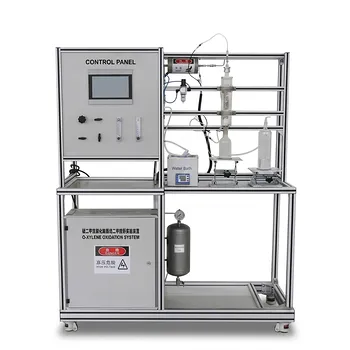
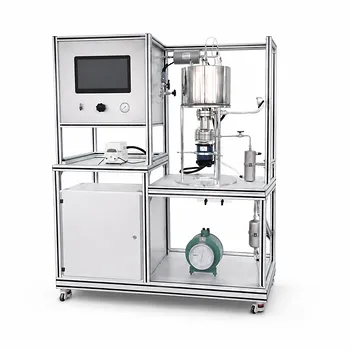
To accurately analyze reaction kinetics and scale up safely, your laboratory needs reliable, high-precision equipment. LABPARK provides premier Educational and Vocational Unit Operations Pilot Plants in chemical engineering, bioprocess & biotech, and environmental & water treatment designed for universities, research institutes, and enterprises.
Our pilot plants empower researchers and students to study dimensionless transport phenomena—including the Thiele modulus and Biot numbers—under real-world operating conditions.
Ready to elevate your research and teaching capabilities? Contact LABPARK today to discuss your custom pilot plant requirements!
Related Products
- Fixed-Bed Chemical Reaction and Gas Dust Tar Removal Unit Operations Pilot Plant
- Fixed Bed Gas Solid Catalytic Reaction Educational Pilot Plant
- Multi-Reactor Educational Pilot Plant for Reaction Engineering Unit Operations
- Educational Unit Operations Pilot Plant for Intraparticle Diffusion Effective Factor Measurement
- Ethylbenzene Dehydrogenation Educational Unit Operations Pilot Plant
People Also Ask
- When to transition from PID to adaptive control in pilot plants? Key process indicators.
- How do deviations in estimating latent heat impact pilot plant thermal systems? Avoid hardware mis-sizing.
- Why Compare Predicted and Experimental Excess Enthalpy? Key to Accurate Pilot Plant Scale-up
- How to study gasification in pilot plants? Compare exit gas composition & efficiency
- Why Use PTFE & Hastelloy in Chemical Pilot Plants? Prevent Corrosion & Ensure Safety