The Damköhler number (Da) is your direct indicator of whether your crystallization process is controlled by mixing or by kinetics. In a pilot plant, Da compares the timescale of mixing (how quickly you can homogenize the vessel) to the timescale of the crystallization phenomena—nucleation, crystal growth, or any accompanying reaction. A low Da means mixing wins, making your particle size distribution robust to agitation changes. A high Da means slow mixing creates local concentration spikes, driving uneven nucleation and growth that erodes batch consistency.
Understanding Da transforms mixing sensitivity from a vague concern into an engineering metric. Once you know whether your system operates in a Da < 0.1 or Da > 10 regime, you can predict if a change in impeller speed will alter crystal quality, and you can set purposeful mixing targets to guarantee product uniformity.
Defining the Damköhler Number in a Crystallization Context
The Damköhler number is the ratio of two characteristic timescales. In a crystallization pilot plant, the relevant form is the mixing time divided by the crystallization kinetic time.
The Timescale of Mixing
Mixing time describes how long it takes for a feed stream or a local concentration fluctuation to become uniform across the vessel. It depends on impeller type, speed, baffle geometry, and the fluid’s physical properties.
The Timescale of Crystallization Kinetics
The kinetic timescale can represent the induction time for nucleation, the growth rate of crystals, or the half-life of a reactive crystallization step. For a cooling crystallization, it might be the time for the solution to traverse the metastable zone. For a reactive crystallization, it is the characteristic reaction time.
The Dimensionless Meaning
When Da = mixing time / kinetic time:
- Da << 1: The vessel homogenizes long before any significant nucleation or growth event occurs.
- Da >> 1: The crystallization event outpaces mixing, so concentration gradients persist while crystals are forming.
Why Da Governs Mixing Sensitivity in Pilot Plants
The value of Da directly predicts how sensitive your crystal attributes will be to changes in agitation or feed rate.
When Da Is Low (Less Than 0.1): The Robust Regime
If mixing is at least ten times faster than the crystallization kinetics, every fluid element experiences the same supersaturation history. Variations in impeller RPM or minor feed interruptions have negligible impact on the final particle size distribution. The process is kinetics-limited—your crystal quality is determined by the recipe, not the hardware.
When Da Is High (Greater Than 10): The Fragile Regime
If the kinetics are ten times faster than mixing, the crystallizer operates with persistent concentration gradients. Feed-rich pockets cause locally high supersaturation, triggering excessive primary nucleation. Adjacent zones, starved of reactant, see slow growth or even dissolution. The result is a broad, unpredictable particle size distribution that shifts dramatically with any change in mixing intensity.
The Transition Zone
Between Da = 0.1 and Da = 10, the system exhibits moderate sensitivity. Small improvements in mixing can still narrow the spread of crystal sizes, but the payoff diminishes as you approach the low-Da plateau. Pilot-plant trials that map this zone are essential before scaling up.
Operational Consequences of Elevated Da
A high Da number explains many common pilot-plant frustrations that operators mistakenly blame on raw-material variability.
Inconsistent Nucleation Rates
Local supersaturation peaks sporadically trigger nucleation events. Because these peaks depend on the instantaneous flow patterns, the number of crystals formed varies from batch to batch even with identical overall stoichiometry.
Uncontrolled Crystal Growth Dispersion
Crystals that nucleate in high-supersaturation zones grow rapidly, while those in low-supersaturation zones lag. This smears the particle size distribution and can trap impurities in fast-growing crystals.
Scale-Up Surprises
A pilot-scale vessel with borderline Da may appear acceptable, but when scaled geometrically, mixing time often increases nonlinearly. A Da that was 0.5 at the pilot scale can become 5 at production scale, pushing the process into a mixing-limited regime. The Damköhler number frames this risk explicitly.
Understanding the Trade-offs
Aiming for the lowest possible Da seems obvious, but the journey there carries hidden costs and operational compromises.
The Energy vs. Sensitivity Balance
Driving Da below 0.1 typically requires higher impeller speeds or more aggressive agitator designs. This increases power consumption, raises the solution temperature through viscous dissipation, and can shear fragile crystals. The minimum effective mixing intensity is the one that brings Da just below the sensitivity threshold—no more.
Slow Kinetics as a Design Lever
Instead of fighting mixing limitations with brute force, you can alter the kinetics. Lowering the feed concentration, changing the anti-solvent addition profile, or adjusting the cooling rate all increase the characteristic kinetic timescale. This reduces Da without touching the agitator, often preserving crystal habit and minimizing mechanical damage.
Secondary Nucleation and Attrition
Over-mixing to achieve a low Da can generate excessive crystal-crystal and crystal-impeller collisions. The resulting secondary nucleation and attrition may counteract the benefit of uniformity, creating fines that must be screened downstream. The goal is a balanced Da that delivers spatial homogeneity without mechanically destroying the product.
Making the Right Choice for Your Crystallization Pilot Plant
The Damköhler number moves you from guessing about mixing sensitivity to engineering it. Here is how to apply it based on your primary goal:
- If your primary focus is achieving a narrow, reproducible particle size distribution: Determine the characteristic nucleation/growth time of your formulation, then confirm experimentally that your mixing time keeps Da below 0.1. If not, prioritize reducing mixing time over changing other variables.
- If your primary focus is scaling up an existing pilot process: Measure the mixing time at both scales. If Da is projected to increase beyond the sensitive threshold, mitigate it by adjusting the feed point location, switching to a more efficient impeller, or deliberately slowing the crystallization kinetics to maintain a safe Da.
- If your primary focus is minimizing energy consumption and crystal damage: Find the highest Da that still delivers acceptable product uniformity. Pilot trials that map the Da-vs.-PSD curve are the most cost-effective way to identify that operating sweet spot.
When you treat the Damköhler number as your mixing sensitivity compass, you stop reacting to inconsistent batches and start designing a process that is inherently uniform from R&D through production.
Summary Table:
| Da Value | Regime | Controlling Mechanism | Impact on Particle Size Distribution (PSD) |
|---|---|---|---|
| Da < 0.1 | Robust | Kinetics-limited (Mixing is fast) | Highly uniform and reproducible; insensitive to agitation changes. |
| 0.1 to 10 | Transition | Mixed Control | Moderately sensitive; mapping required to find operating sweet spot. |
| Da > 10 | Fragile | Mixing-limited (Mixing is slow) | Broad and unpredictable; highly sensitive to local concentration peaks. |
Optimize Your Crystallization & Scale-Up with LABPARK
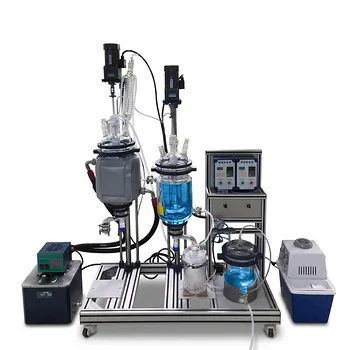
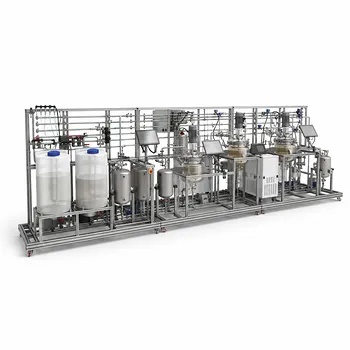
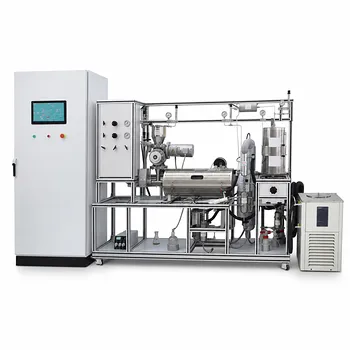
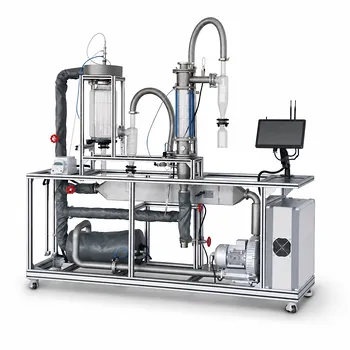
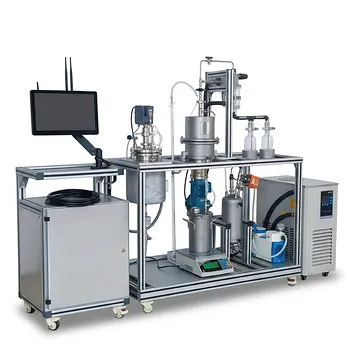
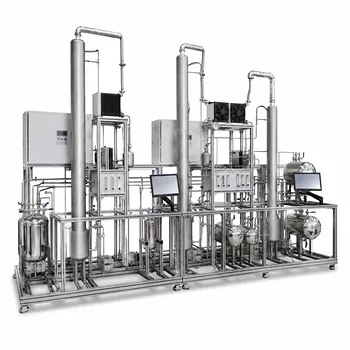
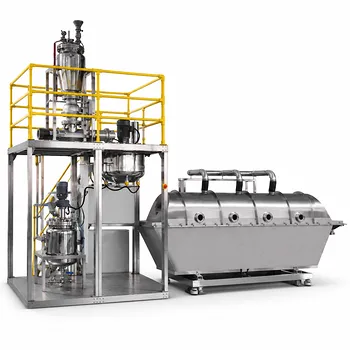
Translating theoretical metrics like the Damköhler number into reliable physical processes requires highly controllable hardware. LABPARK design and provides premium Educational and Vocational Unit Operations Pilot Plants in chemical engineering, bioprocess & biotech, and environmental & water treatment.
Specially tailored for universities, research institutes, and enterprises, our pilot plants allow you to precisely control mixing speed, feed rates, and temperature profiles—giving you the exact data you need to map Da regimes and scale up with confidence.
Contact LABPARK today to discuss how our pilot plant solutions can elevate your research and training programs!
Related Products
- Multi Functional Membrane Crystallization Educational Unit Operations Pilot Plant
- Potassium Salt Thermal Dissolution and Crystallization Separation Educational Unit Operations Pilot Plant
- Multi-Modal Distillation Unit Operations Training Pilot Plant
- Multi-Reactor Educational Pilot Plant for Reaction Engineering Unit Operations
- Dual-Mode Rectification Pilot Plant for Practical Training Unit Operations
People Also Ask
- Control Crystallization Pilot Plant Secondary Nucleation: 4 Key Adjustments
- Why is precise temperature control critical in crystallization pilot plants? Key to Scale-Up Success
- What key factors should be considered when configuring a crystallization unit operations pilot plant?
- What are the benefits of integrating online PAT tools like ATR-FTIR into crystallization unit operations pilot plants?
- How to use crystallization pilot plant agitation speed to identify diffusion vs reaction growth?