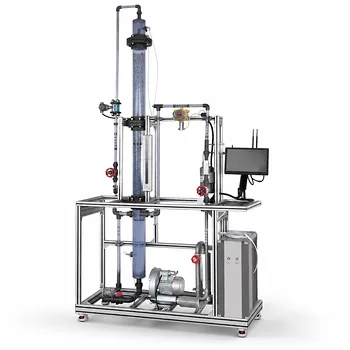
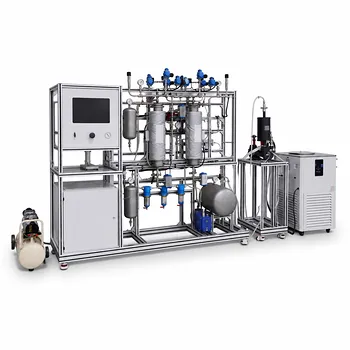
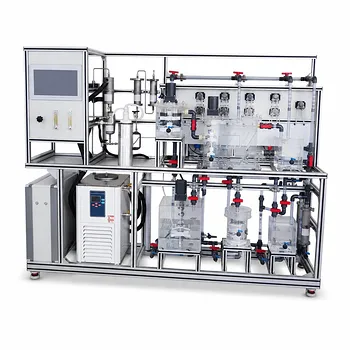
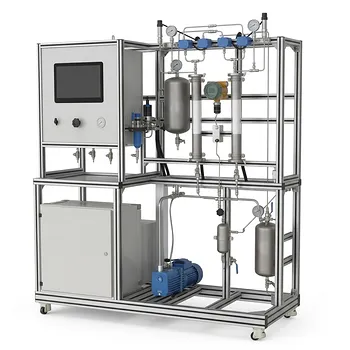
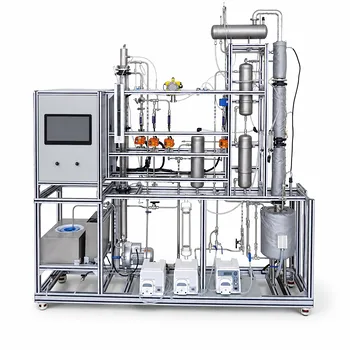
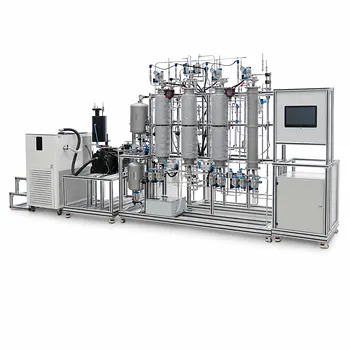
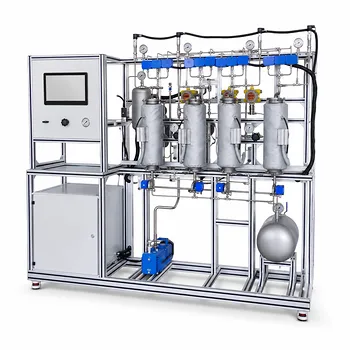
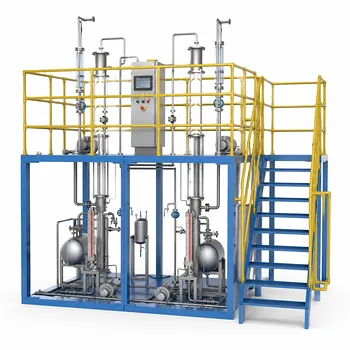
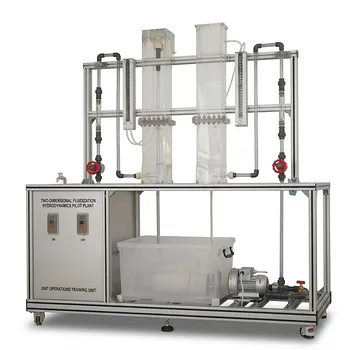
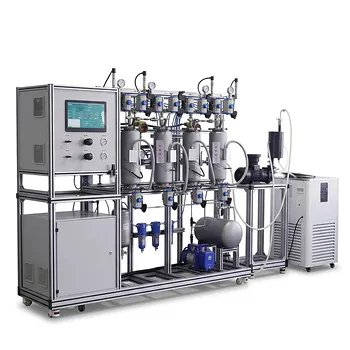
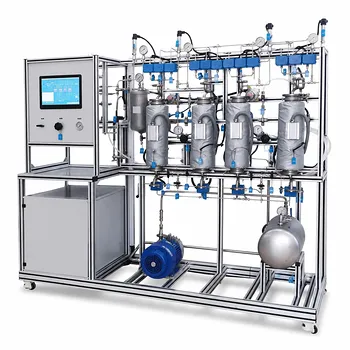
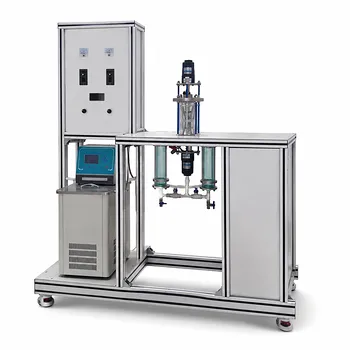
Integrating EBA and chromatography into bioprocess pilot plants transforms biotechnology education from a theoretical exercise into a practical proving ground for industrial reality.
The significance lies in recreating the most critical and costly phase of biomanufacturing—downstream processing—within a controlled learning environment. It moves students beyond textbooks to grapple with real-world complexities like processing "dirty" feedstocks and optimizing purification cascades. In short, this integration is about building an intuitive, hands-on understanding of process economics and biomolecule stability.
The core educational value is bridging the gap between theoretical purity and industrial practicality. Since downstream unit operations can represent a dominant cost driver, pilot-scale EBA and chromatography teach the experiential wisdom needed to design processes that are not just scientifically sound, but economically viable for large-scale production.
The Strategic Importance of Downstream Processing
Before diving into the "how," students must first grasp the "why." The financial stakes in downstream processing define the entire bioprocess design philosophy.
The 40-90% Economic Reality
In modern bioprocessing, separating and purifying a fragile target molecule from a complex, dilute broth is incredibly expensive. These downstream operations often account for 40% to 90% of the total production cost.
This staggering economic reality forces a critical shift in thinking. Education cannot just focus on creating the product in a bioreactor; it must center on how to recover it without destroying it—and without breaking the bank.
The High Cost of Dilution and Sensitivity
Two core biological challenges drive these high costs. First, biomolecules like proteins are exquisitely sensitive to environmental stress, including shear, pH extremes, and temperature fluctuations.
Second, the desired product is usually present in a very low concentration within a messy fermentation broth full of cells, debris, and other contaminants. Teaching students to manage this delicate, dilute mixture is the foundational lesson of bioprocess education.
Decoding the Core Unit Operations: EBA and Chromatography
Integrating these specific technologies into a pilot plant provides concrete, hands-on learning about the two most transformative separation strategies.
Expanded Bed Adsorption (EBA): Processing the Unprocessable
The true power of an EBA pilot unit is its ability to handle unclarified, highly viscous fermentation broths directly.
Instead of a tightly packed column that would instantly clog, the adsorbent bed is operated in a fluidized, stable 'expanded' state. This allows whole cells and debris to flow through while the target product binds to the specialized beads. Students learn, by doing, how a single unit operation simultaneously performs clarification, concentration, and initial purification.
This is a profound lesson in process intensification. By removing multiple traditional steps (like centrifugation and filtration), students see firsthand how EBA dramatically reduces processing time, capital equipment needs, and, ultimately, production costs.
Packed-Bed Chromatography: Mastering High-Resolution Selectivity
Once a product is clarified, the next educational layer is achieving high purity through packed-bed chromatography. A pilot plant allows students to evaluate and optimize various separation mechanisms—ion exchange, affinity, hydrophobic interaction, and gel filtration.
The key learning outcome here is understanding selectivity. Students make direct connections between the choice of a stationary phase and mobile phase composition and the resulting purity of their target.
More importantly, they learn to investigate process robustness. By adjusting critical variables like column temperature, flow rate, buffer concentration, and gradient time, they visually observe the impact on peak resolution and retention time. This mirrors the exact robustness studies required for industrial method validation and scale-up.
Connecting Theory to Chromatographic Reality
Integrating these hardware units provides the crucial bridge from abstract transport equations, like Fick's laws of diffusion, to tangible separation performance. Students determine molecular diffusion coefficients and understand column dynamics not by solving equations on paper, but by witnessing their effects on an elution peak.
This experiential learning is vital. It builds an intuition for optimizing separation efficiency that cannot be gained from simulation software alone, preparing students for troubleshooting in real-world biomanufacturing and chemical industries.
Understanding the Trade-offs of Educational Integration
No educational tool is without its limitations, and an honest assessment of pilot plant training builds deeper understanding.
The Simplification of Feedstock Complexity
Industrial feedstocks are notoriously variable. However, an educational pilot plant often uses a well-characterized, simplified "model broth" for reproducibility. This can mask the extreme, non-homogeneous challenges of real biomass feedstocks.
Students may not fully appreciate the difficulty of handling a feedstock that would require multiple parallel process lines for full utilization. Without explicit emphasis from instructors, the critical importance of robust, non-specific waste treatment unit operations for handling the complex effluent streams from a biorefinery can be an unseen lesson.
The Gap Between Pilot and Production Scale
A pilot-scale column is not a miniature factory. The dynamics of fluidization in EBA or the pressure drop in a chromatography bed change non-linearly with diameter. Students must be cautioned that successful optimization at the 5-cm column scale is a starting point, not an endpoint.
Furthermore, advanced economic technologies like continuous multi-column chromatography for solvent recycling and efficiency gains are harder to prototype and may not be present in a basic educational setup. The curriculum must explicitly teach the path from batch pilot data to designing a continuous, fully-integrated commercial process.
Making the Right Choice for Your Goal
An integrated pilot plant can flex to serve different educational missions. Here’s how to align its use with specific learning outcomes.
- If your primary focus is process economics: EBA becomes your central teaching tool. Task students with comparing the total cost of a traditional clarification-plus-chromatography route versus a direct-capture EBA route for the same crude feedstock.
- If your primary focus is product purity and analytics: Prioritize hands-on time with the packed-bed chromatography system. Have students systematically vary mobile phase gradients to perform a resolution robustness study and correlate their data to theoretical plate models.
- If your primary focus is advanced manufacturing: Extend the pilot plant’s use beyond just protein purification. Configure it with upstream microfluidic or high-shear mixing units to teach the integrated synthesis, purification, and encapsulation workflow for nanocarriers, mimicking a complete pharmaceutical production line.
- If your primary focus is automation and control: Shift the lesson’s emphasis to the process sensors. Have students use the PLC and SCADA systems to measure online parameters like pressure, flow rate, and viscosity, using that real-time data to perform dynamic mass balances and detect process deviations.
Integrating these unit operations does more than just teach students how to purify a protein; it equips them with the critical-thinking framework to design, troubleshoot, and economically justify the entire product recovery process that defines modern biotechnology.
Summary Table:
| Technology | Primary Function | Key Educational Value | Industrial Relevancy |
|---|---|---|---|
| Expanded Bed Adsorption (EBA) | Direct capture from unclarified broth | Teaches process intensification, combining clarification and concentration | Clog-free processing of crude, high-viscosity feedstocks |
| Packed-Bed Chromatography | High-resolution purification | Teaches selectivity, column dynamics, and process validation | Gold standard for achieving high-purity biopharmaceuticals |
Elevate Your Biotech Education with LABPARK Pilot Plants
To successfully transition students from textbooks to industrial biomanufacturing, hands-on experience with pilot-scale equipment is essential.
LABPARK provides state-of-the-art Educational and Vocational Unit Operations Pilot Plants in chemical engineering, bioprocess & biotech, and environmental & water treatment. Designed specifically for universities, research institutes, and enterprises, our systems equip future engineers with the practical skills needed to optimize downstream processes and manage process economics.
Ready to upgrade your laboratory with industry-standard EBA and chromatography pilot units? Contact LABPARK today to request a custom consultation!
Related Products
- Packed Bed Absorption Educational Unit Operations Pilot Plant
- Bench Scale Dual Column Gas Separation and Capture Educational Pilot Plant
- Multimodal Absorption and Desorption Pilot Plant for Unit Operations Training
- High-Gravity Emulsification and Mass Transfer Educational Pilot Plant
- Absorption and Desorption Educational Unit Operations Pilot Plant
People Also Ask
- How Do Flow Regimes Transition in Packed Bed Pilot Plants? Key Scale-up Insights
- How does reactant concentration determine absorption column control? Gas-film vs. dual-film.
- How is the packing height of an absorption column calculated? Master HTU & NTU Concepts
- How does static vs. operating holdup affect pilot plant calibration? Avoid Critical Scale-Up Errors
- Why is counter-current flow selected for gas absorption? Maximize Pilot Plant Efficiency