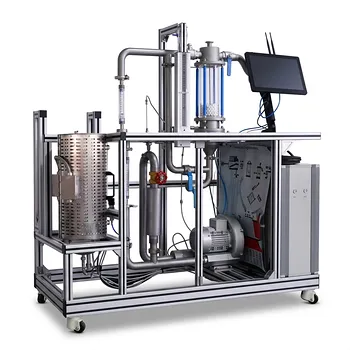
To truly grasp the core principles of mass transfer, students must see them in action. Comparing different packing types—like Raschig rings and Pall rings—in a pilot-scale column is the most direct way to experimentally study how packing geometry governs mass transfer efficiency and pressure drop. This hands-on comparison transforms abstract equations from transport phenomena courses into measurable, industrial design parameters such as the Height Equivalent to a Theoretical Plate (HETP) and gas-phase pressure drop per unit length.
The significance of a side-by-side packing comparison in an educational pilot plant is not just about measuring numbers—it’s about building a deep, intuitive understanding of how a small change in internal geometry can completely reshape hydrodynamics and separation performance. It bridges the gap between classroom theory and the real-world compromises engineers make when designing columns.
Why Hands-On Packing Comparisons Are a Cornerstone of Chemical Engineering Education
Making the Invisible Visible
In a lecture, students learn that mass transfer depends on interfacial area and turbulence. But they can’t see it.
A pilot column filled with Raschig rings—simple ceramic or metal cylinders—allows them to observe higher pressure drop and liquid channeling. Swapping to Pall rings with their internal webs and punched tabs immediately shows improved gas-liquid distribution and lower resistance.
The numerical difference in HETP or pressure drop makes the theory tangible.
Teaching the Language of Industrial Design
Industry doesn't speak in Sherwood numbers alone; it speaks in HETP, pressure drop at given turndown, and flooding velocity.
By measuring these values for two different generations of random packing, students learn to translate first principles into the metrics that size real columns. They develop the judgment to ask: “Is that 15% lower HETP worth the additional cost of a more complex packing?”
Unpacking the Core Insights: Raschig Rings vs. Pall Rings
The Role of Packing Geometry
Raschig rings represent the earliest form of random packing. Their simple hollow cylinder shape creates a straightforward flow path but suffers from poor liquid spreading and dead zones.
Pall rings evolved with two rows of inward-bent tabs and a central web. These features break the liquid into droplets, create more surface renewal, and provide multiple dripping points—dramatically increasing the effective interfacial area without adding significant weight or solid volume.
Direct Impact on HETP and Mass Transfer
Because Pall rings offer better liquid film renewal and more active surface, the Height Equivalent to a Theoretical Plate drops. Students measuring HETP in a distillation or absorption experiment will typically find that a bed of Pall rings requires less packed height to achieve the same separation.
This single experiment cements the concept that mass transfer is a function of geometry, not just column dimensions.
The Pressure Drop Lesson
Pressure drop is a major operating cost. The blunt edges of Raschig rings obstruct gas flow and create higher pressure losses.
Pall rings, with their open structure, allow gas to pass through with less resistance. When students record that the Pall ring bed shows 30–40% lower pressure drop for the same throughput, they internalize the economic and mechanical advantage of advanced packing—critical knowledge for processes where vacuum operation or compressor power is limiting.
Understanding the Trade-offs
Simplicity vs. Performance
Raschig rings are easier to manufacture and load, and their behavior is simple to model theoretically. This makes them valuable as a baseline in teaching transport fundamentals. Pall rings, while superior in mass transfer, introduce more complex flow patterns that can be harder to predict from first principles—so students learn that better performance often comes with increased modeling uncertainty.
The Risk of Over-Generalization
Pilot plant comparisons can mislead if not placed in context. A student might conclude Pall rings are always “better.” But real columns face variables like fouling tendency, corrosion, and turndown ratio. A packing with high open area may suffer from liquid maldistribution at very low flow rates; the simple Raschig ring might prove more robust in a particular niche. The educational value lies in teaching why and when to choose one over the other, not in declaring a universal winner.
Scale-Up Limitations
Data from a small-diameter pilot column cannot be linearly scaled to industrial towers because wall effects and liquid distribution systems differ. A well-designed curriculum will use the Raschig vs. Pall comparison to introduce these scale-up pitfalls, making students aware that pilot plant results are a starting point for deeper analysis, not a final answer.
Making the Right Choice for Your Learning Objectives
The true significance of a packing comparison is the engineering judgment it builds. To maximize value from your pilot plant experiments, align the packing choices with your educational goals.
- If your primary focus is fundamental transport phenomena: Start with Raschig rings to establish a clear, predictable baseline for mass transfer and pressure drop. Then introduce Pall rings to demonstrate how geometry enhances performance without changing the basic physical mechanisms.
- If your primary focus is industrial equipment design: Use the comparison to teach economic trade-offs. Let students calculate the column diameter and packed height for both packings under the same separation duty, then discuss capital vs. operating cost implications.
- If your primary focus is process troubleshooting and operation: Run both packings at multiple liquid and gas rates. Show students how each packing responds to turndown and flooding, building the operational intuition that prevents costly column failures.
Use the pilot plant not just to collect data, but to teach the mindset of a professional who balances performance, cost, and reliability with every design decision.
Summary Table:
| Feature / Parameter | Raschig Rings | Pall Rings |
|---|---|---|
| Geometry | Simple hollow cylinder | Cylinder with internal webs and punched tabs |
| Mass Transfer & HETP | Lower efficiency (higher HETP) due to liquid channeling | Higher efficiency (lower HETP) via film renewal |
| Pressure Drop | Higher resistance and pressure losses | 30–40% lower pressure drop for same throughput |
| Primary Educational Use | Teaching fundamental baseline transport equations | Teaching design optimization and industrial trade-offs |
Bring Hands-On Chemical Engineering Concepts to Life
Help your students bridge the gap between classroom theory and real-world industrial design. LABPARK provides high-quality Educational and Vocational Unit Operations Pilot Plants in chemical engineering, bioprocess & biotech, and environmental & water treatment. Designed specifically for universities, research institutes, and enterprises, our pilot plants enable students and researchers to perform critical hydrodynamic and mass transfer studies.
Ready to upgrade your laboratory setup? Contact LABPARK today to discuss your specific curriculum requirements and request a customized quote.
Related Products
- Multi Functional Catalytic Reaction and Reactor Evaluation Educational Unit Operations Pilot Plant
- Rising and Falling Film Evaporation Educational Unit Operations Pilot Plant
- Constant Pressure Filtration Educational Unit Operations Pilot Plant
- Centrifugal Pump Performance and Orifice Flowmeter Calibration Educational Pilot Plant
- Orifice and Venturi Flowmeter Calibration Educational Pilot Plant for Fluid Mechanics Laboratory
People Also Ask
- What reaction engineering principles are shown in a catalytic reactor pilot plant? SO2 Oxidation Guide
- How does feed gas flow rate affect catalytic RFR yields? Optimize Pilot Plant Performance
- Why is FTIR integration in catalytic pilot plants important? Real-Time Student Insights
- How to analyze active metal distribution & identify catalyst poisoning in pilot plants? Expert Diagnostic Guide
- How to study catalyst poisoning & regeneration? Master catalytic reaction life cycles.