Bubble coalescence and height-dependent growth aren't just academic curiosities—they are the dominant hydrodynamic forces that determine whether your pilot plant yields scalable data or misleading artifacts.
In a fluidized-bed pilot plant, bubbles readily merge as they rise, causing their average size to increase with bed height. The immediate and most critical significance is that this growth dictates the reactor vessel's minimum diameter. If that diameter is too small relative to the evolved bubble size, the bed transitions into a slugging regime, which destroys gas-solid contacting efficiency and renders the pilot data useless for scale-up. Predicting this growth is therefore the first step in ensuring your experiment is physically viable.
While bubble coalescence and height-dependent growth directly threaten stable operation through slugging, they are also the very mechanism that controls gas bypassing, interphase mass transfer, and solid mixing. Mastering the prediction and management of this bubble evolution is what separates a successful pilot study from one whose results will never leave the lab.
The Central Problem: Slugging as a Failure Mode
The most immediate consequence of uncontrolled bubble growth is the loss of a viable fluidization regime. This is the "surface need" problem you must solve before any deeper analysis can begin.
Why Bubbles Grow Unchecked
In a bubbling fluidized bed, the powder has an extremely low effective surface tension. This means there is almost no energy penalty for two bubbles to merge when they touch. Coalescence is the path of least resistance. As gas flows upward, these mergers happen continuously, so the average bubble diameter increases monotonically with height.
The Vessel Diameter Bottleneck
When a bubble's diameter reaches about two-thirds of the vessel's diameter, it can no longer rise freely. The bed transitions from bubbling to slugging. In slug flow, large gas plugs act as pistons, separating sections of the bed and causing severe pressure fluctuations, poor gas-solid contact, and reduced conversion. A pilot plant operated in the slugging regime does not represent a well-scaled industrial reactor, making the data extremely difficult to extrapolate.
The Deep Significance: How Bubble Evolution Governs Reactor Performance
Avoiding slugging is just the starting point. The real power of understanding height-dependent bubble growth lies in how it controls every mass-transfer-limited step in your reactor.
Controlling Gas Bypassing and Conversion
As bubbles grow taller, their rise velocity increases. Larger, faster bubbles carry a smaller relative cloud—the region of gas recirculating around the bubble. This directly leads to gas bypassing: reactant gas shoots through the bed in bubbles without ever contacting the solid emulsion phase where the catalyst sits. That unconverted reactant leaves the bed, slashing your apparent reaction rate. By calculating bubble size as a function of height, you can quantify this bypassing and adjust the bed height or gas velocity to ensure enough residence time for the bubble gas to reach chemical equilibrium.
The Hidden Enhancement During Coalescence
The act of coalescence itself is not all negative. During the brief moments when one bubble encroaches upon another, the interphase mass transfer coefficient can spike to two to three times its steady-state value. This transient convective through-flow enhances gas exchange between the bubble and the emulsion phase. Standard single-bubble models miss this; empirical correction factors used in industrial design are required precisely because coalescence is so common. Thus, a bed with frequent, moderate coalescence can sometimes outperform a model's prediction, but only if the growth is managed to prevent slugging.
Lateral Mixing and the Dominant Resistance
The size of your bubbles determines what resistance controls your solid conversion. In shallow beds where bubbles are still small, lateral mixing of solids is a major factor and must be included in your model. In deep beds with large bubbles, the controlling step shifts to the mass transfer across the bubble-emulsion interface. Knowing how bubble size evolves along the column height tells you which regime your pilot plant is actually operating in, guiding you on whether to improve distributor design or add internal features to manage gas-solid contact.
Understanding the Trade-offs and Pitfalls
An expert knows what can go wrong. Bubble management is full of subtle trade-offs that can invalidate your pilot study if ignored.
The Pressure Deception
One common pitfall is ignoring the effect of pressure on bubble growth. As operating pressure increases (e.g., in high-pressure pilot plants mimicking industrial processes), the average bubble size decreases and fluidization becomes smoother. A protocol developed at atmospheric pressure may greatly overestimate bubble size and bypassing at 60 bar. If you rely on height-dependent models calibrated for ambient conditions, you will incorrectly predict slugging and misdiagnose conversion losses at elevated pressures.
The Baffle Decision
When scaling up, the instinct is to add vertical baffles to break up bubbles and reduce solid mixing. Pilot plant data is unequivocal: vertical baffles fail to stage the solid phase effectively. Only horizontal baffles successfully divide the catalyst into stages, reducing axial mixing and approaching plug flow. If your height-dependent bubble model suggests a certain conversion based on plug-flow assumptions, but you use the wrong internals, your actual residence time distribution will render that model worthless. Your pilot plant must be configured with horizontal baffles if staging is critical.
The Initial Size Assumption
All height-dependent models rely on an initial bubble size right above the distributor. A poorly designed distributor creates larger initial bubbles, which then accelerate the coalescence and growth trajectory. You cannot simply assume a standard value; you must calculate it based on excess gas velocity and orifice design. An error in this boundary condition propagates through the entire column and can lead to a vessel diameter that still slugs under certain turndown conditions.
How to Apply This to Your Pilot Plant Operation
Your strategy for dealing with bubble coalescence and growth depends on your specific research or educational objective. Use this goal-based framework to structure your experiments.
- If your primary focus is acquiring scalable design data: Prioritize calculating the height-dependent bubble size profile to ensure your vessel diameter keeps the maximum bubble size well below the slugging limit. Confirm this experimentally by monitoring pressure drop fluctuations for signs of slug flow.
- If your primary focus is maximizing reactant conversion in a catalytic process: Use your bubble growth model to identify the bed height where bubble gas reaches chemical equilibrium. If bypassing is an issue, consider reducing excess gas velocity or redesigning the distributor to create smaller initial bubbles, rather than simply adding more catalyst.
- If your primary focus is teaching reactor hydrodynamics: Design an experiment that directly contrasts a distributor producing fine bubbles with one producing large ones, while students track the unreacted gas fraction leaving the bed and visually observe the transition to slugging.
- If your primary focus is high-pressure process development: Never rely on atmospheric bubble growth correlations. Quantify the pressure-dependent reduction in bubble size and increased bubble frequency, as these dictate entirely different optimal vessel dimensions and diffuser designs.
A fluidized bed pilot plant is only as informative as your control over its bubbles. Understanding why they coalesce and how they grow empowers you to design experiments that genuinely reflect industrial reality, not just the peculiarities of your specific column.
Summary Table:
| Phenomenon / Issue | Impact on Reactor Performance | Recommended Mitigation / Solution |
|---|---|---|
| Slugging (Excessive Bubble Growth) | Destroys gas-solid contact, causes severe pressure fluctuations. | Ensure vessel diameter is $> 1.5 \times$ maximum bubble size. |
| Gas Bypassing | Reactants shoot through the bed unconverted, reducing efficiency. | Adjust gas velocity, increase bed height, or optimize distributor design. |
| Inadequate Solid Mixing | Solid-phase resistance dominates in shallow beds. | Install horizontal baffles to stage the catalyst bed. |
| High-Pressure Operation | Decreases average bubble size, making ambient models inaccurate. | Calibrate growth models specifically for high-pressure conditions. |
Scale Up Your Research with LABPARK Pilot Plants
Getting reliable, scalable hydrodynamic data requires precise equipment control. LABPARK provides high-quality Educational and Vocational Unit Operations Pilot Plants in chemical engineering, bioprocess & biotech, and environmental & water treatment.
Designed specifically for universities, research institutes, and enterprises, our systems help you master complex phenomena like fluidization, gas bypassing, and reactor scaling with hands-on accuracy.
Ready to elevate your laboratory capability? Contact us today to discuss your customized pilot plant requirements!
Related Products
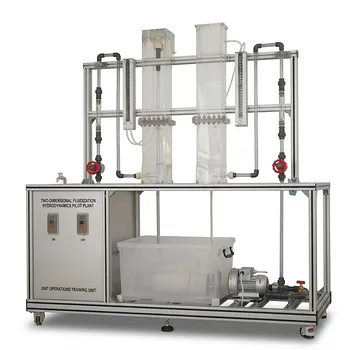
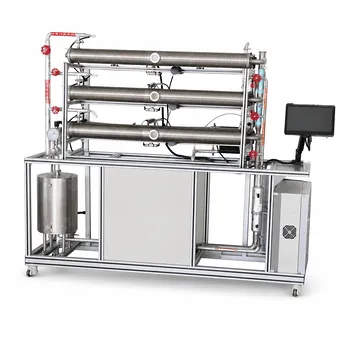
- Two-Dimensional Fluidization Hydrodynamics Educational Pilot Plant for Unit Operations Training
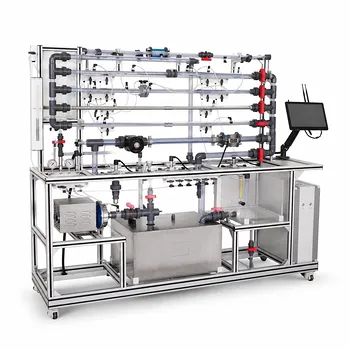
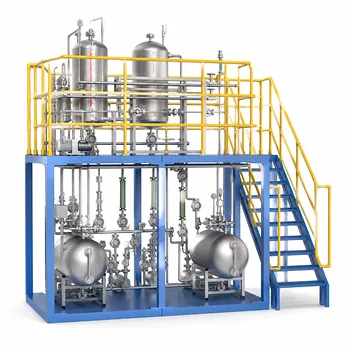
- Multi-Reactor Educational Pilot Plant for Reaction Engineering Unit Operations
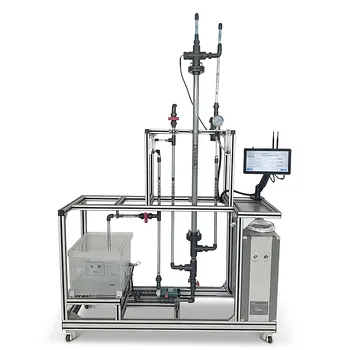
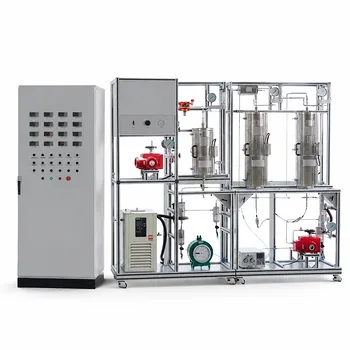
- Multi Functional Catalytic Reaction and Reactor Evaluation Educational Unit Operations Pilot Plant
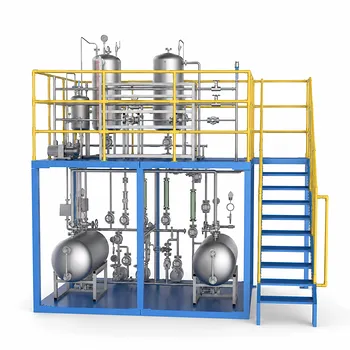
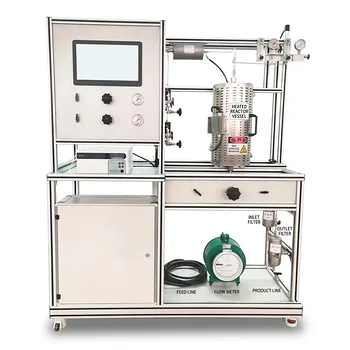
- Fluidized Bed Gas Solid Catalytic Reaction Educational Pilot Plant
- Educational Unit Operations Pilot Plant for Intraparticle Diffusion Effective Factor Measurement
People Also Ask
- What pressure drop characteristics should students & researchers monitor in a fluidization pilot plant?
- How does active time pulsing mixing enhance fluid homogenization? Configuration Guide for Educational Pilot Plants
- How can acoustic chemometrics prevent reactor clogging in educational fluidized bed pilot plants?
- What is the operational significance of solids feed rate on emulsion phase dynamics in fluidized bed pilot plants?
- How can inline NIR & microwave sensors study fluidized bed drying dynamics? A Real-Time Guide