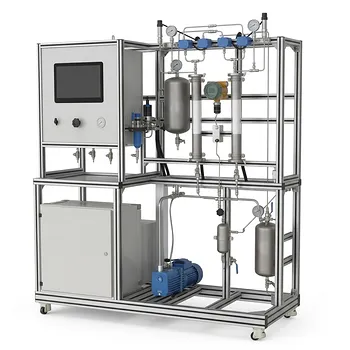
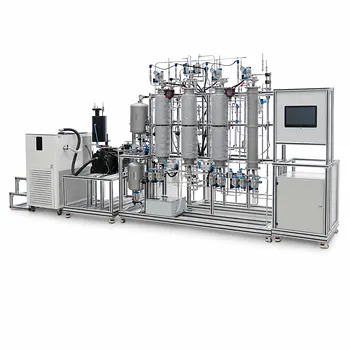
The separation factor (Kc) is the ratio of centrifugal force to gravitational force, representing a centrifuge’s ability to accelerate sedimentation. In laboratory and pilot-scale equipment, it determines which technology can effectively separate a given mixture. Centrifuges are classified as normal-speed (Kc < 3,000), high-speed (Kc = 3,000 to 50,000), or ultra-speed (Kc > 50,000), and this single metric guides the choice between decanter, disc stack, or tubular machines for educational and research applications.
The separation factor directly maps the force field to the particle size and density differences you need to resolve. In a teaching or research pilot plant, selecting the right Kc range ensures that students can meaningfully study scaling behavior and that researchers can achieve target separations without over‑engineering the system.
What the Separation Factor (Kc) Really Tells You
The separation factor expresses how many times stronger the centrifugal field is than Earth’s gravity. In a rotating rotor, a particle experiences a relative centrifugal force (RCF) that multiplies its settling velocity by Kc.
The Physics Behind the Number
For a given particle size and density difference, doubling Kc roughly doubles the sedimentation speed. This makes Kc a direct predictor of whether a centrifuge can handle fine or coarse solids.
A low Kc (e.g., 600) can settle dense, large flocks within a reasonable residence time. A high Kc (e.g., 60,000) can drag down sub‑micron proteins and viruses that would never sediment under gravity alone.
Classification and Typical Ranges
The industry uses three broad bands:
- Normal‑speed (Kc < 3,000): Suitable for coarse particles and dewatering.
- High‑speed (Kc = 3,000 to 50,000): Covers most fine‑particle and liquid‑liquid separations.
- Ultra‑speed (Kc > 50,000): Necessary for the smallest biological entities like proteins and viruses.
These categories are not arbitrary—they reflect the mechanical design limits and the separation tasks each class can complete in a practical timeframe.
How Kc Guides Pilot Plant Selection for Teaching and Research
When equipping an educational or research laboratory, Kc is the first filter. It tells you which centrifugal architectures are viable, and it frames the unit operations that can be demonstrated.
Normal‑Speed Machines for Environmental and Coarse Separations
Decanter centrifuges typically operate at Kc values of 600 to 1,200. This places them firmly in the normal‑speed range.
They excel at sludge dewatering, coarse particle recovery, and applications where a dry cake is more important than absolute clarity. In an environmental engineering teaching lab, a pilot decanter lets students explore polymer dosing effects and solids loading without the complexity of ultra‑high speeds.
High‑Speed Disc Stack Centrifuges for Fine Suspensions and Bioprocessing
Disc stack centrifuges achieve Kc values of 4,000 to 10,000. This high‑speed range is the workhorse for clarifying suspensions with particles below 0.5 µm and for continuous liquid‑liquid separation.
In a bioprocessing pilot plant, a disc stack unit is the go‑to choice for harvesting yeast or separating cell debris after homogenization. It offers enough force to clear bacteria‑scale particles while maintaining a throughput that is meaningful for scale‑up studies.
Ultra‑Speed Tubular Centrifuges for Demanding Bioseparations
Tubular bowl centrifuges can reach Kc values up to 60,000, placing them in the ultra‑speed category. They generate the extreme forces required to recover proteins, viruses, and sub‑micron precipitates.
A research lab focusing on intracellular product recovery would select a tubular pilot centrifuge not because it is convenient—it has low solids capacity and requires manual clean‑out—but because only that level of force can sediment the target material with acceptable yield.
Beyond the Number: Other Critical Pilot Plant Parameters
While Kc defines the separation capability, a pilot plant for teaching and research must also allow meaningful investigation of industrial realities.
Feed Flow Rate and Residence Time
For a given Kc, the separation outcome depends on how long the material spends in the force field. In a pilot plant, varying the feed rate demonstrates the trade‑off between throughput and clarity. Students learn that a high Kc cannot compensate for an absurdly short residence time.
Solids Loading and Discharge Design
Decanters continuously remove settled solids, while tubular centrifuges accumulate a packed bed that must be cleaned manually. This distinction is critical for scale‑up education: a high‑Kc tubular machine may achieve brilliant clarity in the lab but becomes impractical in a 24/7 production line.
Biological Compatibility
For bioprocessing pilot plants, Kc is only one piece of the puzzle. The centrifuge must also maintain aseptic conditions and exert shear stress levels that do not rupture fragile cells or denature proteins. A high‑speed disc stack machine with gentle feed zones may be superior to an ultra‑speed tubular device that damages shear‑sensitive products, even though the latter has a higher Kc.
Understanding the Trade-offs in Centrifuge Selection
No single centrifuge architecture dominates across all Kc ranges. Educational labs and research groups must navigate a tension between separation power, operational simplicity, and total ownership cost.
Higher Kc Comes with Practical Limitations
A machine delivering Kc = 60,000 demands precision bearings, high‑energy motors, and robust containment. It generates significant heat and typically operates at lower flow rates. For a teaching platform, this complexity may distract from the fundamental principles of solid‑liquid separation unless the curriculum specifically targets advanced bioprocessing.
Lower Kc Machines Sacrifice Separation Finesse
A normal‑speed decanter cannot clarify a bacterial broth to leave a clear centrate—the Kc is simply too low. But it is far easier to operate, safer to clean, and capable of handling high solids loads. In a general chemical engineering unit operations lab, a decanter might be the better pedagogical tool because students can change variables (weir settings, bowl speed, feed rate) and immediately see the impact.
The Risk of Over‑Specification
Choosing an ultra‑speed machine for a task that a disc stack can handle wastes capital and complicates maintenance. Conversely, under‑specifying a pilot plant by selecting a low‑Kc device for sub‑micron separation yields frustrating experimental results where no amount of operational tuning can achieve the target clarity.
Making the Right Choice for Your Educational or Research Goal
Align the Kc class with the core objective of the pilot plant, and then verify that the machine’s form factor and operational characteristics support the user’s learning or experimental workflow.
- If your primary focus is training students in wastewater and coarse solids separation: A normal‑speed decanter centrifuge (Kc 600–1,200) offers a forgiving, visually instructive platform to explore dewatering, polymer conditioning, and throughput effects.
- If your primary focus is bioprocess research and cell harvesting: A high‑speed disc stack centrifuge (Kc 4,000–10,000) provides the right balance of separation power, hygienic design, and manageable shear to clarify microbial cultures and recover inclusion bodies.
- If your primary focus is advanced bioseparations of proteins, viruses, or nanoparticles: An ultra‑speed tubular centrifuge (Kc up to 60,000) is the only route to adequate yields, regardless of its low solids handling and manual operation.
- If your primary focus is teaching unit operations and scale‑up principles: Include two centrifuges from different Kc classes—such as a decanter and a disc stack—so that students can directly compare separation efficiency, product dryness, and the real‑world trade‑offs between throughput and clarity.
The separation factor transforms a vague separation challenge into a quantifiable design decision, allowing educational and research laboratories to invest in the centrifugal technology that matches both the physical demands of their mixtures and the learning outcomes they must deliver.
Summary Table:
| Speed Class | Kc Range | Centrifuge Type | Key Applications |
|---|---|---|---|
| Normal-speed | < 3,000 (Decanter: 600–1,200) | Decanter | Sludge dewatering, coarse solids, wastewater training |
| High-speed | 3,000–50,000 (Disc Stack: 4,000–10,000) | Disc Stack | Fine suspensions (<0.5 µm), cell harvesting, bioprocessing |
| Ultra-speed | > 50,000 (Tubular: up to 60,000) | Tubular Bowl | Proteins, viruses, sub-micron biological harvesting |
Are you designing a laboratory curriculum or setting up a new research facility? LABPARK provides state-of-the-art Educational and Vocational Unit Operations Pilot Plants in chemical engineering, bioprocess & biotech, and environmental & water treatment for universities, research institutes, and enterprises. Let our experts help you select the ideal centrifuge setup with the perfect separation factor (Kc) to meet your specific research and educational goals.
Contact LABPARK today to get a tailored solution for your laboratory!
Related Products
- Centrifugal Pump Performance and Orifice Flowmeter Calibration Educational Pilot Plant
- Multifunctional Membrane Separation Educational Pilot Plant with Ultrafiltration, Nanofiltration, Reverse Osmosis
- Multi-Functional Membrane Separation Educational Pilot Plant for Unit Operations Lab
- Bench Scale Dual Column Gas Separation and Capture Educational Pilot Plant
- Ultrafiltration Membrane Separation Educational Pilot Plant
People Also Ask
- What features should instructors look for in pump & flowmeter pilot plants? Key Selection Guide
- Why start a centrifugal pump with a closed outlet valve? Protect your pilot plant motors.
- How to update chemometric calibration models in pilot plants? Best practices for process engineers.
- How can cavitation and slurry erosion be studied and mitigated using fluid transport and centrifugal pump pilot plants?
- How do pilot plants demonstrate siphon pressure variations? Visualizing Bernoulli's Energy Balance