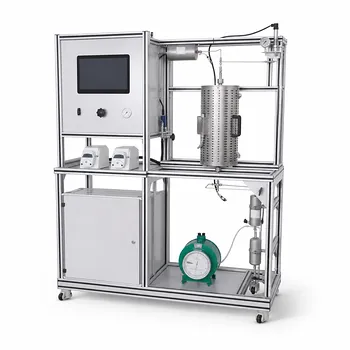
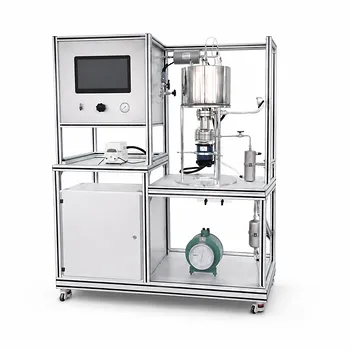
The cooling jacket is the thermal backbone of an exothermic CSTR pilot plant. Its core role is to remove the heat released by the reaction at a precisely controllable rate, keeping the reactor temperature within a safe and productive window. Without this sustained heat removal, the exotherm would drive a positive feedback loop, leading to temperature runaway and potentially catastrophic failure. In a pilot-scale educational unit, the jacket does more than cool—it becomes the central instrument for studying heat transfer, dynamic stability, and advanced process control.
A cooling jacket transforms an unstable exothermic reaction into a stable, observable process. It is simultaneously your guardian against thermal runaway, your laboratory for hands-on heat transfer measurement, and a subtle but powerful knob for tuning reactor stability. Understanding its role is the first step to mastering non-isothermal reactor engineering.
The Fundamental Role: Balancing Heat Generation with Removal
Every exothermic CSTR obeys a strict energy balance. The reaction generates heat at a rate tied to kinetics and conversion. The cooling jacket’s job is to match that generation with an equal removal rate to hold the temperature steady.
The Energy Balance at the Core
The net heat accumulation equals heat generated by reaction minus heat transferred to the jacket. When generation exceeds removal, reactor temperature and reaction rate climb together—a positive feedback that can spiral into thermal runaway. The jacket’s heat removal term, commonly expressed as (UA(T_{reactor} - T_{jacket})), is the only practical lever to break that feedback loop.
The Direct Mechanics of the Jacket
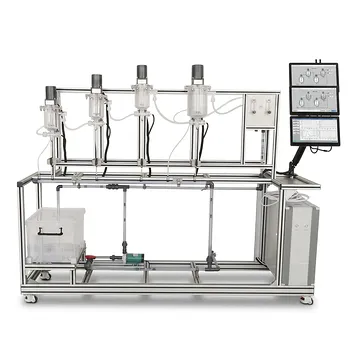
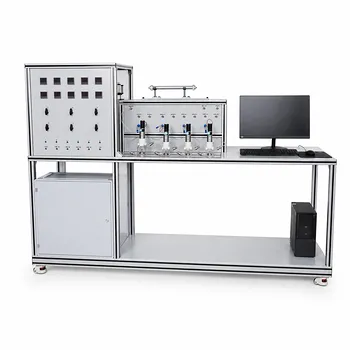
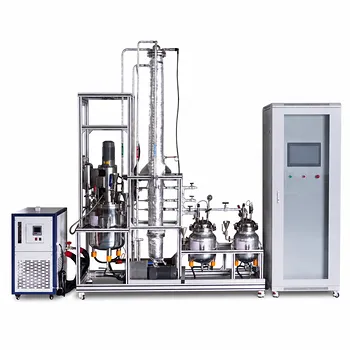
In a pilot plant, the jacket is a physical shell around the reactor vessel through which a coolant—usually water—flows. By varying the coolant flow rate, you directly manipulate the overall heat transfer coefficient (UA) and the effective temperature driving force. This real-time controllability turns theory into direct, observable cause and effect.
A Living Laboratory: The Educational and Research Value
A jacketed CSTR pilot plant does more than prevent accidents. It bridges the gap between idealized mathematical models and the messy, lagged reality of industrial hardware.
Bridging Theory and Real-World Thermal Lag
Textbooks often assume a “perfectly mixed cooling jacket” with instantaneous heat removal. A physical unit reveals the thermal inertia of the jacket fluid and metal walls. You can see the temperature response lag behind a change in coolant flow, a phenomenon that must be accounted for in real industrial control schemes.
Quantifying Heat Transfer and Enthalpy Dynamics
By logging reactor and jacket temperatures under varying flow rates, operators can calculate experimental heat transfer coefficients and compare them to correlations. You also see the direct link between enthalpy of reaction ((\Delta H)) and the resulting temperature rise, reinforcing mass-and-energy balances with tangible data rather than abstract equations.
The Jacket’s Influence on Reactor Stability
Beyond simple heat removal, the jacket’s thermal mass becomes a critical factor in whether the reactor settles at a steady state or oscillates uncontrollably.
Thermal Capacitance and the Lewis Number
The Lewis number (Le) in reactor dynamics compares the thermal capacitance of the system (reactor contents plus jacket) to its mass capacitance. A low Le number—a “thermally light” system—expands the region of instability, making the reactor prone to sustained temperature oscillations and even limit cycles.
How a Water-Filled Jacket Stabilizes Oscillations
Filling the cooling jacket with water dramatically increases the system’s overall thermal capacitance, raising the Lewis number. This higher thermal inertia exerts a stabilizing effect, often shifting the reactor from an unstable, oscillatory state into a stable, high-conversion steady state. A pilot plant makes this abstract stability analysis visual—you can literally watch the temperature profile flatten as the jacket capacity is increased.
Control Loop Integration and Safe Operation
The jacket is not standalone; it is the final control element in a closed-loop safety and performance system.
Split-Range Control: From Startup to Steady State
Many pilot-plant reactors use a split-range control strategy. Initially, steam may be injected into the jacket to bring the reactor up to initiation temperature. Once the exotherm takes over, the control system automatically switches to regulating cooling water flow. This teaches the logic behind industrial safety interlocks and bumpless transfer between heating and cooling modes.
Demonstrating Safety Interlocks and Emergency Shutdowns
The jacket loop is where students learn to implement high-temperature alarms, emergency coolant dump valves, and automatic shutdown triggers. These are the same design principles that protect full-scale production reactors, but the pilot plant allows safe, deliberate exploration off-normal scenarios.
Understanding the Trade-offs
No component is perfect. The jacket introduces its own set of compromises that a skilled operator must manage.
- Increased thermal inertia slows response: While a water-filled jacket stabilizes oscillations, it also makes the temperature loop sluggish. Corrective control actions take longer to show effect, which can lead to overshoot if you tune the controller aggressively.
- Perfect mixing is an ideal, not reality: Real jackets have dead zones and temperature gradients. Students must learn to interpret data that deviates from the smooth curves of a model, recognizing that the “perfectly mixed jacket” is a simplification.
- Coolant limit exists: There is a maximum cooling duty the jacket can deliver. If the reaction exotherm outpaces that capability, runaway is still possible—reinforcing the importance of feed rate limits and reaction selection.
How to Apply This to Your Pilot Plant Studies
To get the most insight from a jacketed CSTR, align your experiments with your primary learning objective.
- If your primary focus is safety and runaway prevention: Design experiments that intentionally vary coolant flow to find the limit of thermal stability. Map the temperature profile and identify the “point of no return” where heat generation overcomes removal capacity.
- If your primary focus is mastering process control: Use step-testing on coolant flow to identify the thermal process dynamics (gain, time constant, dead time). Then practice tuning a PID controller and observe how thermal lag impacts stability margins.
- If your primary focus is reactor design and stability: Alter the jacket fill level (or swap fluids) to change the system’s thermal capacitance. Record how oscillation amplitudes grow or vanish, directly linking theory on Lewis number and Hopf bifurcation to real experimental data.
The cooling jacket is far more than a hollow space for cold water. It is the guardian, the educator, and the tuner that turns an exothermic CSTR from a black-box hazard into a transparent, controllable system you can fully understand.
Summary Table:
| Key Role/Function | Operational Mechanics | Educational & Research Value |
|---|---|---|
| Heat Balance & Removal | Matches reaction heat generation with coolant flow removal ((UA\Delta T)) | Prevents dangerous thermal runaway; demonstrates thermodynamic limits. |
| Thermal Stabilization | Adds thermal mass (capacitance), increasing the system Lewis number | Flattens temperature profiles; mitigates/stabilizes process oscillations. |
| Process Control Training | Integrates with split-range control, PID tuning, and safety interlocks | Teaches real-world industrial safety, thermal lag, and bumpless transfer. |
Elevate Your Engineering Lab with LABPARK
Are you looking to bridge the gap between chemical engineering theory and real-world process dynamics? LABPARK provides premium Educational and Vocational Unit Operations Pilot Plants in chemical engineering, bioprocess & biotech, and environmental & water treatment for universities, research institutes, and enterprises worldwide.
Our pilot plants are designed with industrial-grade control loops, safety interlocks, and realistic thermal jackets to give your students and researchers hands-on experience in managing complex, non-isothermal processes safely.
Ready to upgrade your lab's capabilities? Contact us today to discuss your custom pilot plant specifications and receive a tailored quote!
Related Products
- Multi-Stage Stirred Tanks in Series Residence Time Distribution and Mixing Performance Determination Educational Pilot Plant
- Residence Time Distribution and Reactor Flow Characteristics Determination Educational Pilot Plant
- Gas Phase Mixing and Residence Time Distribution Determination Educational Unit Operations Pilot Plant
- Multi Functional Catalytic Reaction and Reactor Evaluation Educational Unit Operations Pilot Plant
- Multi-Reactor Educational Pilot Plant for Reaction Engineering Unit Operations
People Also Ask
- How does MRF model impeller rotation in CFD? Key Boundary Conditions Explained
- How can a CSTR pilot plant demonstrate reactor staging? Visualize volume savings.
- How does steady-state multiplicity affect the operation and safety of exothermic reactions within a CSTR pilot plant? - Guide
- What parameters to monitor transitioning from Batch to CSTR? Master Pilot Plant Setup
- Why is temperature regulation via a cooling jacket a critical feature in CSTR pilot plants used for laboratory training?