Compressor surge is an unstable and violent flow reversal that occurs in centrifugal and axial compressors when the volumetric flow rate falls below a critical minimum. In gas transport pilot plants, this phenomenon can cause severe mechanical vibration, bearing failure, and even catastrophic equipment damage. Educational unit operations equipment must address this risk by integrating anti-surge control systems—such as automated recycle valves—and adjustable inlet guide vanes that allow students to safely explore the boundary between stable operation and hazardous instability while learning critical control loop and safety concepts.
The true educational value of compressor surge lies not in witnessing a destructive event, but in teaching students how to detect, predict, and control an inherently dangerous process condition. A well-designed pilot plant turns surge from a liability into a powerful, hands-on lesson in system dynamics, instrumentation, and process safety.
What Exactly Is Compressor Surge?
The Instability Cycle
When a compressor operates at a low volumetric flow rate, the pressure in the downstream piping can momentarily exceed the pressure the compressor is capable of generating. This causes a brief backflow of gas toward the compressor, rapidly collapsing the discharge pressure.
Once the pressure drops, the compressor can once again deliver gas forward, only to repeat the cycle. This creates a self-sustaining, rapid pulsation—the classic signature of surge.
Why Surge Can Be Catastrophic
During surge, the flow and pressure oscillate with extreme violence. This mechanical pounding can destroy thrust bearings, bend shafts, and crack impellers in a matter of seconds.
Even if the equipment survives the initial event, repeated surge cycles cause fatigue damage that silently accumulates until a major failure occurs. That is why surge is considered one of the most dangerous operating conditions in any gas transport system.
Addressing Surge Risk in Educational Pilot Plants
Designing for Safety and Learning
Educational equipment must balance authentic process behavior with robust safety margins. A pilot plant that simply never surges fails to teach the diagnostic and corrective skills students need.
The goal is to create a controlled environment where surge can be approached and studied without risking operator injury or equipment destruction. This requires a careful integration of hardware and control logic.
Anti-Surge Control Systems: The First Line of Defense
The most critical safeguard is an anti-surge control loop, typically consisting of a flow sensor, a pressure differential measurement, and a fast-acting recycle or blow-off valve.
As the compressor operating point drifts toward the surge line, the system automatically opens the valve to recycle a portion of the discharge gas back to the suction. This artificially increases the volumetric flow through the compressor, pulling the machine back into stable operation.
Students can study this loop in detail—observing the setpoint, tuning the controller, and even testing the response when safety margins are deliberately tightened under instructor supervision.
Adjustable Inlet Guide Vanes: A Proactive Approach
Beyond simple recycling, adjustable inlet guide vanes (IGVs) provide a more nuanced method of surge prevention. By changing the angle of the gas entering the impeller, IGVs shift the compressor’s performance curve, effectively modifying the surge line itself.
This allows students to explore how pre-rotation affects both efficiency and stability. As a teaching tool, it connects fundamental fluid mechanics to practical machine protection, demonstrating that surge control is not only about reacting to a limit but also about actively reshaping that limit.
Instrumentation and Data Acquisition for Insight
Real educational value comes from seeing the data. High-speed pressure transmitters, flow meters, and vibration sensors capture the transient dynamics that precede and define surge.
A proper pilot plant includes a data acquisition system that logs these signals at a high frequency, enabling students to plot the compressor’s operating point on a head-flow map and visually identify the safe, unsafe, and surge regions. This turns an abstract concept into a tangible, analytical exercise.
Understanding the Trade-offs
Balancing Realism with Safety
To make surge visible, the system must be allowed to approach the instability. However, too much realism risks damage.
The compromise often involves rapid-acting safety overrides that stop the experiment before full-scale surge develops. While this protects hardware, it can limit the students’ ability to observe the complete oscillatory cycle unless the safety logic is carefully tuned.
The Cost of Precision Control
Anti-surge valves and IGVs add complexity and cost to the pilot plant. A simple fixed-inlet blower system may appear more economical, but it removes the entire surge phenomenon from the curriculum.
The educational return on this investment is high, but the upfront budget and maintenance requirements of precision actuation must be weighed against the learning objectives of the specific course.
Potential for Over-Protection
An overly conservative anti-surge system can obscure the very concept it is meant to teach. If the recycle valve opens too soon or too aggressively, the compressor will never approach a state where surge dynamics become visible.
This creates a false sense of security and teaches students that compressor operation is trivially safe—a dangerous lesson that does not hold in industrial practice. The design must therefore include the ability to adjust protection thresholds within safe limits, giving instructors control over the learning experience.
Making the Right Choice for Your Educational Goals
The capabilities of a gas transport pilot plant should match the depth of the curriculum. Here is how to align the equipment’s anti-surge measures with your teaching priorities:
- If your primary focus is introducing fluid transport fundamentals: A system with a simple, fixed-setpoint anti-surge recycle loop suffices. Students learn the concept of a minimum flow limit and the role of a safety valve without needing advanced controller tuning or aerodynamic modifications.
- If your primary focus is advanced process control and system dynamics: The pilot plant must feature a fully configurable anti-surge controller, high-speed instrumentation, and the ability to safely tighten the surge margin. This lets students design control strategies, tune PID loops, and analyze transient data.
- If your primary focus is turbomachinery design and compressor aerodynamics: Adjustable inlet guide vanes become essential. This transforms the pilot plant into a test rig where students can experimentally map performance curves and observe how geometry shifts the surge line, bridging theory and mechanical design.
The most effective educational equipment does not hide the danger of surge—it illuminates it under a controlled, instructive spotlight. By integrating robust but tunable anti-surge systems, you equip students with the diagnostic intuition and operational discipline that only a near-real-world experience can provide.
Summary Table:
| Surge Control Method | How It Works | Educational Value |
|---|---|---|
| Anti-Surge Control Loop | Automatically recycles discharge gas using fast-acting valves. | Teaches PID controller tuning, setpoint optimization, and active system recovery. |
| Adjustable Inlet Guide Vanes (IGVs) | Alters gas inlet angle to dynamically reshape the compressor surge line. | Links fluid dynamics theory with practical, proactive machine protection. |
| High-Speed Instrumentation | Monitors rapid pressure/flow changes and maps operating points. | Provides visual, data-driven insight into transient system dynamics. |
Bring Safe, Hands-on Process Safety to Your Lab
Teaching complex industrial phenomena like compressor surge requires a delicate balance between realistic process behavior and operator safety.
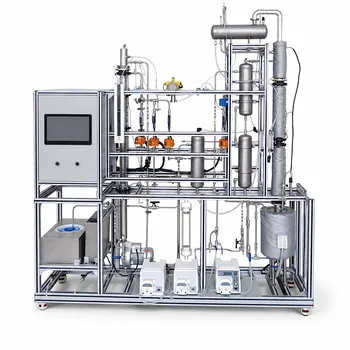
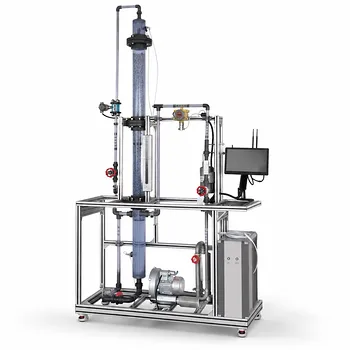
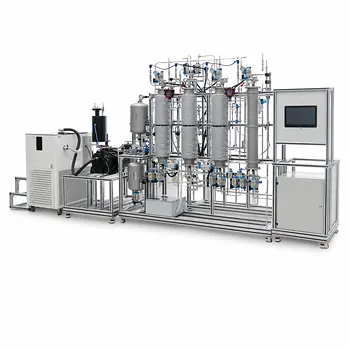
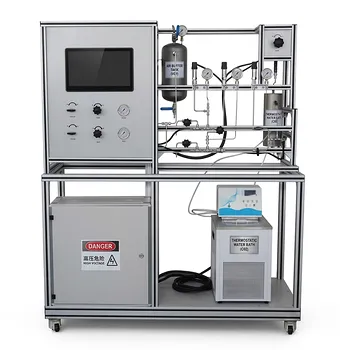
LABPARK provides advanced Educational and Vocational Unit Operations Pilot Plants across chemical engineering, bioprocess & biotech, and environmental & water treatment. Tailored for universities, research institutes, and enterprises, our pilot plants feature industry-standard anti-surge controls and real-time data acquisition to turn operational hazards into powerful, practical learning experiences.
Ready to elevate your engineering labs? Contact LABPARK today to explore our customizable training solutions!
Related Products
- Multi Pump Fluid Transport Process Piping Unit Operations Training Pilot Plant
- Dual-Mode Gas Absorption and Desorption Unit Operations Training Pilot Plant
- Bench Scale Dual Column Gas Separation and Capture Educational Pilot Plant
- Carbon Dioxide Absorption and Desorption Educational Pilot Plant for Carbon Capture Studies
- Chemical Pipeline Assembly and Fluid Transport Practical Training Unit Operations Pilot Plant
People Also Ask
- Why distinguish Newtonian & non-Newtonian fluids in pilot plants? Prevent design errors.
- How do steady-state and dynamic simulations complement pilot plants? Validate scale-up and controllability
- How can unit operations pilot plants demonstrate simultaneous removal of light and heavy impurities? Configure a modular setup
- Why is the chemical plant startup schedule crucial? De-risk scale-up with pilot plants.
- How can chemical engineering students use unit operations pilot plants to study kinetics? Master reactor scale-up!