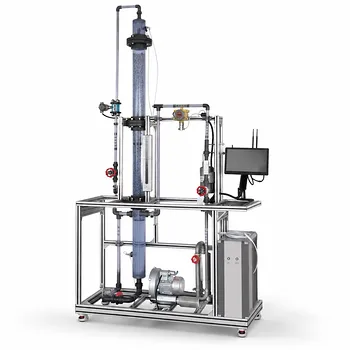
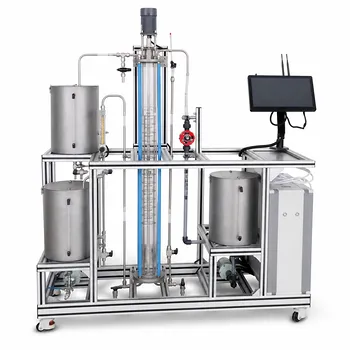
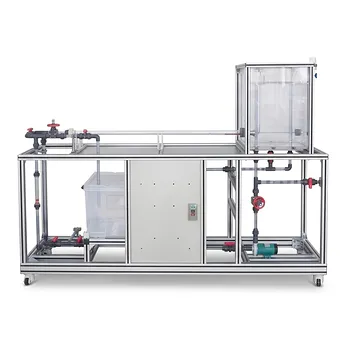
Centrifugal force, not gravity, drives the separation and contact inside an RPB. A Rotating Packed Bed reactor spins a specially designed packing at high speed, creating a radial acceleration tens to hundreds of times stronger than Earth’s gravity. When gas and liquid flow counter‑currently through this spinning zone, the liquid is atomised into exceptionally thin films, micro-droplets, and filaments. That ultra‑fine dispersion delivers gas–liquid contact areas and mass transfer coefficients that are orders of magnitude higher than in a conventional packed column. For a laboratory, this means a process that usually demands a multi‑metre tall tower can be achieved in a benchtop‑scale footprint.
By replacing gravity with a controllable, intense centrifugal field, RPB reactors intensify mass transfer so dramatically that a full column‑scale process fits into a compact, rapid‑startup unit. In an academic or research laboratory, this unlocks faster experiments, minimal inventory of hazardous solvents, and the ability to work with fluids that would degrade, foul, or simply be impractical in a traditional gravity column.
How Centrifugal Force Transforms Mass Transfer
The High‑Gravity (HiGee) Principle in Practice
In a conventional packed bed, gravity pulls liquid downward through a fixed packing. The liquid velocity is limited, and the films remain relatively thick. An RPB flips this on its head. A rotor holding the packing rotates at high speed, generating a centrifugal acceleration ( g' = r \omega^2 ). This artificial high‑gravity field can reach 100–500 g or more, forcing the liquid phase to travel radially outward at velocities impossible under normal gravity.
Shearing Liquid into a Massive Contact Area
As the liquid enters the spinning packing, it hits the surface with enormous force. The packing elements shear the liquid into thin films, tiny droplets, and stretched filaments. Because the liquid inventory is constantly flung into this dispersed form, the effective interfacial area per unit volume is vastly larger than in a stationary column. Simultaneously, the high‑speed relative motion between the phases reduces the liquid‑side and gas‑side mass transfer resistances, making every square centimetre of contact extraordinarily productive.
The Result: Compact, Intensified Mass Transfer
The combination of a much larger specific surface area and higher mass transfer coefficients means that an RPB can deliver the same separation or reaction performance as a column that is 10 to 20 times taller. Even a small laboratory‑scale RPB – often no larger than a desktop centrifuge – can achieve absorption efficiencies that would require a 3‑metre‑tall packed tower. This is the central physical reason why RPBs rewrite the rules for laboratory unit operations.
Why Laboratory Unit Operations Benefit So Dramatically
Extreme Space Savings and a Tiny Footprint
A gravity column needs height. For meaningful separation stages, a pilot‑plant column easily climbs to 2–4 metres. In a university teaching lab or a crowded research facility, that vertical space is a luxury. An RPB delivers the same number of transfer units in a fraction of the height and volume. A unit that would occupy an entire fume hood as a tower can be replaced by a benchtop RPB module, freeing up valuable laboratory real estate.
Speed: Steady State in Minutes, Not Hours
Traditional columns require time to wet the packing, stabilise flow rates, and reach steady operation. An RPB reaches stable hydrodynamic and mass transfer conditions within minutes of startup. For a student lab session or a researcher running a matrix of experiments, this rapid attainment of steady state translates directly into higher throughput. You can run multiple absorption or desorption experiments in the same time a column would still be settling.
Gentle Handling of Heat‑Sensitive and Viscous Feeds
The extremely low liquid holdup and short residence time (often just a few seconds) inside an RPB are a major advantage when working with delicate materials. Temperature‑sensitive pharmaceuticals, flavours, or monomers spend almost no time at process temperature. Similarly, high‑viscosity fluids that would channel and coat a gravity column can be effectively dispersed under the high shear of the centrifugal field, enabling mass transfer with feeds that traditional columns could barely handle.
A Modern Educational and Research Workhorse
For teaching mass transfer fundamentals, the RPB provides a visceral, easily controllable demonstration of intensified unit operations. Students can instantly see the effect of rotational speed on separation efficiency. Researchers benefit from the ability to screen process conditions rapidly with minimal solvent waste, thanks to the low holdup and fast dynamics. The compact unit also integrates easily into modular pilot‑plant setups, making it a favourite for studying absorption, desorption, stripping, and reactive separation processes in a single, safe enclosure.
Understanding the Trade‑offs
Despite their powerful advantages, RPBs are not a universal drop‑in replacement for every gravity column. Being aware of the limitations ensures you apply the technology where it truly shines.
Mechanical Complexity and Energy Demand
An RPB introduces a motor, bearings, and a rotating seal. These moving parts require maintenance, consume electrical energy, and can be a source of vibration or noise. In a simple gravity column, the only energy input may be a small liquid pump; an RPB always adds the power demand of the rotor. For the smallest, low‑flow teaching demonstrations, a simple wetted‑wall or packed column can be a cheaper, mechanically simpler alternative.
Not All Feeds Like High Shear
The intense shear that creates the fine dispersion can be problematic if you are handling high‑solids slurries, fibrous materials, or easily‑emulsified mixtures. Solids may accumulate in the packing, causing unbalance or clogging. Heavy fouling services that are manageable in an open gravity column can rapidly degrade RPB performance and require more frequent cleaning.
Scaling Rules Differ from Traditional Columns
While RPBs excel at laboratory and pilot scale, scaling the technology to very large industrial diameters is not a simple linear extrapolation of column height. The mechanical design of large‑diameter rotating equipment, containment of high‑speed rotors, and uniform distribution across a wide bed introduce engineering challenges that are still the subject of active research. However, for the laboratory scale that unit operations labs target, these concerns do not apply – an RPB is purpose‑built for that size regime.
When the Status Quo Works Better
If you only need a single‑stage contactor, or you are teaching the absolute simplest form of mass transfer, a traditional bubble column or a short packed section may be more than sufficient. The RPB’s extra cost and complexity are justified only when you need its intensification benefits or its ability to handle tricky fluids. Over‑engineering a simple demonstration with an RPB can distract from the core learning objective.
Making the Right Choice for Your Lab
The decision to integrate an RPB or stick with a gravity column depends entirely on what you are trying to achieve. Use the following goal‑oriented guide to focus your evaluation.
- If your primary focus is maximising limited lab space and running many experiments quickly: An RPB is your ideal candidate. Its compact, rapidly self‑stabilising design will transform your throughput while fitting into even the most crowded fume hood.
- If your primary focus is processing heat‑sensitive or high‑viscosity fluids: Choose an RPB. The low holdup, ultra‑short residence time, and high‑shear dispersion directly address the degradation and flow problems that cripple gravity columns.
- If your primary focus is teaching modern process intensification with hands‑on, fast‑feedback experiments: An RPB pilot plant turns abstract concepts into tangible, adjustable demonstrations. Students can observe the direct effect of rotational speed within a single lab period.
- If your primary focus is a low‑cost, low‑maintenance setup for simple, clean liquid–gas contact at very small scale: A conventional packed column may still serve you well. Reserve the RPB for where its intensification power genuinely changes what is possible in your laboratory.
The RPB doesn’t just shrink a column – it reimagines what a unit operation can be. By matching the tool to your deepest experimental need, you can turn a space‑saving piece of equipment into a genuine accelerator for learning and discovery.
Summary Table:
| Feature | Rotating Packed Bed (RPB) | Traditional Gravity Column |
|---|---|---|
| Driving Force | Centrifugal force (HiGee field) | Gravity |
| Footprint & Size | Compact benchtop module | Tall vertical tower (2–4 meters) |
| Startup Time | Reaches steady state in minutes | Requires hours to stabilize |
| Fluid Suitability | Ideal for viscous & heat-sensitive feeds | Prone to channelling and thermal degradation |
Accelerate Your Laboratory Research and Education with LABPARK
Are you looking to optimize your chemical engineering, bioprocess, or environmental laboratories? LABPARK provides state-of-the-art Educational and Vocational Unit Operations Pilot Plants designed specifically for universities, research institutes, and enterprises.
Our advanced modular systems—spanning chemical engineering, bioprocess & biotech, and environmental & water treatment—help you save valuable space, minimize hazardous solvent waste, and deliver hands-on learning experiences.
Contact LABPARK today to discuss your pilot plant requirements with our application specialists!
Related Products
- High-Gravity Emulsification and Mass Transfer Educational Pilot Plant
- Micro-Scale Gas-Solid Catalytic Reaction Educational Pilot Plant
- Packed Bed Absorption Educational Unit Operations Pilot Plant
- Fixed-Bed Chemical Reaction and Gas Dust Tar Removal Unit Operations Pilot Plant
- Multi Functional Catalytic Reaction and Reactor Evaluation Educational Unit Operations Pilot Plant
People Also Ask
- How to update chemometric calibration models in pilot plants? Best practices for process engineers.
- Why is Peng-Robinson preferred over SRK? Enhance thermodynamic modeling in educational pilot plants.
- Why is continuous measurement preferred over manual sampling in pilot plants? Get real-time kinetic insights.
- How does temperature affect mass transfer rates in chemical engineering educational pilot plants?
- Why Compare Membrane-Reservoir Models with Pilot Plant Data? Ensure Successful Process Scale-Up