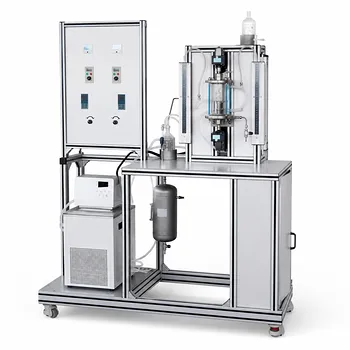
The mechanism behind intensified heat and mass transfer in an impinging streams reactor (ISR) is straightforward: two opposing high-velocity fluid streams collide head-on, creating a zone of extreme turbulence and shear.
In that narrow impingement region, droplets, bubbles, or particles are violently broken apart, maximizing interfacial contact area. Simultaneously, the collision drives large relative velocities between phases and causes particles to oscillate repeatedly across the impingement plane. These physical effects directly boost the key transport coefficients—heat and mass move orders of magnitude faster than they do in a gently stirred vessel.
The ISR’s intensification comes from a controlled, violent collision that pulverizes phases, supercharges relative motion, and forces phases to interpenetrate continuously. In pilot plants, this translates to a compact module where students can visually and quantitatively see how a tiny reaction zone can match or beat a large stirred tank, making process intensification tangible.
The Physical Mechanism That Drives the Intensification
The Collision Point Becomes a Furnace of Turbulence
Two opposing streams, often carrying gas and liquid or liquid and solid particles, meet at speeds that can exceed 20 m/s.
The head-on impact transforms linear kinetic energy into intense turbulent kinetic energy within a narrow, disk-like zone.
This turbulence generates eddies that shrink the boundary layers around particles and droplets, slashing the resistance to heat and mass transfer.
Relative Velocity Does the Heavy Lifting
High turbulence creates large slip velocities between the continuous and dispersed phases.
According to fundamental transport equations, a higher relative velocity directly increases the convective contribution to heat transfer (Nusselt number) and mass transfer (Sherwood number).
What would require a massive stirred tank with high power input can be achieved in a small ISR volume simply because the collision multiplies the effective velocity differential.
Droplet and Bubble Breakup Maximizes Area
In multiphase streams, the intense shear stress in the impingement zone shatters droplets and bubbles into vastly finer sizes.
Interfacial area per unit volume (a) skyrockets, and since mass transfer rate is proportional to the product kL×a, even a modest increase in the mass transfer coefficient kL is amplified into a dramatic leap in overall transport.
Similarly, the large surface-area-to-volume ratio of the fragmented phases feeds higher heat transfer rates, as there is more contact surface to exchange thermal energy.
Oscillatory Penetration: The Phase That Refuses to Stay Still
Particles and droplets don’t just meet once; they can overshoot the impingement plane and then be pushed back by the opposing stream.
This oscillatory motion forces each particle to re-enter and re-cross the high-turbulence zone several times, effectively increasing its residence time in the region of highest transport intensity.
The result is a further boost in conversion per unit volume, because the active material keeps returning to the most mixing-intensive location.
How a Chemical Engineering Pilot Plant Brings the Mechanism to Life
The ISR Module Turns Equations into Observation
A pilot-plant ISR is typically a transparent or well-instrumented vessel where students can control the velocity and phase ratios of the two inlet streams.
High-speed cameras or probes capture the impingement zone, making the turbulent curtain and droplet breakup directly visible.
This immediacy turns abstract transport theory into something a student can see happening in real time.
Direct Measurement of the Intensification Effect
Laboratory ISRs are fitted with thermocouples and concentration sensors along the impingement zone and at the outlet.
By varying the collision velocity, students plot how the overall mass transfer coefficient (kLa) or the heat transfer coefficient (U) changes with Reynolds number of the streams.
The data typically show an exponential-like rise, confirming that the turbulent collision—not just bulk mixing—is the driver of performance.
The Benchmark Test: ISR vs. Stirred Tank
A classic pilot-plant exercise places the ISR side by side with a conventional stirred tank reactor operating on the same reaction.
Under identical feed conditions, the ISR routinely achieves the same conversion in a fraction of the reactor volume, often with lower energy input.
Students then calculate the “intensification factor,” making the concept of process intensification—smaller, safer, cheaper equipment—concrete and quantifiable.
Demonstrating the Principle of Decoupled Energy Demand
An ISR pilot plant shows that you don’t need a massive heating jacket or prolonged stirring to overcome transport limitations.
The collision itself supplies the mixing power where it matters most: right at the point of contact between phases.
This teaches an essential lesson for future plant designers: intensification is about placing energy exactly where the transport resistance exists, not spreading it across a large tank volume.
Understanding the Trade-offs: When the Impingement Zone Is No Panacea
Pressure Drop and Pumping Costs
Generating the 20+ m/s stream velocities requires significant upstream pressure.
The energy needed to drive pumps or compressors can be substantial, and for certain large-scale applications, this parasitic load may erode the gains from a smaller reactor size.
In a pilot plant, students measure the power draw and learn that intensification always carries a utility cost that must be weighed against capital savings.
Scale-Up and Residence Time Control
The impingement zone is small, so the mean residence time can be extremely short.
This makes ISRs ideal for fast, mixing-limited reactions, but less suitable for slow reactions that need minutes or hours of contact.
Scaling up also poses a challenge: creating two perfectly opposed, uniform streams in a large-diameter industrial vessel is not trivial and can lead to bypassing or uneven mixing.
Limited to Certain Phase Combinations
ISRs work best when both streams can be brought to high velocity without clogging or erosion.
Slurries with large, abrasive particles or highly viscous fluids can defeat the impingement design.
Pilot plant demonstrations often highlight the narrow window of operability, underscoring that process intensification is not a one-size-fits-all solution.
Making the Right Choice for Your Unit Operations Lab
Depending on the core lesson you want to reinforce, you can exploit the ISR module in a few targeted ways:
- If your primary focus is teaching transport fundamentals: Use the ISR to let students vary collision velocity and directly measure how kLa scales with specific power input, reinforcing the link between turbulence and transfer coefficients.
- If your primary focus is process intensification and footprint reduction: Set up a direct comparison between the ISR and a stirred tank; task students with calculating the volume reduction factor and the energy trade-off to illustrate the real meaning of intensification.
- If your primary focus is reaction engineering and selectivity: Operate the ISR with a fast parallel-consecutive reaction scheme; the short, intense contact time will suppress byproducts better than a back-mixed tank, showing how mixing time directly influences yield.
- If your primary focus is pilot-plant safety and chemical inventory: Highlight that the ISR’s tiny active volume holds less hazardous material at any instant, driving home the inherent safety advantage of intensification.
A well-designed ISR pilot module takes the abstract promise of “do more with less” and makes it a measurable, visual, and unforgettable lesson.
Summary Table:
| Intensification Mechanism | Physical Action | Impact on Transport / Pilot Plant Value |
|---|---|---|
| Turbulent Collision | Opposing streams collide head-on at >20 m/s | Slashes boundary layer resistance; converts kinetic energy to turbulence. |
| High Relative Velocity | Large slip velocity between phases | Directly increases convective heat (Nusselt) and mass (Sherwood) transfer. |
| Droplet/Bubble Breakup | Intense shear shatters dispersed phases | Skyrockets interfacial area ($a$), amplifying overall transport rates ($k_La$). |
| Oscillatory Penetration | Particles cross the impingement plane repeatedly | Extends residence time in the highest turbulence zone for higher conversion. |
Bring Process Intensification to Your Lab with LABPARK
Are you looking to bridge the gap between abstract transport theory and hands-on engineering? LABPARK designs and manufactures premium Educational and Vocational Unit Operations Pilot Plants in chemical engineering, bioprocess & biotech, and environmental & water treatment.
Our hands-on pilot systems enable universities, research institutes, and enterprises to:
- Visualize Complex Dynamics: Observe turbulence, phase breakup, and reactor performance in real time.
- Quantify Efficiency: Compare advanced reactor designs like ISRs directly against conventional stirred tanks.
- Ensure Operational Safety: Experience scale-down safety benefits with lower chemical inventories.
Ready to elevate your engineering curriculum or research capabilities? Contact LABPARK today to find the perfect pilot plant solution for your facility!
Related Products
- Multi-Stage Stirred Tanks in Series Residence Time Distribution and Mixing Performance Determination Educational Pilot Plant
- Residence Time Distribution and Reactor Flow Characteristics Determination Educational Pilot Plant
- Educational Unit Operations Pilot Plant for Intraparticle Diffusion Effective Factor Measurement
- Internal Circulation Gradient Free Catalytic Reaction Educational Pilot Plant
- Dual-Drive Stirred Gas-Liquid Mass Transfer Coefficient Determination Pilot Plant
People Also Ask
- CSTR Multiplicity: Which physical variables map to universal unfolding?
- How does impeller configuration affect RTD & reactor performance? Optimize mixing and conversion in pilot plants.
- How do multiple CSTRs in series affect stability? Master Complex Pilot Plant Dynamics
- How does MRF model impeller rotation in CFD? Key Boundary Conditions Explained
- How can a CSTR pilot plant demonstrate reactor staging? Visualize volume savings.