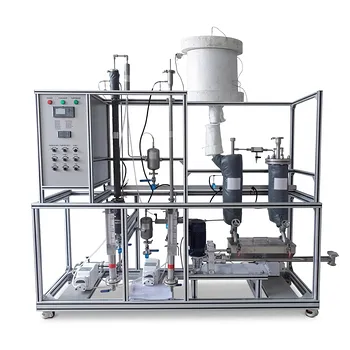
Steam is the lifeblood of the chemical process industry. Incorporating a steam generator unit operation pilot plant answers a critical educational need: it bridges the gap between thermodynamic theory and the industrial utility systems that power over 80% of all chemical separations. Students gain irreplaceable hands-on experience in how steam is generated using fuel gas burners and tube‑side heating, and they see firsthand how that steam drives turbines, creates near‑absolute vacuum for distillation, and acts as a stripping medium—all while learning to manage the essential auxiliary operations of condensate recovery, cooling water circulation, and waste heat recovery.
Core Takeaway: A steam generator pilot plant transforms steam from a textbook concept into a tangible, integrated system. It does far more than simply produce steam; it teaches students to operate the full steam‑condensate loop, manipulate real vacuum jets and turbines, and manage the auxiliary utilities that determine plant efficiency—exactly the systems‑level mindset required in every modern refinery and chemical plant.
Why Steam is the Cornerstone of Industrial Education
The Ubiquitous Utility That Can’t Be Simulated on a Bench
Chemistry is fundamentally an experimental science, but standard laboratory glassware cannot replicate the fluid dynamics, mass transfer limitations, or energy distribution challenges of commercial‑scale operations. Steam is the universal heating medium used for reactor jackets, reboilers, and tracing, yet its behavior at a pilot scale—the hammer, the quality changes, the traps—cannot be understood through simulation alone. A steam generator plant lets students see how fuel gas burners and tube‑side heating convert water into the driving force behind entire production trains.
Bridging the Gap Between the Classroom and the Control Room
Educational pilot plants replicate industrial flows by organizing systems into modular units: raw material preparation, reaction, separation, and post‑treatment. The steam generator becomes the heart of that modular plant. It exposes students to the intermediate scale‑up challenges that kilo‑lab and pilot‑plant training address, such as thermal efficiency losses and pressure control, which simply do not exist in a round‑bottom flask. This direct manipulation of a live steam system gives students an operator’s intuition for process safety, energy integration, and real‑time decision‑making.
The Hands‑On Learning Experience: More Than Just Making Steam
Mastering the Full Steam Cycle: From Fuel to Condensate Return
A proper training setup goes beyond the boiler shell. Students interact with a surge high‑pressure steam drum, a deaerator, feed pumps, and a condensate receiving system. The primary reference details the key loop: generating steam via fuel gas burners, then recovering condensate and managing cooling water. When students physically trace the condensate back, they master why water treatment and waste heat recovery are not afterthoughts but integral to plant economics and sustainability. The unit becomes a live laboratory for heat transfer calculations, where they can measure heat loss and condensation efficiency directly.
Driving Critical Unit Operations with Steam
The true educational power lies in how the steam is used. As the primary source highlights, steam powers turbines and vacuum jets to produce near‑absolute vacuums in distillation. Students see that vacuum distillation is not just a pump—it is a steam‑driven ejector system whose performance depends on steam pressure and quality. Similarly, using steam as a stripping medium in a crude column demonstrates vapor‑liquid equilibrium in action: the carrier gas lowers the boiling point, exactly the principle extended to steam distillation for releasing ammonia from samples. By connecting steam generator output to a working distillation column, students witness the direct cause‑and‑effect between energy input, separation efficiency, and final product purity.
Real‑Time Process Control and Instrumentation
Modern educational pilot plants integrate industrial‑grade instruments. With a steam generator, students manipulate fuel‑gas flow, drum level, and steam pressure while observing the impact on downstream operations. This environment is perfect for applying Quality by Design (QbD) principles—categorizing variables as controllable, noise, or experimental—and for designing experiments (DoE) to map the operating envelope. They might use an online spectrophotometer to verify product purity while varying steam rate, cementing the link between the Lyman/Balmer‑series data and real‑time process monitoring.
Understanding the Trade‑offs of Pilot‑Scale Steam Systems
Complexity and Maintenance Demands Over a Simple Heater
A steam generator brings boiler water chemistry, blowdown, safety relief valves, and fuel‑handling logistics into the curriculum. While these teach crucial industrial hygiene, they also demand significant instructor effort and rigorous standard operating procedures. Without a dedicated technician and a structured maintenance schedule, the system can become a source of frustration rather than insight. The educational value therefore hinges on institutional commitment to maintaining the unit as a true learning asset.
Cost and Space Versus the Tangible Payoff
A steam pilot plant is capital‑intensive and consumes valuable floor space, utilities, and fuel. Process simulation software can model many steam‑system behaviors at a fraction of the cost. However, no simulation can replicate the sound of a leaking steam trap, the shudder of condensate hammer, or the split‑second judgment required to safely shut down an unstable boiler. The trade‑off is between immediate affordability and the unmatched experiential learning that builds confident, job‑ready engineers who have already felt—not just calculated—a steam system’s demands.
Safety Hazards That Teach Process Safety Culture
High‑pressure steam, flammable fuel gas, and hot surfaces introduce real‑world hazards that demand pre‑startup safety reviews, lock‑out‑tag‑out, and personal protective equipment. This imposes a necessary level of supervision and restricts unsupervised exploration. Paradoxically, this is also a profound educational benefit: it forges a genuine safety culture. Students leave respecting the energy stored in a live steam drum, a lesson that transfers directly to the hydroprocessing units and fractionators they will operate in industry.
Making the Right Choice for Your Curriculum
How you integrate a steam generator pilot plant should reflect your program’s core goals. The following recommendations can help you maximize its educational return.
- If your primary focus is producing job‑ready process engineers: Make the steam generator the backbone of a capstone unit‑ops lab. It teaches the utility ecosystem every refinery relies on, giving students direct experience with turbines, vacuum jets, and condensate return that employers immediately recognize.
- If your primary focus is reinforcing thermodynamics and heat transfer fundamentals: Use the plant as a live measurement station. Students can quantify fuel efficiency, calculate steam quality, and compare measured heat losses to theoretical predictions, grounding abstract equations in tangible data.
- If your primary focus is advanced process control and automation: Integrate the steam system with a distributed control system. Allow students to tune PID loops on drum level, fuel‑gas pressure, and steam header pressure, delivering a true hands‑on control‑theory experience that screen‑only simulations cannot match.
- If your primary focus is research on separation processes like steam distillation: Use the generator as a platform to explore vapor‑liquid equilibrium and heat integration. Students can correlate steam injection rate with distillate purity, bridging analytical chemistry and industrial column operation in a single, cohesive experiment.
By investing in a steam generator pilot plant, you are not simply teaching steam—you are cultivating the systems‑level thinking, practical troubleshooting skills, and safety instinct that separate a competent chemical engineer from a textbook‑trained theorist.
Summary Table:
| Key Aspect | Industrial Relevance | Educational Value |
|---|---|---|
| Full Steam Loop | Replicates commercial-scale utility systems, deaeration, and condensate recovery | Builds system-level thinking and understanding of plant efficiency |
| Unit Operations | Drives critical operations like vacuum distillation and steam stripping | Demonstrates thermodynamics and vapor-liquid equilibrium in real time |
| Process Control | Features industrial-grade instrumentation and PID loop tuning | Provides hands-on experience in process automation and QbD principles |
| Safety & Operations | Manages high-pressure steam, flammable fuels, and startup reviews | Establishes a strong safety culture and practical troubleshooting skills |
Elevate Your Engineering Curriculum with LABPARK
Prepare your students for real-world industrial success by bringing textbook theory to life. LABPARK designs and manufactures premium Educational and Vocational Unit Operations Pilot Plants in chemical engineering, bioprocess & biotech, and environmental & water treatment. We help universities, research institutes, and enterprises build safe, hands-on learning environments that cultivate job-ready engineers.
Ready to transform your laboratory or training facility? Contact us today to explore our custom pilot plant solutions!
Related Products
- Steam Methane Reforming Hydrogen Production and Purification Educational Pilot Plant
- Dual Mode Heat Transfer Pilot Plant for Unit Operations Training
- Three-Tube Heat Transfer Educational Pilot Plant for Unit Operations Training
- Multi-Reactor Educational Pilot Plant for Reaction Engineering Unit Operations
- Natural Product Extraction Unit Operations Training Pilot Plant
People Also Ask
- How does integrating unit operations impact pilot plant thermal efficiency & CO management? Key design insights.
- How Do Temp, Pressure & S:C Ratio Affect Methane Reforming? Optimize Your Pilot Reactor
- In educational chemical engineering pilot plants, why use absorption and adsorption before reforming?
- SMR, POX, or ATR? Trade-offs in Hydrogen Production Educational Pilot Plants
- What are steam reforming pilot plant challenges? Master Feedstock Selection & Design