The constant molar overflow (CMO) assumption is the simplifying rule that makes classical McCabe-Thiele stage analysis practical. It states that the molar flow rates of liquid and vapor remain constant within the rectifying section and within the stripping section of a distillation column. For students analyzing pilot‑plant data, this assumption can dramatically simplify the graphical determination of theoretical stages, but it fails whenever the column loses significant heat or the components’ latent heats differ markedly. Recognizing those failure points transforms raw experimental numbers into a meaningful engineering judgment about which analytical method to trust.
CMO assumes equal molar vaporisation and negligible energy losses, giving you straight operating lines. In a real unit‑operations pilot plant, uninsulated walls or dissimilar latent heats can bend those lines into curves. Your core task as an analyst is to first assess whether CMO holds—by checking the thermal profile and energy balances—before you choose between the simplicity of McCabe‑Thiele and the rigor of Ponchon‑Savarit or simulation.
What Is the Constant Molar Overflow Assumption?
The Definition in Practice
CMO means that for every mole of vapor condensed, exactly one mole of liquid is vaporised, leaving the molar flows of both phases unchanged across each column section. This allows you to draw straight operating lines on an x‑y diagram using simple material balances, without solving heat effects at every tray.
Why It Matters for McCabe‑Thiele
Without constant molar flows, the operating lines would shift at every stage. CMO eliminates that complexity, letting you step off stages graphically. It is the invisible backbone that makes the McCabe‑Thiele method a quick, teachable tool.
Why Does CMO Fail in a Unit Operations Pilot Plant?
Unequal Latent Heats of the Components
The assumption crumbles if the mixture’s components have significantly different molar heats of vaporization. A mole of a high‑latent‑heat substance condensing releases more energy than is needed to vaporize a mole of a lower‑latent‑heat substance. The result is a progressive change in molar flows that bends the operating lines—something a straight‑line method cannot capture.
Heat Losses Along the Column Wall
Pilot‑plant columns are often uninsulated or only partially insulated. Even modest heat losses to the surroundings add a cooling duty that is not accounted for in the simple CMO model. This effect acts like an extra internal condenser, reducing the internal vapor rate in the rectifying section or increasing liquid reflux, again warping the operating lines away from linearity.
How to Diagnose When CMO Breaks Down
Read the Thermal Profile
Your first diagnostic tool is the column’s temperature profile. Install sensors to record steady‑state temperatures along the shell. Sharp, unexplained temperature drops or a profile that does not match the expected boiling‑point progression of the mixture often signals that heat is leaking out, violating the adiabatic assumption behind CMO.
Perform an Energy Balance Audit
Go directly to the source: measure the actual duties in the reboiler and condenser, then compare them against the theoretical needs of the separation. If the condenser is removing substantially less heat than the reboiler supplies, the difference is lost through the column wall. That imbalance is a clear red flag that CMO no longer holds and that you must abandon straight operating lines.
Consequences for Analysis: From Simple Lines to Complex Curves
Operating Lines Become Curved
When CMO fails, the operating lines on the x‑y diagram are no longer straight. They curve downward in the rectifying section or upward in the stripping section, reflecting the changing internal vapor and liquid traffic. Trying to force a McCabe‑Thiele step‑off on a curved line introduces systematic error in the calculated number of stages.
Methods Beyond McCabe‑Thiele
To accurately model the pilot‑plant’s performance under these real conditions, you must switch to enthalpy‑concentration methods like the Ponchon‑Savarit technique or to process simulation software. These tools account for the actual heat released or absorbed at each stage, yielding realistic stage counts and compositions when CMO fails.
Understanding the Trade‑offs
The Comfort of Simplicity vs. Physical Reality
CMO is seductive because it turns a complex energy and mass balance problem into a few quick lines on a graph. In many classroom examples, the assumption is perfectly adequate. However, in a real pilot plant—especially with exotic mixtures or a drafty lab—the simplicity comes at the cost of accuracy. Choosing an inappropriate method is worse than acknowledging the limitation; it can give you a false sense of confidence in an experimental result.
Additional Complexity That CMO Masks
Even if latent heats are similar, CMO ignores small but cumulative effects like heats of mixing and sensible heat differences. These become relevant when you try to validate a thermodynamic model against pilot data. Overlooking them can lead to a mismatch that is later blamed on faulty sensors, when in truth the analytical model itself was oversimplified.
Making the Right Choice for Your Experimental Data
Your decision should hinge on what you want to learn from the pilot plant and how much deviation you can tolerate.
- If your primary goal is an educational first‑pass stage estimate: Acknowledge CMO as an assumption, use McCabe‑Thiele, but explicitly state that the result is an idealized baseline. Then, discuss what would change with heat losses.
- If your primary goal is a rigorous performance benchmark: First, audit the column’s energy balance. If the heat loss is minor (within a few percent), a corrected McCabe‑Thiele constant‑overflow approximation may still serve. If the loss is significant, switch to Ponchon‑Savarit or a simulator.
- If your primary goal is to identify the root cause of a deviation between theory and experiment: Let the thermal profile and energy imbalance guide you. A curved operating line is not just a nuisance—it directly reveals whether the column needs better insulation or whether the mixture’s thermophysical properties demand a more advanced model.
Treat the constant molar overflow assumption as a deliberate choice, not a default. The moment you check its validity against your own pilot‑plant data, you move from blindly applying a formula to truly understanding the soul of the column.
Summary Table:
| Parameter | CMO Assumption (Ideal) | Real Pilot Plant Reality |
|---|---|---|
| Molar Flow Rates | Constant within each column section | Vary due to component latent heat differences |
| Energy Losses | Negligible (adiabatic operation) | Heat loss through uninsulated column walls |
| Operating Lines | Straight lines on x-y diagram | Curved lines (systematic errors if forced straight) |
| Recommended Analysis | McCabe-Thiele method | Ponchon-Savarit or computer simulation |
Bridge Theory and Practice with LABPARK
Are you looking to provide your students or researchers with hands-on experience that goes beyond idealized textbook assumptions?
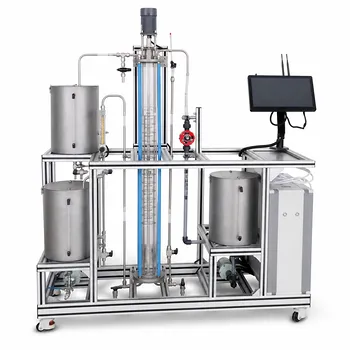
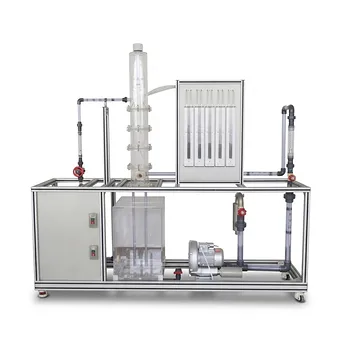
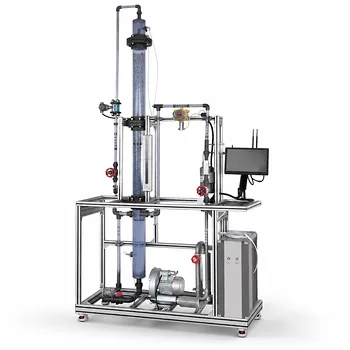
LABPARK provides premium Educational and Vocational Unit Operations Pilot Plants in chemical engineering, bioprocess & biotech, and environmental & water treatment. Tailored for universities, research institutes, and enterprises, our pilot plants feature advanced thermal monitoring and realistic column dynamics to help users accurately diagnose heat losses and master complex distillation analysis.
Ready to elevate your engineering lab? Contact our team today to find the perfect pilot plant solution for your institution.
Related Products
- Continuous Sieve-Plate Distillation Pilot Plant for Unit Operations Laboratory Education
- Multi-Functional Special Distillation Educational Pilot Plant
- Multi-Modal Distillation Unit Operations Training Pilot Plant
- Continuous Batch Extractive Distillation Educational Pilot Plant
- Dual-Mode Rectification Pilot Plant for Practical Training Unit Operations
People Also Ask
- How does catalyst water concentration affect distillation pilot plant design? Key separation train choices.
- What are the primary reflux ratio control strategies? Master Distillation Unit Operations
- Why is vacuum operation capability an essential feature for a distillation unit operations pilot plant? Unlock Efficiency
- How to select the right activity coefficient model (Wilson, NRTL, UNIQUAC) for distillation pilot plants?
- How can real-time carbon number prediction improve distillation pilot plants? Optimize control.