Knowledge Chemical Engineering Education What is instrument hysteresis and its impact on pilot plant control loops? Optimizing process stability.
Author avatar

Tech Team · LABPARK

Updated 1 month ago

What is instrument hysteresis and its impact on pilot plant control loops? Optimizing process stability.


At its core, instrument hysteresis is a subtle but destructive form of measurement error. It’s the maximum difference in a sensor’s reading when the exact same process condition is approached from opposite directions—first increasing, then decreasing. In automated biotech or environmental pilot plants, this phenomenon directly degrades control loop performance by introducing a hidden deadband that forces valves, pumps, and dosing systems to overcompensate, leading to instability, batch inconsistency, and corrupted experimental data.

The hidden threat of hysteresis lies not in its magnitude but in its directional memory. It decouples the controller’s action from the plant’s true state, making every corrective move a guess. For pilot-plant operators, this means the difference between a reproducible process insight and a set of untrustworthy results.

Understanding Instrument Hysteresis

What It Really Means for a Measurement

Hysteresis is an error in repeatability. When a pH probe reads 7.00 as you buffer upward but 6.85 as you drift back down to the same condition, the 0.15 difference is the hysteresis.
This gap is not random noise—it’s a systematic lag caused by the sensor’s inability to respond identically in both directions.
Crucially, the controller sees only the current reading, never the direction of approach. That blindness is where the trouble begins.

Where It Comes From in Pilot-Plant Sensors

Mechanical friction and elastic deformation are the most common culprits. In a magnetic flow meter, worn bearings or build-up on electrodes cause the signal to stick.
In pressure transmitters, over-pressurization can introduce material fatigue that shifts the zero point depending on pressure history.
Even solid-state sensors like pH glass electrodes suffer from ion-exchange memory effects if not properly conditioned, mimicking mechanical hysteresis.

The Domino Effect on Control Loops

The Deadband That Kills Responsiveness

A PID controller calculates an error, then commands a pump or valve to correct it. But when a sensor is stuck in a hysteresis deadband, small true deviations go undetected.
The controller waits until the process drifts far enough to break through that deadband—by which point the error is already oversized. The result is a control loop that is always late and always too aggressive.

Overshoot and Oscillation: The Vicious Cycle

Once the sensor finally reports the change, the controller slams the final control element to compensate for the accumulated error.
That violent correction overshoots the setpoint. Now the process reverses direction, and the sensor’s hysteresis flips its error sign, tricking the controller into another overreaction.
You see this as a persistent oscillation that no amount of tuning can eliminate—the root cause is in the instrument, not the PID parameters.

Why Pilot-Plant Data Becomes Untrustworthy

Pilot plants exist to generate data for scale-up decisions and regulatory filings. Hysteresis introduces a directional bias into every logged value.
If a critical parameter like dissolved oxygen or pH is reported with a ±0.2 hysteresis, your kinetic models or yield calculations become contaminated with an error you cannot back-calculate out.
The system may appear to meet its control performance metrics while silently producing experimentally invalid data.

The Trade-off Between Perfection and Practicality

When Hysteresis Is Acceptable

Not all loops demand nano-scale precision. A utility water temperature loop with a wide operating band can tolerate moderate hysteresis without any functional impact.
The real danger zone is in fast, tight loops where product quality or biological activity hinges on a narrow setpoint—pH control in mammalian cell culture or nutrient dosing in activated sludge.

The Real Cost of Chasing Zero Hysteresis

Specifying instruments with negligible hysteresis (like premium Coriolis meters or laser-based analyzers) comes with a steep price tag and often higher maintenance sensitivity.
The goal is not zero hysteresis; it’s keeping the installed variation below the total allowable loop error. Over-specifying everywhere drains capital without adding value to the experiment.

The Silent Aggravator: Installation and Aging

Even a perfect sensor will develop hysteresis if it’s installed with excessive stress on process connections or exposed to vibration.
Aging is also directional: a worn-out valve positioner adds its own mechanical hysteresis, which stacks with the sensor’s error to create a combined deadband far larger than expected.

Making the Right Choice for Your Pilot Plant

Apply a risk-based approach to every instrument in a critical control loop. Match the hysteresis specification to the loop’s true tolerance, and never ignore the installation factors.

  • If your primary focus is regulatory-compliant or IP-critical data generation: Treat every percentage point of hysteresis as a direct threat to data integrity. Commission instruments with documented hysteresis values and validate the entire loop’s dynamic error budget before starting trials.
  • If your primary focus is maximizing process stability for delicate biological systems: Mandate hysteresis testing during loop checks, and select sensors with proven repeatability under your specific process conditions. A digital pH sensor with predictive diagnostics is worth its premium.
  • If your primary focus is cost-effective, multi-purpose pilot operation: Set a practical hysteresis ceiling based on the tightest loop you run. Use that ceiling as a pass/fail gate during procurement, but avoid the temptation to chase a single “perfect” number for every tag.

Hysteresis never disappears on its own, but a well-defined instrument specification and a keen eye for deadband during tuning can transform a frustrating pilot plant into a reliable source of truth.

Summary Table:

Aspect Impact on Control Loops Recommended Solution
Causes Mechanical friction, sensor aging, ion-exchange memory. Regular calibration & predictive diagnostics.
Consequences Loop deadband, overshoot, persistent oscillations. Risk-based loop testing & precise tuning.
Critical Loops Compromises data integrity & process yield (e.g., pH, DO). Specify low-hysteresis premium instruments.
Utility Loops Negligible effect on slow-response systems (e.g., water temp). Use standard instruments to optimize cost.

Optimize Your Pilot Plant’s Control and Data Accuracy with LABPARK

Eliminate measurement errors and ensure reliable scaling data for your research. LABPARK provides state-of-the-art Educational and Vocational Unit Operations Pilot Plants in chemical engineering, bioprocess & biotech, and environmental & water treatment.

Designed specifically for universities, research institutes, and enterprises, our systems feature high-precision instrumentation configured to minimize hysteresis and guarantee process stability.

Ready to elevate your laboratory's capabilities? Contact LABPARK today to discuss your custom pilot plant requirements!

Related Products

People Also Ask

Related Products

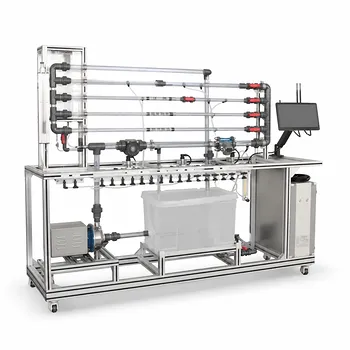
Fluid Friction Resistance Determination Educational Unit Operations Pilot Plant

Fluid Friction Resistance Determination Educational Unit Operations Pilot Plant

Engineered bench-scale system for university engineering labs. Provides hands-on fluid mechanics experience: quantitative energy loss analysis, flow regime observation, friction coefficient determination. Features four-point pressure measurement, transparent sections, industrial touchscreen PLC, 3D virtual simulation. Ideal for chemical, mechanical, civil engineering.

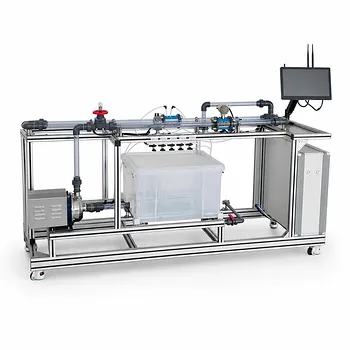
Orifice and Venturi Flowmeter Calibration Educational Pilot Plant for Fluid Mechanics Laboratory

Orifice and Venturi Flowmeter Calibration Educational Pilot Plant for Fluid Mechanics Laboratory

Enhance fluid dynamics education with the Orifice and Venturi Flowmeter Calibration Educational Unit Operations Pilot Plant, featuring transparent orifice and Venturi meters, industrial sensors, touchscreen interface for real-time data analysis and automatic coefficient calculations in engineering student laboratories.

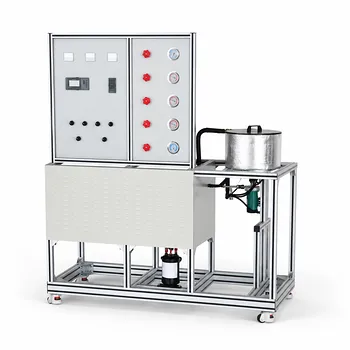
Educational Compression Refrigeration Performance Determination Unit Operations Pilot Plant

Educational Compression Refrigeration Performance Determination Unit Operations Pilot Plant

This educational pilot plant for compression refrigeration performance determination offers dual COP evaluation, regenerative cycle comparison, and calorimeter calibration. Customizable for curriculum integration, it features environmentally conscious design. Supports thermodynamic mapping on pressure-enthalpy diagrams and synchronous monitoring with centralized instrumentation.

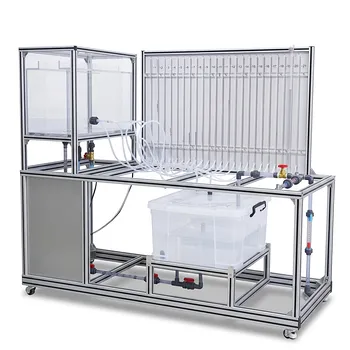
Bernoulli Equation Demonstration Unit Operations Pilot Plant

Bernoulli Equation Demonstration Unit Operations Pilot Plant

Laboratory pilot plant for Bernoulli's equation demonstration with transparent PVC pipes, 23 piezometer tubes for pressure measurement, and hands-on experiments. Designed for engineering education to study energy conservation, hydraulic grade line, and localized losses in fluid steady-flow systems.

Centrifugal Pump Performance and Orifice Flowmeter Calibration Educational Pilot Plant

Centrifugal Pump Performance and Orifice Flowmeter Calibration Educational Pilot Plant

This versatile educational pilot plant enables engineering students to conduct centrifugal pump performance tests, orifice flowmeter calibration, and fluid mechanics experiments using a transparent flow loop, industrial HMI, and 3D virtual simulation for a comprehensive hands-on learning experience.

Constant Pressure Filtration Educational Unit Operations Pilot Plant

Constant Pressure Filtration Educational Unit Operations Pilot Plant

Hands-on educational pilot plant for constant pressure filtration. Classic plate and frame filter press allows students to study kinetics, determine specific cake resistance, perform cake washing and evaluate washing rates. Ideal for chemical engineering curriculum. Mobile, customizable, safety-compliant design.

100L Continuous Loop Hydrogenation Educational Unit Operations Pilot Plant

100L Continuous Loop Hydrogenation Educational Unit Operations Pilot Plant

This 100L continuous loop hydrogenation pilot plant is designed for chemical engineering education, featuring 316 stainless steel construction, advanced gas-liquid mass transfer components, explosion-proof safety systems, and a 15.6-inch touchscreen with 5G connectivity, cloud data logging, bridging theory and industry.

Cavitation Phenomenon Demonstration and Analysis Educational Unit Operations Pilot Plant

Cavitation Phenomenon Demonstration and Analysis Educational Unit Operations Pilot Plant

Advanced educational pilot plant for demonstrating and analyzing cavitation phenomena in fluid systems. Features a transparent acrylic Venturi test section, high-precision pressure and flow sensors, digital data acquisition, and integrated safety relief valves for engineering curricula.

Comprehensive Heat Transfer Coefficient Determination Educational Unit Operations Pilot Plant

Comprehensive Heat Transfer Coefficient Determination Educational Unit Operations Pilot Plant

Advanced industrial-grade educational pilot plant for comprehensive heat transfer coefficient determination. Enables quantitative convective heat transfer analysis, evaluates double-pipe and shell-and-tube exchanger configurations, and includes digital data acquisition. Customizable for engineering curriculum. Ideal for engineering unit operations labs.

Rising and Falling Film Evaporation Educational Unit Operations Pilot Plant

Rising and Falling Film Evaporation Educational Unit Operations Pilot Plant

Hands-on educational pilot plant for studying rising and falling film evaporation, flow regimes, and heat transfer. Customizable for university labs with industrial instrumentation and data acquisition. Enables comparative evaluation of evaporation modes and energy efficiency.

Multi Functional Catalytic Reaction and Reactor Evaluation Educational Unit Operations Pilot Plant

Multi Functional Catalytic Reaction and Reactor Evaluation Educational Unit Operations Pilot Plant

Bench-scale educational pilot plant for catalytic reaction and reactor evaluation, integrating fixed bed, fluidized bed, and stirred tank reactors. Students compare reactor designs, evaluate catalysts, and study reaction kinetics and hydrodynamics. Perfect for unit operations labs in chemical engineering curricula.

Electrolytic Hydrogen Production Educational Unit Operations Pilot Plant

Electrolytic Hydrogen Production Educational Unit Operations Pilot Plant

Bench-scale electrolytic hydrogen production pilot plant designed for university engineering labs. Provides hands-on training in water electrolysis, gas-liquid separation, and process safety. Fully customizable system with digital PID control, corrosion-resistant components, and hydrogen gas detector. Ideal for chemical engineering curricula.

Centrifugal Pump Performance Determination Educational Unit Operations Pilot Plant

Centrifugal Pump Performance Determination Educational Unit Operations Pilot Plant

This lab system determines centrifugal pump performance curves for unit operations. Students configure dual pumps in series or parallel for hands-on learning. Includes industrial controls, clear piping, and data logging. Customizable for chemical, mechanical, and environmental engineering programs.

Shell and Tube Heat Exchanger Heat Transfer Coefficient Determination Educational Pilot Plant

Shell and Tube Heat Exchanger Heat Transfer Coefficient Determination Educational Pilot Plant

LABPARK's shell and tube heat exchanger pilot plant enables students to investigate heat transfer coefficients, LMTD, co-current vs counter-current flow, bridging theory and industrial practice. Customizable for chemical, mechanical, environmental engineering curricula. Ideal for unit operations and process engineering labs.

Solid Spherical Heat Transfer Coefficient Determination Educational Chemical Engineering Pilot Plant

Solid Spherical Heat Transfer Coefficient Determination Educational Chemical Engineering Pilot Plant

This educational chemical engineering pilot plant enables students to determine convective heat transfer coefficients and observe transient thermal behavior of solid spheres under natural convection, forced convection, fixed beds, and fluidized bed regimes.

Three-Tube Heat Transfer Educational Pilot Plant for Unit Operations Training

Three-Tube Heat Transfer Educational Pilot Plant for Unit Operations Training

Three-tube heat transfer pilot plant for studying convective heat transfer enhancement and condensation. Allows comparison of smooth, corrugated, turbulent tubes, verifying empirical correlations. Ideal for chemical engineering education with safety and closed-loop steam recovery.

Hot Filtration Educational Unit Operations Pilot Plant Laboratory System

Hot Filtration Educational Unit Operations Pilot Plant Laboratory System

This integrated laboratory bench-scale hot filtration pilot plant enables students to study solid-liquid separation under thermal conditions, featuring a stainless steel vessel, removable heating jacket, and multi-layer filter plates for unit operations education, ideal for chemical engineering laboratory curriculum.

Tubular Reactor Flow Characteristics Determination Educational Unit Operations Pilot Plant

Tubular Reactor Flow Characteristics Determination Educational Unit Operations Pilot Plant

Educational pilot plant for investigating tubular reactor flow characteristics and residence time distribution Features adjustable recycle for plug flow and backmixing studies industrial touchscreen interface and real-time data acquisition Ideal for chemical engineering unit operations laboratory training and education

Carbon Dioxide PVT Curve Determination Educational Unit Operations Pilot Plant

Carbon Dioxide PVT Curve Determination Educational Unit Operations Pilot Plant

Enable hands-on learning of thermodynamic principles with this carbon dioxide PVT curve determination pilot plant. Students visualize critical opalescence, phase transitions, and generate P-V isotherms across liquid, gas, and supercritical regions. Robust safety features, adaptable for university engineering labs.

Educational Unit Operations Pilot Plant for Intraparticle Diffusion Effective Factor Measurement

Educational Unit Operations Pilot Plant for Intraparticle Diffusion Effective Factor Measurement

Designed for chemical engineering university labs, this pilot plant allows hands-on determination of catalyst particle intraparticle diffusion effective factors and gas-solid reaction kinetics using a fixed-bed tubular reactor with industrial touchscreen control, bridging theory and practical reactor design.


Leave Your Message