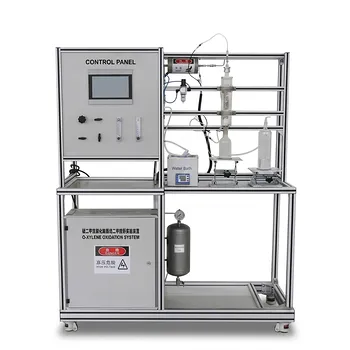
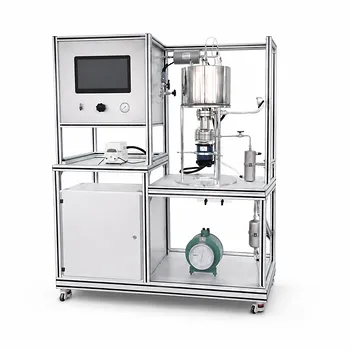
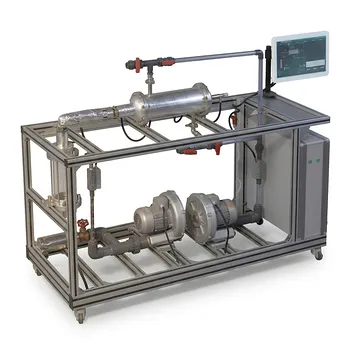
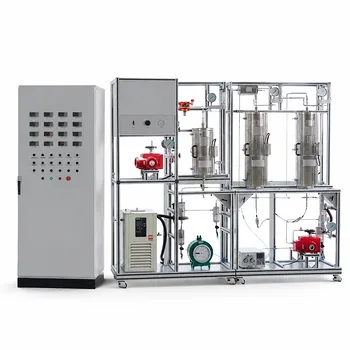
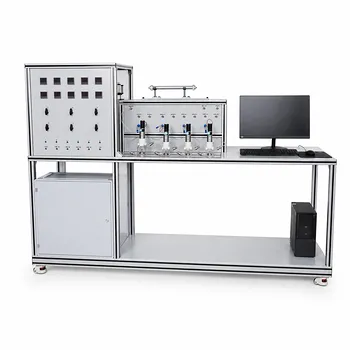
The most dangerous scaling myth in chemical engineering is that what works in a beaker works in a barrel—especially when heat is involved. The central heat management challenge when scaling up educational batch and tubular reactors is the rapid divergence between heat generation, which scales with volume, and the vessel’s natural heat transfer capability, which scales only with its surface area. In batch units, this forces a deliberate separation of reaction volume from cooling surfaces using external loops or reflux condensers, while in continuous tubular modules it imposes hard limits on tube diameter and demands staged, segmented cooling strategies to maintain safe, uniform temperature profiles.
Educational reactor scale-ups turn a fundamental geometric imbalance—heat production rising with the cube of size while jacket area rises with the square—into a controlled learning experience. The solution is never a bigger vessel alone; it’s the demonstration of external heat exchange, reflux cooling, tube diameter constraints, and multibed intercooling that teaches students to decouple heat generation from reactor geometry.
Why Reactor Scale-Up Breaks Heat Management
At the heart of every scaling problem sits a simple spatial mismatch. Understanding it makes all the specific challenges for batch and tubular reactors immediately intuitive.
The Geometry Trap: Volume Outruns Surface
Heat generation in a reacting system rises proportionally to the reactor’s volume. For a cylindrical vessel, that means it grows with the cube of the diameter ((d_R^3)). The available jacket or wall heat transfer area, however, increases only with the square of the diameter ((d_R^2)).
This gap widens rapidly. A modest diameter increase quickly creates a situation where the reaction produces more heat than the vessel’s own walls can remove or supply, even though the heat transfer coefficient ((h_w)) itself changes only slightly (theoretically declining by (d_R^{-1/9})).
The educational demonstration is immediate and powerful. Students measuring temperatures in a scaled-up unit see hot spots and runaway risk not despite the cooling system, but because of the very geometry they are working with.
When a Constant Coefficient Isn’t Enough
The film heat transfer coefficient often remains nearly constant during scale-up. This can be misleading. Because the area per unit volume drops sharply, a constant (h_w) still delivers drastically less total heat duty per unit of reacting mass.
Small reactors can “get away” with jacket cooling alone; large ones cannot. The educational mission is to show where and why that limit is crossed, and how engineers intervene.
Heat Management in Scaled-Up Batch Educational Units
Batch reactors in teaching labs move the scaling conversation from theoretical equations to visible, controllable hardware. The primary reference highlights how pilot plants separate reaction volume from heat exchange area.
Separating Reaction Volume from Heat Exchange Area
In a lab-scale flask, the glass walls double as the cooling surface. Once you scale beyond a few liters, that direct coupling fails. The educational unit must formally separate the two functions.
This separation is the single most important lesson of batch scale-up. Rather than trying to make the vessel’s jacket larger (which the square-cube law renders futile), the design moves the cooling duty to an external loop that doesn’t scale with the reactor’s main dimensions.
Students see that the reactor becomes a contained mixing volume, not a heat exchanger. All serious cooling is provided by a dedicated external circuit whose size can be chosen independently.
External Heat Exchangers and Reflux Cooling as Teaching Tools
A pump-around loop with a shell-and-tube or plate exchanger is a common educational configuration. Here, the reaction mixture is circulated through a cooler whose surface area is no longer tied to the reactor diameter. The unit demonstrates how heat removal can be scaled independently of the reactor, giving students a direct feel for decoupling.
Reflux cooling uses an overhead condenser to remove heat via vaporization. For exothermic reactions with volatile components, this is both a safety net and a powerful demonstration of latent heat utilization. The condenser surface can be expanded independently, and the boiling point of the reaction mixture acts as a natural temperature limiter.
Both approaches show that safe scale-up means moving heat removal out of the vessel. The educational value lies in letting students compare jacket-only cooling with these advanced configurations under controlled, instrumented conditions.
Heat Management in Tubular and Fixed-Bed Educational Units
Continuous-flow systems face the same square-cube challenge but express it through temperature profiles along a tube rather than inside a stirred volume. The primary reference focuses on temperature profile behavior, heat flux limits, and the strict diameter rules that emerge.
Temperature Profiles and Heat Flux Limits
In a tubular reactor, heat does not just accumulate—it creates an axial temperature gradient. The educational unit must reveal this gradient with multiple thermocouple points, showing how the reaction front moves and how heat dissipates (or doesn’t) along the reactor length.
Heat flux limits become tangible. At a small diameter, the wall can remove the exothermic heat rapidly enough to keep the profile flat. Scale up the diameter, and the centerline temperature can spike while the wall remains cool. The pilot unit demonstrates that a safe, uniform profile in a small tube does not guarantee safety in a wider one.
Students learn to think in terms of radial temperature differences, not just inlet-outlet values. This shift is essential for understanding industrial reactor hazards.
Endothermic Reactions: The 0.1-Meter Tube Diameter Rule
For endothermic systems, the challenge is supplying heat uniformly from the furnace or jacket to the reacting fluid. The primary reference is explicit: tube diameters must typically stay below 0.1 meters to ensure the heat can penetrate to the center without creating large radial cold zones.
In educational units, a tube exceeding this limit is a deliberate experiment. Students observe that as the diameter grows, the center of the catalyst bed runs significantly cooler, quenching the reaction. The unit becomes a physical demonstration of thermal penetration depth, not just a chemical reactor.
Staying below the 0.1-meter threshold therefore becomes a scaling law, not a preference. It teaches that for endothermic tubular reactors, diameter is not a free variable—it is constrained by heat transfer physics.
Exothermic Fixed-Bed: Multibed Cooling and Cold-Feed Injection
Exothermic fixed-bed reactors cannot simply be made longer to increase conversion—the temperature would rise uncontrollably. Educational units mirror industrial practice by splitting the catalyst into multiple beds separated by intercooling stages.
Intermediate cooling can be done with external heat exchangers between beds or by injecting a quench stream of cold feed. Both strategies break the temperature rise into manageable steps, keeping the reaction path away from runaway conditions and selectivity losses.
Cold-feed injection also demonstrates in-situ temperature trimming. Students can adjust the split ratio and see the immediate effect on bed temperatures, linking heat management directly to operational controllability and product quality.
Understanding the Trade-offs and Pitfalls
No heat management strategy comes free. Educational units that oversimplify risk creating a dangerous gap between theory and practice.
The Cost of External Circuits: Complexity and Residence Time
Adding external loops introduces extra holdup and can alter residence time behavior. A teaching module must make this transparent: the pump, piping, and exchanger all add volume that may skew kinetic results or introduce dispersion effects.
Reflux cooling ties the pressure to the boiling point. If the reaction mixture changes composition, the bubble point shifts, and so does the cooling capacity. This interdependence is a valuable lesson but can confuse students expecting a simple “more cooling = lower temperature” relationship.
Every additional piece of hardware is a potential leak point and a safety consideration. Educational units must balance demonstration clarity with a frank discussion of industrial trumps—maintenance, reliability, and hazard containment.
When Small-Scale Demos Hide the Real Problem
Pilot-scale educational units can still mislead if they are too close to the lab bench size. The square-cube problem becomes acute only above a threshold diameter; a unit that is just slightly larger may still function well with a jacket, giving students a false sense of security.
The most valuable demonstrations intentionally operate at a scale where the jacket alone clearly fails. Only then do the external cooling or multibed interventions reveal their true purpose. Without that visible failure point, the lesson remains academic.
Balancing Safety and Instruction
Exothermic runaway is not a theoretical curiosity—it is a real danger. Educational units must incorporate interlocks, rupture discs, and quenching systems, which themselves become learning points about process safety management.
Transparent safety systems teach as much as the reactor itself. Students who trip a high-temperature interlock learn the stakes firsthand, turning heat management from an equation into an operational discipline.
Making the Right Choice for Your Educational Goal
The heat management configuration you select for a scaled-up teaching reactor should mirror the principle you want to embed in your students. There is no single correct answer—only the right match between unit design and learning objective.
- If your primary focus is demonstrating the square-cube problem directly: Choose a batch vessel just large enough to show jacket insufficiency, then retrofit it with an external heat exchanger loop to let students measure the before-and-after difference.
- If your primary focus is endothermic tubular reactor design: Use a tube with a diameter slightly over 0.1 meters next to one under that limit, mapping the radial temperature profile in both to make the penetration constraint unmistakable.
- If your primary focus is exothermic fixed-bed safety: Split the catalyst into at least two beds with inter-stage cooling or cold-feed quench, and instrument each bed inlet and outlet to display the temperature step-downs that prevent runaway.
- If your primary focus is process dynamics and control: Implement reflux cooling with a variable condenser duty; students can then explore how the system’s natural boiling point constraint interacts with external heat removal, revealing the difference between manipulated and self-regulating cooling.
A properly instrumented, deliberately scaled educational reactor doesn’t just teach heat management—it ingrains the engineer’s instinct that size changes everything, and that every watt generated must have a pre-planned path out of the system.
Summary Table:
| Reactor Type | Core Heat Challenge | Educational Solution / Intervention | Key Learning Objective |
|---|---|---|---|
| Batch Reactors | Volume-to-surface mismatch (square-cube law) | External loop heat exchangers; Reflux cooling | Decoupling heat removal from reactor geometry |
| Tubular / Fixed-Bed | Radial & axial temperature gradients, hot spots | Tube diameter limits (<0.1m); Multi-bed intercooling; Cold-feed quench | Managing thermal penetration and preventing runaway risks |
Bring Industrial-Scale Reactor Concepts to Your Lab
Teaching the physics of thermal management requires pilot-scale systems that demonstrate physical limits. LABPARK provides premium Educational and Vocational Unit Operations Pilot Plants in chemical engineering, bioprocess & biotech, and environmental & water treatment. Designed specifically for universities, research institutes, and enterprises, our safety-instrumented reactors let students master heat transfer, scale-up dynamics, and process control firsthand.
Ready to upgrade your chemical engineering laboratory? Contact us today to find the perfect pilot plant for your curriculum.
Related Products
- Tubular Reactor Flow Characteristics Determination Educational Unit Operations Pilot Plant
- Residence Time Distribution and Reactor Flow Characteristics Determination Educational Pilot Plant
- Educational Unit Operations Pilot Plant for Intraparticle Diffusion Effective Factor Measurement
- O-Xylene Oxidation to Phthalic Anhydride Educational Unit Operations Pilot Plant
- Fixed-Bed Chemical Reaction and Gas Dust Tar Removal Unit Operations Pilot Plant
People Also Ask
- How do educational unit operations pilot plants address safety and waste management when scaling up?
- How do educational unit operations pilot plants bridge theory and design? Bridge the Engineering Gap
- What are the formulas for single-pass vs overall conversion in pilot plants? Master reactor mass balances
- How Do Pilot Plants Teach Limiting Reactants, Yield, & Selectivity? Real-World ChE Practice
- Why are implicit numerical methods preferred for stiff kinetics? Optimize Reactor Simulation