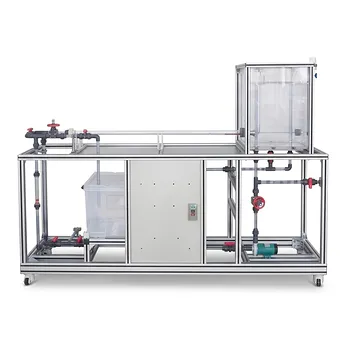
For a horizontal reflux drum in a chemical engineering pilot plant, the principal sizing heuristics are a 5-minute liquid holdup time at 50% operating capacity and an optimum vessel length-to-diameter ratio of approximately 3. The acceptable L/D range is typically about 2.5 to 5. These rules provide enough surge volume for stable reflux flow and level control while keeping the vessel compact and practical for pilot-plant operation.
Size the vessel so that the liquid volume held at normal operation equals approximately five minutes of reflux liquid flow, with the vessel half full. Then select dimensions near an L/D ratio of 3 and verify the result against hydraulic, mechanical, and operating requirements.
How the Basic Sizing Heuristic Works
Determine the required liquid holdup
The required operating liquid volume is calculated from the volumetric reflux flow rate:
[ V_{\text{liquid, operating}} = Q_L \theta ]
where:
- (V_{\text{liquid, operating}}) is the liquid volume at normal operating level
- (Q_L) is the liquid reflux flow rate
- (\theta) is the required holdup time, typically (300) seconds for 5 minutes
For example, if the reflux flow rate is expressed in (\text{m}^3/\text{s}):
[ V_{\text{liquid, operating}} = 300Q_L ]
Account for the 50% operating level
The 5-minute volume is assumed to occupy approximately half of the vessel's total internal volume:
[ V_{\text{vessel}} = \frac{V_{\text{liquid, operating}}}{0.5} ]
Therefore:
[ V_{\text{vessel}} = 600Q_L ]
when (Q_L) is in (\text{m}^3/\text{s}).
This provides liquid volume below the normal level while retaining vapor space above it for level fluctuations and vapor disengagement.
Apply the length-to-diameter ratio
For a cylindrical horizontal vessel:
[ V_{\text{vessel}} \approx \frac{\pi D^2}{4}L ]
Using the preferred ratio:
[ L = 3D ]
gives:
[ V_{\text{vessel}} \approx \frac{3\pi}{4}D^3 ]
The preliminary diameter is therefore:
[ D \approx \left(\frac{4V_{\text{vessel}}}{3\pi}\right)^{1/3} ]
and the corresponding length is:
[ L = 3D ]
These equations provide a preliminary geometric size, after which standard vessel dimensions and fabrication constraints should be considered.
Why These Heuristics Suit Pilot Plants
Provide surge capacity
A reflux drum must absorb short-term changes in condenser condensate rate, reflux flow, and distillate withdrawal. The 5-minute holdup rule provides a practical buffer against these fluctuations.
Pilot plants often operate across a wide range of conditions, so this buffer is particularly useful during startup, shutdown, and changes in reflux ratio.
Improve level-control stability
A vessel with insufficient liquid volume can experience rapid level changes. These changes make the level-control loop sensitive to pump cycling, valve movement, and disturbances from the condenser or column.
The half-full, 5-minute basis gives the controller usable operating volume without requiring an excessively large vessel.
Preserve vapor disengagement space
Operating the vessel at approximately 50% liquid capacity leaves space for vapor disengagement above the liquid surface. This reduces the likelihood that liquid droplets will be carried into the overhead vapor or vent connection.
The exact vapor-space requirement depends on vapor velocity, pressure, fluid properties, and the need for downstream separation equipment.
Maintain practical vessel proportions
An L/D ratio near 3 balances footprint, internal volume, support arrangement, and fabrication practicality. Extremely short vessels can require large diameters, while very long vessels can create support, drainage, and level-measurement complications.
The range of approximately 2.5 to 5 allows the design to adapt to available space and standard vessel dimensions.
Design Inputs That Must Be Defined
Use the maximum relevant reflux flow
The sizing flow rate should represent the intended design or maximum operating reflux rate, not merely a nominal laboratory condition. Pilot plants may be used at different reflux ratios and feed rates.
Where the unit will run multiple experiments, the drum should be checked against the highest expected condensate and reflux throughput.
Define the operating level range
The 50% value is a sizing heuristic, not a substitute for specifying low, normal, and high liquid levels. The control strategy should identify the usable working range and the volume available between alarm or trip points.
This is important because the actual available surge volume may be less than the full liquid volume calculated at the nominal level.
Consider reflux and distillate withdrawal
The drum's liquid balance depends on both reflux return and distillate withdrawal. The design should account for the relationship between condenser duty, reflux ratio, reflux flow, and product withdrawal.
A drum sized only from an average reflux flow may be inadequate during total reflux operation or other high-reflux conditions.
Account for fluid and operating conditions
Density, viscosity, volatility, operating pressure, temperature, and foaming tendency affect hydraulic performance and vapor-liquid disengagement. These properties should be evaluated at the relevant operating conditions.
The basic holdup rule is primarily a volume and control heuristic; it does not by itself establish vapor-space adequacy or mechanical design.
Understanding the Trade-offs
A longer holdup time increases stability
Increasing the holdup time provides more surge capacity and generally makes level control less sensitive to flow disturbances. It also increases vessel volume, footprint, cost, and liquid inventory.
The 5-minute value is a practical starting point for pilot-plant sizing, but the required time may be increased where flow fluctuations or operating procedures justify it.
A smaller vessel reduces inventory
Reducing the vessel volume lowers material inventory and may reduce equipment cost and footprint. However, it can cause faster level changes, reduce operating flexibility, and make control more difficult.
This trade-off matters in educational facilities, where the unit may be operated manually by different users and under varying experimental conditions.
L/D affects layout and operation
An L/D ratio outside the preferred value can still be acceptable within the approximate 2.5 to 5 range. The final choice may be governed by platform space, nozzle locations, support geometry, drainage, instrumentation, or access requirements.
A vessel should not be forced to an exact ratio of 3 if doing so creates poor piping or maintenance arrangements.
Heuristics do not replace detailed design
The holdup and L/D rules do not determine wall thickness, allowable pressure, relief-device sizing, nozzle reinforcement, support loads, corrosion allowance, or code compliance.
They also do not fully establish vapor-liquid separation performance. These items require separate process, mechanical, and safety checks.
Common Pitfalls to Avoid
Confusing operating volume with total vessel volume
The 5-minute holdup volume applies to the liquid volume at the assumed operating level. If the vessel is intended to be half full, the total internal volume must be approximately twice that liquid volume.
Failing to make this distinction results in a vessel with only about half the intended holdup capacity.
Sizing from mass flow without converting units
The calculation requires volumetric liquid flow:
[ Q_L = \frac{\dot{m}_L}{\rho_L} ]
Using mass flow directly without dividing by liquid density produces an incorrect volume.
Ignoring level-control deadband
A vessel may satisfy the nominal 5-minute calculation but still provide inadequate usable volume if the control range is narrow. Low-level, normal-level, and high-level settings should be checked against the actual vessel geometry.
Treating the L/D ratio as an independent performance guarantee
An L/D ratio of 3 is a geometric guideline. It does not guarantee adequate vapor disengagement, drainage, mixing, or control performance under every operating condition.
Vapor velocity, inlet momentum, outlet arrangement, internal devices, and foaming must still be evaluated.
Omitting pilot-plant operating scenarios
Startup, total reflux, changes in reflux ratio, shutdown, condenser transients, and manual intervention can produce conditions different from the nominal design point. These scenarios should be included in the operating review.
Making the Right Choice for Your Goal
Use the heuristics as the preliminary process-sizing basis, then validate the selected vessel against the actual operating envelope.
- If your primary focus is stable reflux control: Provide approximately 5 minutes of liquid holdup at the design reflux flow while maintaining a normal liquid level near 50% of vessel volume.
- If your primary focus is compact pilot-plant layout: Select an L/D ratio near 3, adjusting within the approximate 2.5 to 5 range to suit supports, piping, instrumentation, and access.
- If your primary focus is flexible experimentation: Size against the maximum intended reflux or condensate flow and verify level performance across startup, total reflux, and changing reflux-ratio conditions.
- If your primary focus is safe equipment specification: Treat the holdup and L/D rules as preliminary heuristics, then complete pressure, relief, nozzle, mechanical, vapor-disengagement, and code checks.
A well-sized horizontal reflux drum combines practical holdup and vessel proportions with detailed checks that reflect the pilot plant's real operating conditions.
Summary Table:
| Sizing factor | Recommended basis | Design purpose |
|---|---|---|
| Liquid holdup | 5 minutes of maximum reflux flow | Provides surge capacity and stable level control |
| Normal liquid level | Approximately 50% of vessel volume | Balances liquid inventory with vapor disengagement space |
| Length-to-diameter ratio | Preferred near 3; typical range 2.5-5 | Supports practical layout, fabrication, and operation |
| Design flow | Maximum relevant reflux or condensate flow | Covers total reflux and changing operating conditions |
| Validation checks | Hydraulic, mechanical, relief, nozzle, and code reviews | Confirms safe and reliable final design |
Planning a chemical engineering pilot plant or upgrading an existing unit? Contact LABPARK to discuss your requirements. LABPARK provides Educational and Vocational Unit Operations Pilot Plants for universities, research institutes, and enterprises, including chemical engineering, bioprocess and biotechnology, and environmental and water treatment systems. Our team can help you select and configure reflux drums, columns, condensers, pumps, instrumentation, and control systems around your target flow rates, operating scenarios, layout, teaching objectives, and safety requirements. Get practical pilot-plant equipment designed for stable operation, flexible experimentation, effective training, and reliable long-term use.
Related Products
- Centrifugal Pump Performance Determination Educational Unit Operations Pilot Plant
- Educational Rotary Disc Liquid-Liquid Extraction Pilot Plant
- Centrifugal Pump Performance and Orifice Flowmeter Calibration Educational Pilot Plant
- Bernoulli Equation Demonstration Unit Operations Pilot Plant
- Orifice and Venturi Flowmeter Calibration Educational Pilot Plant for Fluid Mechanics Laboratory
People Also Ask
- Why start a centrifugal pump with a closed outlet valve? Protect your pilot plant motors.
- How are pump shaft power, valve pressure drops, and NPSH evaluated? A practical pilot-plant guide
- How can cavitation and slurry erosion be studied and mitigated using fluid transport and centrifugal pump pilot plants?
- How does fluid density affect pump head and pressure? Avoid Pilot Plant Motor Overload
- How does fluid viscosity affect centrifugal pump performance? Key pilot plant correction methods.