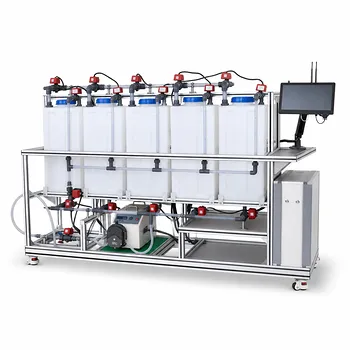
Precision temperature control, electrical stability, and optimized flow geometry are non-negotiable. When evaluating pilot plants for electrochemical unit operations, laboratory coordinators must look for three specific design features: integrated temperature control jackets, stabilized DC power supplies, and optimized flow-channel geometries. These elements work together to suppress the thermal convection and concentration disturbances that arise from Joule heating at high currents, ensuring students and researchers can measure transport properties like transference numbers or membrane permeability with reproducible accuracy.
The core challenge: High currents generate localized heat, creating density‑driven convection and uneven ion distribution that mask true migration behavior. A pilot plant designed specifically to counteract these effects turns an inherently unstable system into a reliable teaching and research platform.
Understanding the Problem: How Thermal Convection and Concentration Disturbances Sabotage Measurements
In any high‑current electrochemical cell, Joule heating is inevitable. This heat does not spread uniformly.
The Origin of Buoyancy‑Driven Convection
As electrolyte near the electrode surface heats up, its density decreases. That less‑dense fluid rises while cooler, denser fluid sinks, creating a continuous mixing loop. This natural convection completely overrides the steady‑state diffusion‑migration layer you are trying to study. Instead of a serene, purely electro‑driven ion flux, you measure a chaotic hydrodynamic signal.
The Formation of Concentration Gradients
Rapid electrode reactions deplete reactants and accumulate products faster than diffusion can replenish them. Coupled with temperature‑induced buoyancy, this creates “dead zones” of stagnant fluid and steep, unstable concentration profiles. For a student measuring a limiting current or a membrane’s permselectivity, this variability can render data meaningless.
The Three Critical Design Features to Demand
A properly designed pilot plant attacks these disturbances at their root. The primary reference identifies three non‑negotiable features, and each addresses a distinct physical mechanism.
Feature 1: Integrated Temperature Control Jackets
A jacketed cell or compartment surrounds the reactive volume with a flowing heat‑transfer fluid. This isn’t merely about “keeping things cool.”
It enforces isothermal conditions, eliminating temperature differences that drive buoyancy. When the entire cell wall is held at a tightly regulated setpoint (often ±0.1 °C), density variations are suppressed, and natural convection collapses. The result is a near‑quiescent hydrodynamic environment where ion transport is dominated by migration and diffusion alone.
Moreover, the jacket serves as a thermal sink for the Joule heat generated at the electrodes. Without it, heat would bleed unevenly into the ambient lab air, creating thermal gradients along the cell height that further distort velocity fields.
Feature 2: Stabilized DC Power Supplies
A fluctuating current or voltage input superimposes transient thermal spikes onto the system. Even small ripples can trigger micro‑convection events that perturb the diffusion layer.
A high‑quality stabilized DC supply delivers a constant current or potential with minimal ripple, typically less than 0.1% of full scale. This steadiness translates directly into steady heat generation. The cell achieves thermal equilibrium faster, and the diffusion layer thickness stabilizes. For experiments like chronoamperometric transference‑number measurements, this precision is the difference between a clear Hittorf number and an uninterpretable scatter plot.
Feature 3: Optimized Flow‑Channel Geometries
In systems with forced electrolyte flow—such as electrodialysis stacks or flow‑by electrodes—the internal channel design is crucial. Poor geometries create recirculation zones, preferential flow paths, and dead volumes.
Optimized channels ensure a uniform velocity profile across the entire electrode or membrane surface. Flat, narrowly spaced channels or carefully designed flow distributors eliminate spatial variations in mass transfer coefficient. This directly suppresses the localized concentration depletion that would otherwise distort the measured current‑voltage curve. The goal is a controlled, laminar flow field that complements the thermal control, not a chaotic one that compounds the disturbance.
Supporting Instrumentation That Reinforces Control
While not primary design features, several measurement tools act as essential guardians. Digital multimeters and potentiostats provide real‑time feedback on cell potential and current density, allowing operators to quickly identify deviations caused by thermal drift. In‑line temperature sensors and conductivity probes confirm that the jacket and power supply are maintaining the intended steady state. These instruments close the control loop, transforming passive design into active process assurance.
Understanding the Trade‑offs
No design solution is without cost or limitation. Coordinators must weigh these factors honestly.
The Complexity and Maintenance Burden
Temperature control jackets require external circulators, chillers, and periodic maintenance of sealing gaskets. If the jacket leaks, the entire experiment is compromised. Additionally, adding a jacket increases the cell’s thermal mass, which slows down initial heat‑up and cool‑down times—a practical nuisance in a teaching lab with short session durations.
The Cost of Electrical Precision
True research‑grade stabilized power supplies with ultra‑low ripple are significantly more expensive than basic rectifiers. For undergraduate demonstrations of electrolysis or simple battery charging, this precision may be overkill. The coordinator must decide whether the educational value of clean transport measurements justifies the higher capital outlay.
Pressure Drop and Cleaning Constraints
Optimized flow channels often mean narrow gaps and precise machined manifolds. This geometry can generate higher pressure drops, requiring slightly more powerful pumps. It also makes thorough cleaning more difficult, especially if precipitates or fouling species are part of the student curriculum. A design that excels in hydrodynamics might frustrate users during the post‑lab cleanup phase.
Making the Right Choice for Your Laboratory’s Goals
Not every pilot plant needs the highest level of disturbance mitigation. Match your selection criteria to your primary pedagogical or research objective.
- If your primary focus is fundamental transport phenomena (transference numbers, diffusion coefficients): Prioritize a jacketed, quiescent‑cell design with a library‑grade stabilized power supply. The ability to isolate migration from convection is indispensable.
- If your primary focus is electrodialysis or continuous electro‑bioprocessing: Concentrate on flow‑channel uniformity and precise temperature control across multiple compartments. Insist on flow distributors that have been validated with residence‑time distribution studies.
- If your primary focus is industrial‑scale demonstrations (e.g., chlor‑alkali, water electrolysis): Accept that some thermal convection is inherent. Choose a system with robust, multi‑point temperature monitoring and safety interlocks, and treat the resulting polarization curves as engineering approximations rather than fundamental data.
- If your primary focus is biosensor or microelectrode development: Look for a platform that integrates a temperature‑controlled jacketed cell with a Faraday cage and a low‑noise potentiostat. Minimizing electrical interference and thermal drift is more critical than macroscopic flow optimization.
The right pilot plant is an investment in clarity. By deliberately selecting design features that counteract the physics of convection and diffusion, you give students and researchers a window into the true electrochemical process—not a distorted view through a turbulent lens.
Summary Table:
| Key Design Feature | Primary Mechanism | Trade-offs & Limitations |
|---|---|---|
| Temperature Control Jackets | Eliminates temperature gradients to suppress buoyancy-driven convection | Higher complexity, maintenance, and increased thermal mass |
| Stabilized DC Power Supplies | Delivers constant current with <0.1% ripple to prevent thermal spikes | Significantly higher capital cost than basic rectifiers |
| Optimized Flow Geometries | Ensures uniform velocity profile and eliminates stagnant flow zones | Higher pressure drops and more difficult cleaning/maintenance |
Elevate Your Lab's Electrochemical Research with LABPARK
To achieve precise, reproducible results, universities, research institutes, and enterprises need pilot plants designed to mitigate complex transport disturbances. LABPARK offers state-of-the-art Educational and Vocational Unit Operations Pilot Plants across chemical engineering, bioprocess & biotech, and environmental & water treatment.
Our systems integrate isothermal control, ultra-stable power delivery, and optimized fluid dynamics to ensure your students and researchers get accurate data every time.
Contact LABPARK today to discuss your laboratory specifications and request a customized quote!
Related Products
- Electrochemical Water Treatment Educational Unit Operations Pilot Plant
- Multi Pump Fluid Transport Process Piping Unit Operations Training Pilot Plant
- Multi-Reactor Educational Pilot Plant for Reaction Engineering Unit Operations
- Electrolytic Hydrogen Production Educational Unit Operations Pilot Plant
- Multi-Modal Distillation Unit Operations Training Pilot Plant
People Also Ask
- What design features do educational electrochemical pilot plants utilize to manage gas liberation and water loss?
- How can unit operations pilot plants show lead-acid concentration vs state of charge? Real-time monitoring guide.
- How do educational electrochemical pilot plants scale up electrolysis? Master industrial engineering.
- How to Estimate Sulfate in Water Treatment Pilot Plant Deposits: Gravimetric Guide
- How can foaming be managed during steam generation experiments in water treatment unit operations pilot plants? Tips