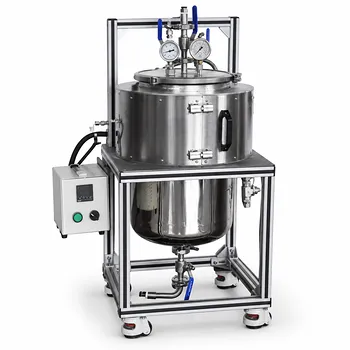
Achieving true isothermal operation in a pilot-scale batch reactor is not just about adding a jacket—it’s about engineering a deliberate balance between surface area, mixing dynamics, and control responsiveness. The fundamental design features necessary are a high-capacity heat transfer system (either a vessel jacket or internal coils) and a robust mechanical agitation system. These work in concert to rapidly dissipate the heat generated by an exothermic reaction and distribute it uniformly, preventing the localized hot spots that lead to thermal runaway or hazardous side reactions.
The core challenge of isothermal operation is that heat removal is strictly limited by the reactor’s physical design. Effective temperature control is not a single component but an emergent property of the synergy between the heat exchange surface and the fluid dynamics created by the agitator. Fail to optimize either, and holding a steady temperature becomes physically impossible.
The Imperative of Heat Exchange Surface Area
The primary barrier to removing heat is the thermal resistance at the reactor wall. To overcome this, you must maximize the surface area available for heat transfer.
Jacketed Vessels: The First Line of Defense
A conventional external jacket is the standard first approach. It allows a cooling medium to circulate along the vessel’s outer wall. This design is mechanically simple and does not interfere with the reactor’s internals. However, its heat transfer capacity is limited by the vessel’s surface-to-volume ratio, which becomes increasingly unfavorable at larger pilot scales.
Internal Coils: Maximizing Heat Transfer Capacity
When a jacket alone is insufficient, you must install internal cooling coils directly submerged in the reaction mixture. This dramatically increases the effective heat transfer area and places the cooling surface exactly where heat is generated. The trade-off is that these coils can obstruct mixing patterns and make cleaning more difficult.
The Critical Role of Agitation and Mixing
A heat exchange surface is useless if the fluid next to it is cold while the bulk of the reactor is overheating. Agitation is the mechanism that connects the heat source to the cooling surface.
Eliminating Thermal Gradients
A properly designed mechanical stirring system forces convective mixing, ensuring the reaction mixture is homogeneous. Without this, localized hot spots will form, where the temperature vastly exceeds the target set point. At these hot spots, reaction kinetics accelerate, generating heat faster than it can be conducted away. This positive feedback loop is the classic precursor to a thermal runaway.
The Agitator as a Heat Transfer Multiplier
The agitator does not just mix the fluid—it directly enhances the heat transfer coefficient. By generating high fluid velocity and turbulence at the heat exchange surface, the agitator disrupts the stagnant boundary layer that insulates the wall. The selection of the impeller type (e.g., pitched-blade turbine for axial flow), its sizing, and the use of baffles are critical design parameters that directly determine your ability to maintain isothermal control.
The Control Mindset: Instrumentation and Intelligence
Hardware must be paired with a control strategy capable of reacting to conditions in real-time. Pilot plants must be designed to prevent runaway reactions, not just observe them.
High-Resolution Temperature Sensing
Reliance on a single thermocouple in a thermowell is inadequate. The reactor must be instrumented with multiple, low-thermal-mass temperature sensors placed directly in the fluid at various locations. This rapid-response sensor network provides the real-time data necessary to detect the onset of a hot spot long before it becomes a safety incident.
Cascade Control Architectures
The most effective approach uses a cascade control system. A master loop monitors the reactor's internal temperature, while a secondary slave loop governs the jacket or coil coolant flow rate. When an exothermic spike occurs, the master controller instantly demands more cooling from the slave loop. This compensates for the thermal lag in the system and maintains the target temperature with minimal oscillation.
Understanding the Trade-offs and Design Conflicts
Engineering is the art of balancing conflicting requirements, and isothermal batch reactor design forces you to confront several hard compromises.
Agitation Power vs. Heat Removal. High-speed agitation generates its own heat from shaft work—a significant factor at the pilot scale. You must balance the energy input from the impeller against the energy removal from the jacket to avoid unknowingly heating the vessel while trying to cool it.
Internal Surface Area vs. Flow Patterns. Adding internal cooling coils increases surface area but can create dead zones where fluid stagnates. The coil geometry must be designed in partnership with the impeller hydraulics to ensure a uniform flow field sweeps over all cooling surfaces.
Cooling Capacity vs. Reaction Rate. Using a very cold coolant to increase the driving force for heat transfer introduces a risk of thermal shock or "freezing" the reaction at the wall. This can lead to a dangerous scenario where a crust forms, retarding heat transfer until the bulk temperature soars and destroys the entire batch.
Making the Right Choice for Your Goal
The specific combination of features must be tailored to your primary research or operational objective. The emphasis changes whether you are scaling up a novel chemistry or training operators on safety protocols.
- If your primary focus is scale-up predictability: Invest in a jacketed reactor with a precisely defined surface-to-volume ratio and a geometrically similar agitation system. This allows you to base your design on empirical heat transfer correlations.
- If your primary focus is maximum flexibility for diverse chemistries: Specify a reactor with both a jacket and removable internal coils, combined with a variable-speed drive. This modular setup allows you to reconfigure the physical hardware to match the heat load of each new reaction.
- If your primary focus is operator safety and runaway prevention: Prioritize a cascade control system with a failsafe automated interlock. This system should be capable of triggering emergency high-flow coolant injection based on an accelerometer-based rate-of-temperature-rise alarm, not just an absolute threshold.
A successful isothermal batch reactor is a holistic assembly where materials of construction, mixing hydraulics, and control algorithms function as one integrated system to master the energy balance.
Summary Table:
| Key Design Feature | Function in Isothermal Control | Critical Considerations |
|---|---|---|
| Heat Exchange Surfaces | Maximizes heat removal via jackets or internal coils | Surface-to-volume ratio, cleaning accessibility |
| Mechanical Agitation | Eliminates hot spots; disrupts thermal boundary layers | Agitator power vs. heat generation, impeller type |
| Sensors & Instrumentation | Provides real-time, low-lag temperature data | Multiple sensors to detect localized hot spots |
| Cascade Control Systems | Minimizes thermal lag by pairing master and slave loops | Prevents temperature oscillations & runaway |
Bring Precision to Your Pilot-Scale Operations
Designing a safe, efficient, and truly isothermal reactor system requires a precise balance of heat transfer, fluid dynamics, and advanced control. LABPARK is here to help you bridge the gap between theory and practice.
We provide state-of-the-art Educational and Vocational Unit Operations Pilot Plants across chemical engineering, bioprocess & biotech, and environmental & water treatment. Tailored for universities, research institutes, and enterprises, our systems offer:
- Scalable Predictability: Master heat transfer dynamics with industry-standard, geometrically optimized systems.
- Advanced Safety & Control: Equip your facility with cascade control architectures and runaway prevention mechanisms.
- Flexible Configurations: Choose modular designs combining jacketed vessels and customizable internal coils to match diverse chemistries.
Ready to elevate your research, testing, or vocational training? Contact LABPARK today to discuss your custom pilot plant requirements with our specialists!
Related Products
- Micro-Scale Gas-Solid Catalytic Reaction Educational Pilot Plant
- Methanol Synthesis and Catalyst Performance Evaluation Educational Unit Operations Pilot Plant
- Multi-Reactor Educational Pilot Plant for Reaction Engineering Unit Operations
- Fixed-Bed Chemical Reaction and Gas Dust Tar Removal Unit Operations Pilot Plant
- Internal Circulation Gradient Free Catalytic Reaction Educational Pilot Plant
People Also Ask
- Fluidized vs. Fixed Bed Reactors: Comparing Heat & Complexity in Pilot Plants
- Why is a multibed configuration necessary for exothermic reactions? Optimize your pilot plant trajectory.
- Why is thermal management a major challenge in methane oxidative coupling? Reactor Solutions for Pilot Plants
- How does the Mears criterion evaluate transport resistance? Key Guide to Intrinsic Kinetics
- How do reactor pilot plants safely study gas-solid reactions? Master kinetics with thermal & flow control.