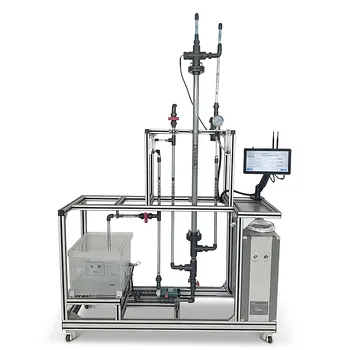
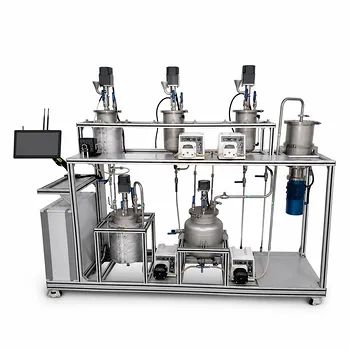
Sparger type is the single most powerful design variable you can manipulate to dramatically boost mass transfer in a bubble column pilot plant. The key consideration is to move beyond standard single-orifice plates and instead select a sparger that engineers the smallest possible bubble swarm. Specifically, replacing a conventional sparger with a sintered (porous) plate or a two-phase nozzle can increase the volumetric mass transfer coefficient (kLa) by a factor of 4 to 5, a gain that transforms the column’s performance for gas‑liquid reactions.
The fundamental insight is this: sparger design controls the initial bubble size, which directly sets the interfacial area available for mass transfer. While high-efficiency spargers deliver an enormous kLa boost at low gas velocities, their advantage fades once the column enters the churn‑turbulent or slug flow regime. The optimal choice must therefore balance the sheer mass transfer reward against pressure drop, fouling sensitivity, and the target operating regime.
The Direct Link Between Sparger Design and Mass Transfer
Why Initial Bubble Size Dictates Performance
The volumetric mass transfer coefficient ((k_La)) is the product of the liquid‑side mass transfer coefficient and the specific interfacial area (a). That area is inversely proportional to the Sauter mean bubble diameter. Every reduction in bubble size creates a disproportionate increase in contact surface, so the sparger that creates the smallest, most uniform swarm from the moment gas enters the column will set the upper limit for oxygen (or any gas) transfer.
The Conservative Baseline of Standard Spargers
A simple single‑orifice or low‑hole‑count perforated plate produces relatively large bubbles, especially at low to moderate gas velocities. This leads to conservative, “textbook” values of (k_La) that can severely underestimate the intensification potential of the column. Such spargers are easy to build and clean, but they leave a huge mass transfer opportunity on the table.
High-Impact Alternatives: Sintered Plates and Two‑Phase Nozzles
The two sparger families that unlock a 4‑ to 5‑fold (k_La) increase are:
- Sintered (porous) plates – made from metal, glass, or ceramic – generate a dense cloud of sub‑millimeter bubbles.
- Two‑phase nozzles – where the gas is sheared by a co‑flowing liquid – break the gas into extremely fine dispersions via intense local energy dissipation.
Both designs create a much larger initial interfacial area at the same superficial gas velocity, which is why they are the go‑to choice when the deep need is to maximize oxygen transfer for aerobic bioprocesses or to demonstrate mass transfer intensification in teaching labs.
Gas Holdup and Sparger Type: Two Regimes, Two Rules
Sparger design also governs the gas holdup – the volume fraction of the column occupied by gas. At low gas velocities (the homogeneous bubbly flow regime), a porous plate or multinozzle sparger provides significantly higher gas holdup than a single‑nozzle sparger because it creates a higher population of small bubbles that rise more slowly. However, once the column transitions into the slug or churn‑turbulent flow regime at higher velocities, bubble coalescence becomes dominated by turbulence rather than initial size. In that regime the effect of sparger design on holdup becomes insignificant, and overall performance is controlled by column geometry and gas throughput.
Matching Sparger Choice to Bubble‑Size Correlations
For researchers modeling reactor kinetics, the sparger type dictates which empirical correlation you should use to predict the bubble swarm’s volume‑surface mean diameter ((d_{vs})):
- Two‑phase nozzle spargers → Calderbank’s correlation, which links bubble size to the energy dissipation rate per unit mass.
- Perforated plates and single orifices → the Akita–Yoshida correlation, which factors in column diameter, surface tension, liquid viscosity, and gas velocity.
Choosing the right correlation is essential for translating experimental (k_La) data into scale‑up rules, so the sparger decision has a direct downstream impact on the reliability of your predictive models.
Understanding the Trade‑offs: Limitations You Must Manage
Pressure Drop and Energy Cost
Fine‑pore sintered plates and two‑phase nozzles impose a higher gas‑side pressure drop. This increases compressor energy requirements and can affect the overall energy balance of the pilot plant. In a teaching or research environment, you must weigh the mass transfer gain against the extra energy input, especially when the lesson involves heat transfer or total system efficiency.
Sensitivity to Fouling and Maintenance
Porous spargers with micron‑sized openings are inherently prone to clogging from particulates, precipitates, or microbial growth. If the pilot plant runs bioreactor‑type fluids or un‑filtered air, a multinozzle sparger with a moderately small hole size may represent a better balance between performance and operability.
Flow‑Regime Dependence: When Sparger Choice Stops Mattering
In the slug flow regime, the large bubbles that form are dictated by column hydrodynamics, not the initial breakup pattern. At high gas velocities, even the most sophisticated sparger offers no measurable advantage. This means that selecting an advanced sparger only makes sense if you intend to operate in the homogeneous or transition flow regimes; otherwise, invest your complexity budget elsewhere.
Scale‑Up Realities Beyond the Pilot Scale
A pilot column (typically above 0.15 m in diameter) is insensitive to column diameter for (k_La) but small enough to ignore large‑scale complications. When extrapolating results to industrial heights, the hydrostatic head, lower superficial velocities, and gas‑phase backmixing become dominant. The sparger alone cannot solve these issues. Thus, the sparger you choose for the pilot plant should be seen as a controlled variable for studying fundamentals, not as a direct prototype for production‑scale internals.
How to Select the Right Sparger for Your Specific Goal
The optimal sparger is not universal – it aligns with your primary purpose for running the pilot plant.
- If your primary focus is maximizing kLa for oxygen‑sensitive fermentations: Use a sintered plate or a two‑phase nozzle and operate at low gas velocities to exploit the full 4–5‑fold intensification.
- If your primary focus is studying bubble dynamics and validating correlations: Choose the sparger that matches the correlation framework you intend to test (perforated plate for Akita–Yoshida, two‑phase nozzle for Calderbank).
- If your primary focus is demonstrating industrial scale‑up fundamentals: Start with a simple perforated plate to establish a conservative baseline, then retrofit a porous sparger to quantify the intensification potential – a powerful pedagogical comparison.
- If your primary focus is minimising downtime and maintenance in a long‑running pilot rig: Select a multinozzle sparger with a moderate hole size that still improves upon a single orifice but avoids the fouling risk of micro‑porous materials.
Treat the sparger as a deliberate experimental knob, and you will turn your pilot‑scale bubble column into a decisive, data‑driven tool for mastering gas‑liquid mass transfer.
Summary Table:
| Sparger Type | Mass Transfer Boost ($k_La$) | Key Advantages | Major Limitations |
|---|---|---|---|
| Sintered (Porous) Plates | Very High (4-5x baseline) | Generates sub-millimeter bubbles; high interfacial area | High pressure drop; highly prone to fouling and clogging |
| Two-Phase Nozzles | Very High (4-5x baseline) | Intense local shear creates fine dispersion; fits Calderbank correlation | Complex design; requires external liquid co-flow energy |
| Perforated Plates / Orifices | Baseline | Low fouling; easy to clean; ideal baseline for industrial scale-up studies | Larger bubble sizes; lower mass transfer rates at low velocities |
Optimize Your Unit Operations with LABPARK
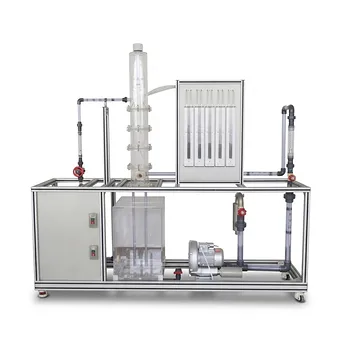
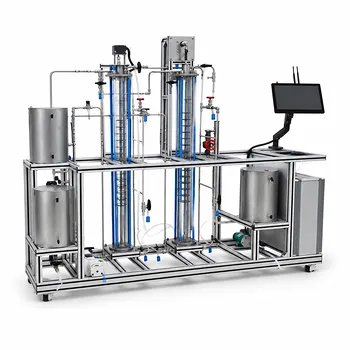
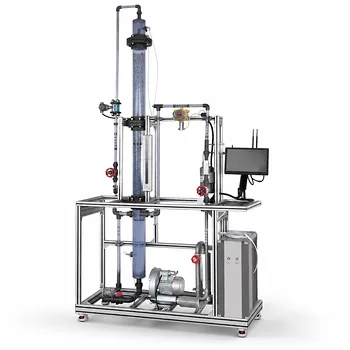
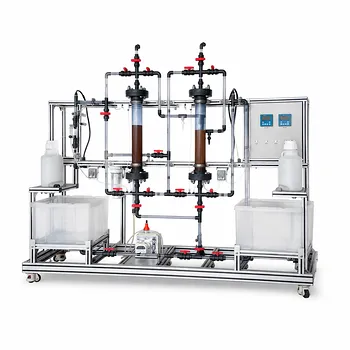
Are you looking to achieve precise control over mass transfer and hydrodynamic studies in your lab? LABPARK provides state-of-the-art Educational and Vocational Unit Operations Pilot Plants in chemical engineering, bioprocess & biotech, and environmental & water treatment.
Designed specifically for universities, research institutes, and enterprises, our pilot plants enable researchers and students to experiment with advanced configurations, including high-efficiency sparger systems.
Ready to elevate your research and teaching capabilities? Contact LABPARK today to discuss your customized pilot plant requirements!
Related Products
- Plate Column Hydrodynamics Tray Demonstration Educational Pilot Plant
- Comprehensive Liquid-Liquid Extraction Pilot Plant for Engineering Education
- Absorption and Desorption Educational Unit Operations Pilot Plant
- Packed Bed Absorption Educational Unit Operations Pilot Plant
- Multi-Functional Special Distillation Educational Pilot Plant
People Also Ask
- How to update chemometric calibration models in pilot plants? Best practices for process engineers.
- Why Correct Sig Figs & Rounding Matter in Educational Pilot Plants: Ensure Data Accuracy
- How can educational pilot plants be used to teach process safety and risk assessment in chemical engineering curricula?
- How does nuclear yield inefficiency translate to chemical engineering education? Optimize kinetics with pilot plants.
- Why Calculate Sieve Tray Pressure Drop? Optimize Distillation Pilot Plant Performance