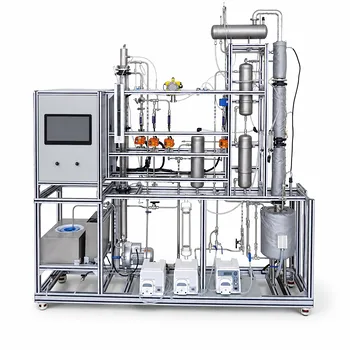
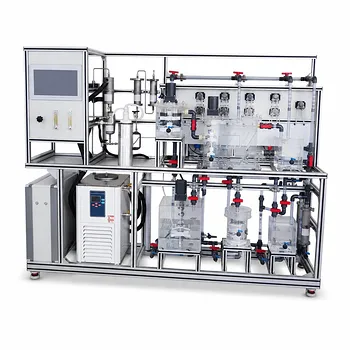
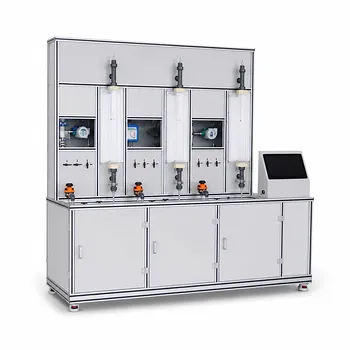
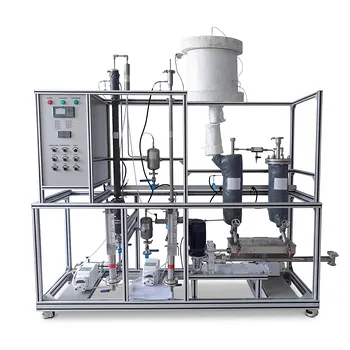
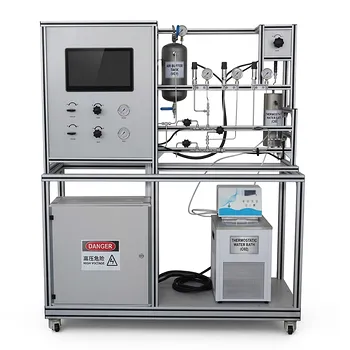
A vocational hydrocarbon dew point pilot plant must be built around an industrial membrane separation stage. The centerpiece is a membrane module (organophilic hollow-fiber or spiral-wound) that strips heavier hydrocarbons from a natural gas stream. To replicate real fuel-gas conditioning, the plant needs modular permeate handling: one path recycles permeate through a re-compressor and condenser for maximum recovery, while a second path routes it directly as a low-pressure fuel gas. This dual-configuration lets trainees manipulate pressure, temperature, and flow, then observe dew-point depression and methane number improvement under simulated ambient conditions—exactly the decisions operators face in the field.
To build workforce-ready skills, a training pilot plant must combine a commercial-style membrane stage with switchable permeate routing and precise environmental control. That architecture turns abstract phase envelopes and methane numbers into hands-on operational cause-and-effect, while embedding the safety and pretreatment steps that protect real assets.
The Core Membrane Configuration: Dew Pointing and Permeate Handling
The primary reference makes it clear: industrial hydrocarbon dew pointing is best taught by faithfully replicating the membrane separation process. Every design decision flows from that principle.
The Membrane Stage as the Unit Operation
Organophilic membranes preferentially permeate C3+ hydrocarbons and aromatics, leaving a conditioned natural gas stream on the high-pressure side with a lower hydrocarbon dew point. The pilot module should be rated for typical pipeline or fuel-gas pressures (20–100 bar) and equipped with temperature and pressure sensors immediately upstream and downstream. This allows trainees to map the relationship between feed conditions and permeate quality, foundational for understanding phase envelopes.
Modular Permeate Routing
Two plant configurations must be selectable via valving or jumper spools. Recycle mode sends the hydrocarbon-rich permeate through a re-compressor and condenser—teaching the energy penalty of deep dew-point control. Fuel-gas mode directs the permeate to a low-pressure header (or a safe vent stack), simulating the most common field practice where permeate is consumed as compressor fuel. Switching between modes lets trainees calculate mass balances and energy trade-offs themselves.
Thermodynamic Training Under Simulated Ambient Temperatures
Install a feed gas heater/chiller upstream of the membrane to mimic seasonal or nighttime cooling. Coupled with online dew-point meters and a gas chromatograph sampling port, the plant gives operators real-time data to construct thermodynamic phase envelopes. They learn precisely how lowering the feed temperature raises the dew-point margin, and how membrane cut rates adjust the resulting methane number (often raising it from ~35 to well above 50 to prevent engine knocking).
Ancillary Units That Make Training Real
Operators on a production site never see a naked membrane skid. The pilot plant must teach the upstream and safety disciplines that surround it.
Feed Pretreatment and Conditioning
Ahead of the membrane, include a coalescing filter, a knockout drum, and a feed preheater. This physically treats the gas to remove free liquids and ensure the membrane sees only vapor. Trainees practice setting the preheater to stay above the gas’s water dew point, directly linking raw feed variability to membrane health. This replicates the typical industrial “feed pretreatment → physical separation” sequence and prevents the most common membrane failure: liquid carryover.
Safety Instrumented System
Because natural gas is flammable, the pilot plant must incorporate explosion-proof electrical enclosures, point gas detectors for methane and heavier hydrocarbons, pressure relief valves, and flame arrestors on vents. An automatic shut-off system triggered by high pressure or gas detection gives trainees the muscle memory for emergency response. Vocational environments gain double value: operators learn process control and the layered protection required by industrial safety codes.
Comprehensive Instrumentation and Data Acquisition
Equip every critical point: pressure transmitters, temperature probes, flowmeters, and an online hydrocarbon dew-point analyzer. Link them to a SCADA system that logs trends and allows operators to adjust setpoints. This data-rich setup turns abstract concepts—compaction, boundary layer effects, methane number optimization—into visible trends and calculated performance curves.
Understanding the Trade-Offs
Membrane dew pointing is energy-efficient and low-maintenance compared to cryogenic condensation or absorption, but it has clear limits that operators must learn to manage.
Membrane Compaction and Boundary Layer Effects
At the pilot scale, deliberately run the plant at high differential pressure to show how membrane substructures compact over time, reducing permeability. Operate at reduced cross-flow velocity to demonstrate boundary layer (concentration polarization) effects that lower selectivity. These observations teach the real-world compromise: recovery rate vs. methane number lift is never free.
The Recovery–Quality Dilemma
Recycling permeate yields a higher-conditioned gas recovery but demands substantial compression energy and cooling duty. Using permeate as fuel is simpler, but the heating value of that low-pressure stream must be evaluated against the primary fuel’s methane number target. Trainees learn to quantify this economic vs. operational trade-off—a skill directly transferable to field optimization.
Limits of Pilot Scale Simulation
A small-scale plant cannot replicate the full energy integration or the massive membrane surface area of a commercial unit. However, it excels at demonstrating dynamic response to changed setpoints, which is exactly the operator’s core job. What’s sacrificed in absolute production volume is gained in observability and repeatability for deep learning.
Making the Right Choice for Your Training Goal
Design decisions should be driven by the primary skill you want to build. Use these focus areas to tailor the plant’s configuration and capability.
- If your primary focus is fundamental hydrocarbon dew-point control: Build the plant around a single-stage membrane cell with a wide operating pressure envelope, a reliable feed chiller, and real-time dew-point readout. Include the recycle and fuel-gas paths so trainees can connect pressure ratio and stage cut to dew-point depression directly.
- If your primary focus is fuel-gas conditioning for gas engines: Integrate a small combustion engine simulator or a fast-response calorimeter. Use the feed heater/chiller to vary the simulated ambient temperature and let trainees quantify how the membrane’s methane number lift (from ~35 to >50) eliminates engine knocking at each condition.
- If your primary focus is safe, compliant plant operation: Prioritize a full safety instrumented system—gas detection, flame arrestors, hardwired shutdown logic—and require trainees to execute a formal startup/shutdown sequence and a simulated emergency drill. That muscle memory is far more valuable than any theoretical calculation.
- If your primary focus is understanding membrane limits: Opt for a module that can be operated near its maximum differential pressure for sustained periods. Include a spare module or a viewing window so operators can inspect membrane elements and see physical signs of compaction or fouling, turning abstract degradation mechanisms into a visual lesson.
A well-designed vocational pilot plant doesn’t just mirror an industrial P&ID—it forces the operator to sense, decide, and react exactly as they would on an operating plant, building genuine troubleshooting instinct alongside technical knowledge.
Summary Table:
| Configuration Component | Key Feature | Training Value |
|---|---|---|
| Membrane Stage | Organophilic hollow-fiber/spiral-wound | Learn dew-point depression & phase envelopes |
| Permeate Routing | Recycle & Fuel-Gas modes | Understand mass balances & energy trade-offs |
| Pretreatment Unit | Coalescing filter & knockout drum | Prevent liquid carryover & protect membrane health |
| Safety Systems | Gas detection & auto shut-off | Practice emergency response & industrial safety codes |
Elevate Your Practical Training with LABPARK
Are you looking to equip your students or operators with hands-on, industry-ready skills? LABPARK provides advanced Educational and Vocational Unit Operations Pilot Plants in chemical engineering, bioprocess & biotech, and environmental & water treatment for universities, research institutes, and enterprises.
Bring real-world process dynamics into your facility with our customizable, safe, and highly instrumented pilot systems. Contact us today to discuss your project requirements!
Related Products
- Carbon Dioxide Hydrogenation Methanol Synthesis Educational Unit Operations Pilot Plant
- Methane Cracking Educational Unit Operations Pilot Plant
- Fixed-Bed Chemical Reaction and Gas Dust Tar Removal Unit Operations Pilot Plant
- Multi-Functional Special Distillation Educational Pilot Plant
- Natural Product Extraction Unit Operations Training Pilot Plant
People Also Ask
- How do temperature variations affect CO2 transport models in pilot plants? Model vs Reality
- Why is a purge system necessary when operating a gas recirculation loop in a methanol synthesis pilot plant? (Guide)
- How do temp & pressure affect methanol synthesis pilot plants? Optimize equilibrium and catalyst performance.
- How do CVD parameters affect stoichiometry and phase purity? Optimize thin film deposition.
- Why do modern methanol pilot plants operate at lower pressures? Catalyst & Feed Requirements Explained