The most delicate dance in scaling up a bioreactor is not one of size, but of physiological preservation. The critical factors are maintaining a constant volumetric oxygen transfer coefficient (kLa) to meet the culture’s respiratory demand, carefully balancing impeller speed and gas flow rate to prevent lethal hydrodynamic shear stress, and redesigning the heat transfer system to compensate for the dramatically reduced surface-area-to-volume ratio of larger vessels. If these three elements are not harmonized, a robust lab-scale process will fail catastrophically at the pilot stage.
The surface need is a checklist of factors, but the deep need is to understand how these variables fight each other. Scaling agitation and aeration is a trilemma: you cannot simultaneously maximize oxygen delivery, minimize cell damage, and effortlessly remove heat. The art of scale-up lies in strategically choosing a dominant scaling criterion—usually constant kLa or constant power per unit volume—and then engineering the loss of the other gifts back into the system through targeted investments in cooling and careful impeller selection.
The Heart of Aerobic Bioprocessing: Oxygen Transfer
The entire purpose of agitation and aeration in an aerobic bioreactor is to dissolve oxygen into a liquid broth full of respiring cells. As volume increases, maintaining this function becomes disproportionately harder.
Why kLa is the North Star for Scale-Up
The volumetric oxygen transfer coefficient (kLa) dictates how effectively oxygen moves from gas bubbles into the liquid phase. In most aerobic cultures, the maximum achievable cell density is limited directly by oxygen supply. So, the primary reference and decades of industrial experience state that keeping kLa constant across scales is the single most critical factor.
If kLa drops during scale-up, your cells move from a feast of oxygen to a famine, triggering stress responses, changing metabolism, and cratering productivity. The entire pilot plant exercise then becomes an investigation into oxygen starvation, not a meaningful technology demonstration.
The Agitation-Aeration Balance
You cannot simply increase the impeller speed to boost kLa. Higher speeds generate excessive shear stress that can rip the membranes of sensitive mammalian or filamentous cells. The pilot plant design must, therefore, achieve the target kLa by balancing impeller speed with a higher air flow rate.
Increasing gas flow offers more oxygen without proportionally increasing the mechanical forces on the cells. However, you cannot raise gas flow indefinitely without risking flooding, where the impeller becomes engulfed in gas and mixing stops completely. This interplay is the central tension of the design.
The Unseen Challenge: Shear Stress and Cell Viability
If oxygen is the engine’s fuel, the living cell is the engine itself. Damage it, and nothing else matters.
The Tip Speed Criterion for Shear-Sensitive Cultures
In bioprocesses where cells are fragile, the maximum shear rate, related directly to the impeller tip speed, becomes the dominant constraint. The supplementary references emphasize the constant tip speed scaling rule: N_plant = N_lab * s (where s is the geometric scale factor). By keeping tip speed constant, you ensure the maximum fluid velocity at the blade edge—the primary source of lethal shear—does not increase.
This criterion is non-negotiable for many animal cell and stem cell processes. However, it comes at a heavy price: at a constant tip speed, the larger vessel’s impeller rotates much slower, which can drastically reduce the bulk mixing and oxygen transfer rates.
When Shear is Not the Limiting Factor
For robust organisms like E. coli or yeast, shear damage may be secondary. Yet you must still manage mechanical forces. That means integrating baffles to prevent the formation of a deep vortex that could pull gas into the shaft seal and starve the fluid of mixing. It also means monitoring motor torque on the pilot system’s mechanical drive as a real-time indicator of broth viscosity and potential cell lysis. Safety and control at the pilot scale are not manual; they are embedded in automated control loops that maintain consistent mixing without human intervention.
The Thermal Crisis of Scale-Up: Heat Transfer
As the vessel grows, a steel wall becomes your enemy rather than your ally.
The Surface-Area-to-Volume Trap
Metabolic heat generated by the cells scales with the volume (V), but the surface area (A) available for natural heat dissipation scales with only V^(2/3). The primary reference makes this explicit: the surface-area-to-volume ratio plummets. A 3-liter bench-top reactor might dissipate heat through its glass walls with a gentle fan, but a 300-liter pilot vessel becomes a massive, self-insulating oven.
Without mitigation, the temperature spikes, enzyme kinetics shift, and the cells cook. This fundamental physical reality demands a step-change in thermal engineering.
Integrating Cooling with External Jackets and Internal Coils
Pilot systems must proactively strip this heat. You can no longer rely on passive convection; you must add external cooling jackets, internal cooling coils, or even external heat exchanger loops. These add geometric complexity, introduce new shear forces near the coil surfaces, and demand a larger capital investment. The adjustable agitation speed now serves a dual purpose: increasing it helps heat transfer into the cooling surfaces, but it also generates more heat. The pilot phase exists to find the precise economic and biological balance.
Selecting the Right Scaling Criterion: A Systematic Approach
No single mathematical rule translates a 1-liter process to a 1000-liter one. The choice is a strategic decision based on your organism’s biology.
The Four Classical Scale-Up Rules
The supplementary references lay out the four options evaluated using geometrically similar vessels:
- Constant Reynolds Number (Re): Keeps flow patterns identical but leads to impractically low rotational speeds at scale. Almost never used for mass-transfer-limited processes.
- Constant Power per Unit Volume (P/V): Ensures equal energy input, preserving mixing intensity and bubble break-up. This is the default starting point for most chemical and robust-cell bioprocesses. The scale-up formula is
N_plant = N_lab * s^(-2/3). - Constant Impeller Tip Speed: Preserves maximum shear rate, essential for fragile cells, but sacrifices mixing and heat transfer at large scale.
- Constant Mass/Heat Transfer Coefficients: Applied when the reaction is entirely transport-limited, using empirical correlations to calculate the required speed and power.
The internal conflict is ruthless: a single numerical choice protects one physical phenomenon at the expense of the others.
Power per Unit Volume (P/V) as the Pragmatic Starting Point
For many pilot programs, constant P/V is the preferred initial condition, as cited in both the crystallization and fermentation supplementary materials. It offers a rational basis for maintaining mixture homogeneity and initial kLa while minimizing particle attrition. By pairing constant P/V with adjustable superficial gas velocity, you can then experimentally tune the oxygen transfer rate. This systematic, step-by-step validation in the pilot plant—measuring actual power curves and kLa readings across multiple scales—de-risks the final industrial design.
Understanding the Trade-offs
Pilot-scale work is not about finding a perfect solution; it is about objectively quantifying the compromises required by physics.
The Inevitable Conflict Between Mixing, Shear, and Cost
A higher agitation rate improves kLa and heat transfer but destroys shear-sensitive cells and burns exponentially more electricity. As the supplementary references note, higher fermentation rates reduce vessel capital costs but simultaneously increase aeration and cooling operating costs. You could also elevate the operating pressure to force more oxygen into solution, but that demands a pressure-rated vessel, dramatically increasing capital expense.
The pilot plant’s true value is generating the data that allows an economic optimization, minimizing the net present value of both capital and operating costs.
Pitfalls in Assuming Identical Flow Regimes
A dangerous hidden trap is the shift in fluid dynamics. At the small scale, surface tension and wall effects dominate; at a larger scale, the superficial gas velocity and liquid flow paths can change, creating dead zones or altering the residence-time distribution. An external mass transfer resistance that controlled the rate in the lab may vanish in the pilot plant, or vice versa. Assuming geometric similarity alone will save you is a recipe for failure. You must verify.
Making the Right Choice for Your Goal
The ideal pilot protocol depends on what you are protecting most. Align your scaling criterion with your process’s unique fragility.
- If your primary focus is maintaining cell viability and product quality: Prioritize the constant impeller tip speed criterion, and accept that you will need to invest in enhanced cooling and tolerate a lower maximum oxygen transfer rate.
- If your primary focus is maximizing productivity and oxygen supply: Anchor your scale-up on maintaining a constant kLa, using constant P/V as your initial mechanical foundation, and then implement aggressive active cooling via jackets and internal coils to remove the resulting heat.
- If your primary focus is minimizing scale-up risk: Conduct a systematic pilot-plant campaign across three geometrically similar vessel sizes, measuring power, kLa, and temperature profiles to build a predictive model, rather than relying on a single theoretical criterion.
Ultimately, scaling agitation and aeration successfully means treating oxygen, shear, and temperature not as independent variables but as three limbs of a single, living body. Your role at the pilot scale is to learn the precise choreography that allows your cells to breathe deeply, stay cool, and remain whole as you grow them into industrial reality.
Summary Table:
| Scale-Up Criterion | Core Metric / Formula | Main Advantage | Primary Limitation / Disadvantage |
|---|---|---|---|
| Constant kLa | Oxygen transfer coeff. | Maintains oxygen supply | Can increase shear stress |
| Constant P/V | Power per unit volume | Standard for robust cells | May cause shear in fragile cultures |
| Constant Tip Speed | N_plant = N_lab * s | Minimizes shear damage | Reduces bulk mixing & heat transfer |
| Constant Re | Reynolds number | Identical flow patterns | Impractically low rotational speeds |
Bring Industrial-Scale Precision to Your Lab
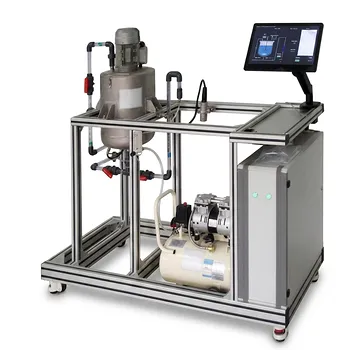
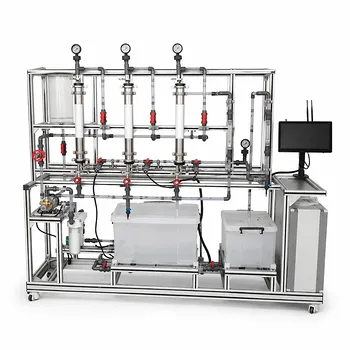
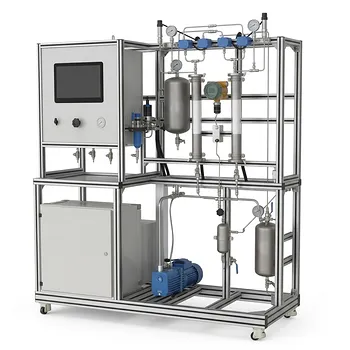
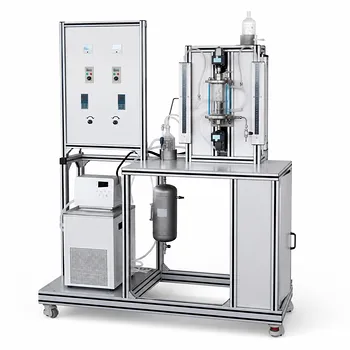
Scaling up bioprocesses requires the right equipment to transition seamlessly from bench to pilot scale. LABPARK provides state-of-the-art Educational and Vocational Unit Operations Pilot Plants in bioprocess & biotech, chemical engineering, and environmental & water treatment. Designed specifically for universities, research institutes, and enterprises, our systems help you master agitation, aeration, and heat transfer challenges with ease.
Ready to optimize your pilot-scale operations? Contact our experts today to find the perfect pilot plant solution for your institution.
Related Products
- Agitation and Mixing Educational Unit Operations Pilot Plant
- Micro-Scale Gas-Solid Catalytic Reaction Educational Pilot Plant
- Bio-fermentation Ethanol Production Practical Training Unit Operations Pilot Plant
- Multi-Reactor Educational Pilot Plant for Reaction Engineering Unit Operations
- Rising and Falling Film Evaporation Educational Unit Operations Pilot Plant
People Also Ask
- How do cost-capacity exponents vary across chemical equipment? Scaling insights.
- What are the primary considerations when managing and scaling up shear rates in pilot plant mixing operations? Guide
- What are the differences between set-point, servo, and program control? Master unit operations training.
- Evaluate Tablet Compaction: Force, Density & Porosity in Unit Operations Pilot Plants
- Why Switch Unit Operations Flow Configurations? Impact on Experimental Measurements