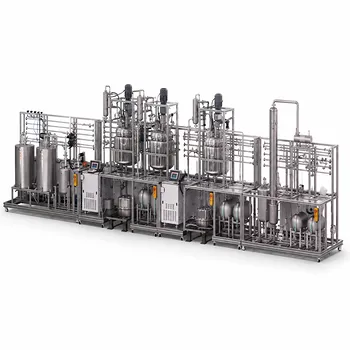
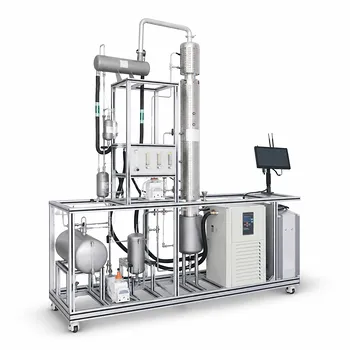
Total vs. partial condensers and direct vs. indirect heating methods are the primary thermodynamic configurations evaluated on chemical engineering unit operations pilot plants. These systems are typically built with total condensers for clean reflux control and indirect heating (electric reboilers or steam jackets) to avoid product dilution. By deliberately switching to a partial condenser or analyzing a direct steam injection setup, students can measure how these choices shift heat duty, mass balance, and separation efficiency.
The real value of a pilot plant lies not in running a single standard configuration, but in using it to explore how the choice between total/partial condensation and direct/indirect heating fundamentally changes process controllability, product purity, and energy integration. These experiments bridge textbook thermodynamics and the messy trade-offs of industrial design.
Condenser Configurations: Evaluating Total vs. Partial Operation
The type of condenser installed on a distillation pilot plant determines the physical state of the overhead product and the amount of liquid sent back to the column as reflux.
Total Condensers: The Standard for Clean Reflux Control
A total condenser condenses all of the rising vapor into a saturated liquid at the column's top pressure. In a pilot plant, this is the default choice. It simplifies reflux control by ensuring that the liquid returning to the column is in a known, subcooled or saturated state, making composition sampling straightforward. Students can immediately correlate heat duty with a complete mass balance because the overhead vapor is fully recovered as a liquid distillate stream.
Partial Condensers: Unlocking an Additional Theoretical Stage
A partial condenser is intentionally designed to condense only a portion of the overhead vapor. The uncondensed vapor becomes the distillate product, while the condensate forms the reflux. Thermodynamically, a partial condenser acts as one additional theoretical stage because it performs an equilibrium flash separation. Evaluating this configuration on a pilot plant teaches a critical lesson: a partial condenser can boost separation efficiency without adding column height, but it complicates control and requires careful handling of vapor product lines.
Beyond Condenser Duty: Physical Orientation and Flow Path
While the total/partial decision is thermodynamic, pilot plant setups often also expose students to the physical layout of the condenser itself—a factor that directly impacts heat transfer performance.
Horizontal Shell‑Side Condensation as the Industrial Baseline
The most common industrial condenser configuration is horizontal with condensation on the shell side. This layout offers high heat transfer coefficients and is easy to maintain. Providing this setup in a pilot plant lets students measure the influence of vapor shear and condensate inundation on overall heat transfer rates—key data for scaling up.
Vertical Condensers for Film Mechanism Analysis
In a vertical condenser, condensate forms a film that flows downward under gravity. As the film thickens, it can develop wave effects or become turbulent. A pilot plant that features both horizontal and vertical configurations allows a direct comparison of film condensation mechanisms, pressure drops, and the impact of vapor velocity. This side-by-side evaluation is impossible from a textbook alone and highlights why orientation is not a trivial manufacturing detail.
Heating Methods: Balancing Product Integrity and Process Simulation
How energy is supplied to the reboiler directly influences the bottom product composition, the accuracy of heat duty calculations, and the ease of replicating industrial conditions.
Indirect Heating via Electric Reboilers or Steam Jackets
Indirect heating—typically using electric cartridge heaters or a steam jacket—is the norm on a pilot plant. Its primary advantage is that it does not dilute the bottom product, preserving the liquid’s composition so that students can perform precise mass balances. It also simplifies heat duty measurement: the power input to an electric reboiler or the condensate flow from a steam jacket can be tracked exactly, making it a clean experimental variable.
The Dilution Trap of Direct Steam Injection
Direct steam injection introduces live steam into the column’s base. While it is an authentic industrial practice for systems that can tolerate water dilution, on a pilot scale it often obscures the very lesson it’s meant to teach. The added steam dilutes the bottom product, making it harder to close the material balance and calculate intrinsic separation efficiency. Evaluating this configuration side-by-side with indirect heating forces students to quantify the operational trade-off between simplicity and product purity.
Understanding the Trade-offs and Hidden Risks
No configuration is universally “better.” Each choice carries technical and safety consequences that must be actively managed in a teaching or research environment.
- Partial condensers add a separation stage but introduce complexity. The presence of a vapor distillate stream demands precise pressure and level control, and any deviation skews the reflux ratio. Students must see this as a control challenge, not just a thermodynamic bonus.
- Horizontal vs. vertical condenser selection changes the maintenance profile. Vertical units can suffer from uneven film distribution, while horizontal shell-side models may trap non-condensables. Pilot plant instructors should surface these practical limits.
- Direct steam injection compromises mass balance clarity. It is pedagogically valuable only when the experimental objective is to study the dilution effect itself or to simulate a process where water is a component.
- Sealing and thermal fluid hazards scale with complexity. Configurations that involve thermal oil heating or high-pressure steam introduce risks at gasket, sight glass, and pump seal interfaces. A pilot plant that uses swappable heating skids, for example, must be scrutinized for leak integrity and over-temperature protection.
Making the Right Choice for Your Educational or Research Goal
Your selection of condensation and heating configurations should be driven entirely by the core skill you want participants to walk away with. Align the hardware with the learning outcome.
- If your primary focus is mastering heat and mass balances: Stick with a total condenser and indirect electric heating. This eliminates dilution ambiguity and gives you a clean, measurable system.
- If your primary focus is advanced separation theory: Install a partial condenser and run it alongside a total condenser column. The direct comparison of stages, product states, and control strategies is invaluable.
- If your primary focus is equipment design and scale-up: Include both horizontal and vertical condenser modules. This reveals how physical layout alters the heat transfer coefficient and pressure drop, which directly feeds into capital cost estimates.
- If your primary focus is plant-level energy integration: Add a utility network that lets students shift between steam levels, cooling water, and even boiler feed water preheating, using pinch analysis rules to minimize energy waste.
The best pilot plant is not the one with the most complex hardware, but the one that makes the consequences of each configuration choice transparent, measurable, and impossible to ignore.
Summary Table:
| Configuration Option | Key Characteristics | Primary Advantage | Best Educational/Research Focus |
|---|---|---|---|
| Total Condenser | Condenses all rising vapor into liquid | Simplifies reflux control & mass balance | Standard teaching & baseline testing |
| Partial Condenser | Condenses partial vapor; vapor is product | Acts as one additional theoretical stage | Advanced separation & control theory |
| Indirect Heating | Electric reboiler or steam jacket | No product dilution; precise heat duty | Clean mass & energy balance validation |
| Direct Steam Injection | Live steam injected into column base | Simulates specific industrial processes | Dilution study & industrial simulation |
Elevate Your Chemical Engineering Lab with LABPARK
Choosing the right configuration for your pilot plant is crucial for bridging textbook thermodynamics and practical industrial design.
LABPARK provides premium Educational and Vocational Unit Operations Pilot Plants in chemical engineering, bioprocess & biotech, and environmental & water treatment. Designed specifically for universities, research institutes, and enterprises, our pilot plants feature flexible configurations—including swappable condenser orientations and heating methods—to give your students and researchers hands-on experience with real-world process trade-offs.
Ready to upgrade your lab's capabilities? Contact LABPARK today to customize the perfect pilot plant setup for your curriculum or research needs!
Related Products
- Carbon Dioxide Hydrogen Methanol Synthesis Educational Unit Operations Pilot Plant
- Multi-Reactor Educational Pilot Plant for Reaction Engineering Unit Operations
- Ethyl Acetate Synthesis Unit Operations Pilot Plant for Practical Training
- Multi Pump Fluid Transport Process Piping Unit Operations Training Pilot Plant
- Natural Product Extraction Unit Operations Training Pilot Plant
People Also Ask
- How do temp & pressure affect methanol synthesis pilot plants? Optimize equilibrium and catalyst performance.
- Why is a purge system necessary when operating a gas recirculation loop in a methanol synthesis pilot plant? (Guide)
- Why do modern methanol pilot plants operate at lower pressures? Catalyst & Feed Requirements Explained
- What are the operational requirements for catalyst activation? Safe Methanol Pilot Plant Operation
- Why is the chemical plant startup schedule crucial? De-risk scale-up with pilot plants.