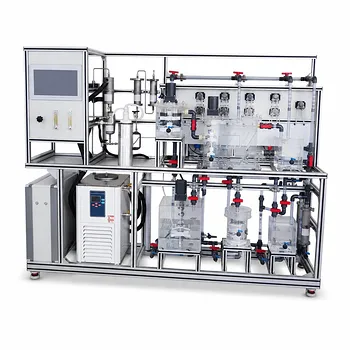
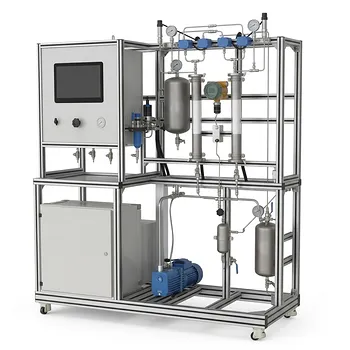
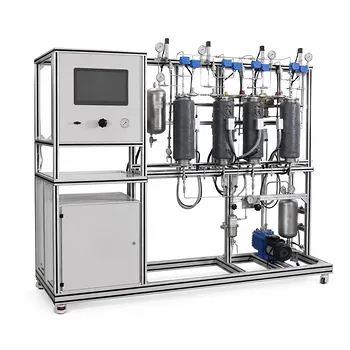
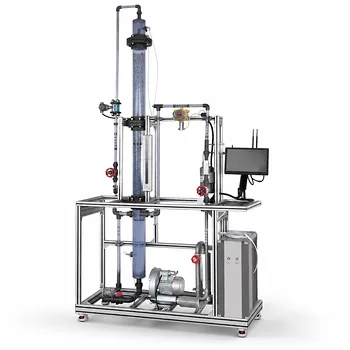
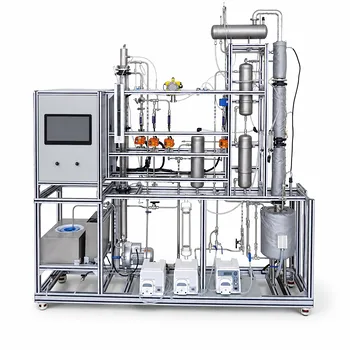
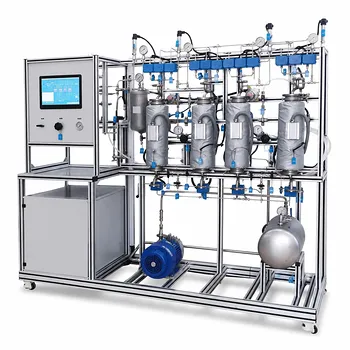
Gas scrubbing pilot plants designed to demonstrate hydrogen cyanide removal from cracking byproducts must be configured to recirculate a reactive sodium polysulfide solution through a packed or trayed absorption column. The setup requires precise control of both liquid and gas flow rates, as well as a chemical dosing system to maintain the polysulfide concentration. This configuration allows the cyanide ions to chemically react with polysulfide, forming thiocyanate and sulfide, while enabling study of absorption kinetics and gas-liquid contact efficiency.
While many gas absorption units simply transfer a solute from gas to liquid, demonstrating HCN removal demands a chemically reactive system. The core requirement is a recirculating sodium polysulfide loop within a well-instrumented column, letting users see how chemical reaction enhances absorption and prevents toxic cyanide slip.
The Chemistry Behind the Configuration: Why Sodium Polysulfide?
Chemical absorption differs fundamentally from physical absorption. In HCN scrubbing, the solute undergoes a fast, irreversible reaction in the liquid phase. This eliminates the equilibrium back‑pressure of HCN, dramatically increasing mass transfer driving force.
The Reaction That Drives Removal
Cyanide ions (CN⁻) react with polysulfide ions (Sₙ²⁻) to form thiocyanate (CNS⁻) and sulfide (S²⁻). The reaction is rapid and turns a highly toxic volatile species into a stable, less hazardous liquid-phase product. Because the HCN is chemically destroyed, the scrubbing liquid never reaches saturation; the process can achieve near‑complete removal even at low liquid flow rates.
Why Recirculation Is Critical
A single pass of fresh polysulfide solution would be wasteful and impractical. Recirculating the scrubbing liquor allows the same solution to be reused while the polysulfide is gradually consumed. The chemical dosing system then replenishes the reactant, maintaining steady-state conditions that are essential for reproducible kinetic studies.
Essential Pilot Plant Configuration
To faithfully demonstrate this industrial process, the pilot plant must integrate several tightly controlled subsystems.
1. The Absorption Column
The column must provide intimate gas‑liquid contact. Both packed columns and trayed columns are suitable:
- Packed columns offer high interfacial area and low pressure drop, ideal for studying mass transfer coefficients.
- Trayed columns let users observe stage-wise contact and are easier to sample at different heights.
A modular design, with adjustable bed heights or the ability to connect two columns in series, further allows investigation of the impact of contact volume on removal efficiency.
2. Liquid and Gas Flow Control Systems
Precise flow metering is non‑negotiable. The liquid-to-gas ratio (L/G) directly influences HCN capture and the onset of flooding. A pilot plant must include:
- Mass flow controllers or rotameters for gas (typically a simulated flue gas containing HCN, nitrogen, and perhaps CO₂).
- Variable‑speed chemical metering pumps for the liquid loop, enabling manipulation of recirculation rate.
- Differential pressure transmitters across the column to monitor pressure drop and detect flooding or foaming.
3. Chemical Dosing and Replenishment
Sodium polysulfide concentration decays as it reacts. A dosing system—usually a small tank with a metering pump—continuously or intermittently adds fresh polysulfide solution at a rate calibrated to the incoming HCN load. This system is vital for demonstrating steady‑state operation and for studying the effect of reactant concentration on kinetics.
4. Analytical and Safety Instrumentation
Hydrogen cyanide is extremely toxic. The rig must be equipped with HCN detectors at the gas outlet and within the laboratory, along with a scrubber on the vent. On‑line analyzers (such as ion‑selective electrodes for cyanide and sulfide, or UV‑Vis for thiocyanate) allow students to monitor the liquid phase and calculate the reaction rate.
Monitoring and Control Parameters That Define Success
Running a meaningful demonstration means measuring more than just inlet and outlet concentrations. Key observables include the rate of thiocyanate formation, which confirms chemical reaction, and the pressure drop across the column, which indicates hydraulic performance. Users should also track liquid‑phase pH, as the polysulfide reaction can shift alkalinity, and monitor liquid holdup to avoid premature flooding.
Understanding the Trade‑offs
A sodium polysulfide system is not without its challenges. Being transparent about these builds credibility and provides a complete learning experience.
Chemical Handling and Stability
Sodium polysulfide solutions are corrosive, have a strong odor, and can release hydrogen sulfide if the pH drops too low. The pilot plant must use compatible wetted materials (e.g., stainless steel or PTFE-lined components) and be operated under slight vacuum or with proper vent scrubbing. Over‑time, polysulfide can also decompose or form precipitates, so the dosing system needs careful design.
Safety Complexity
Working with HCN demands gas‑tight construction, redundant safety shutoff systems, and strict operational protocols. For educational settings, this often means limiting HCN concentrations in the feed gas and building in an emergency ventilation system. The added safety infrastructure increases cost and complexity, but it is non‑negotiable.
Limited Representativeness for Physical Absorption
Because the reaction is so fast, the system masks the limitations that would plague a purely physical absorption column. Users may see a “perfect” removal curve unless they intentionally reduce the polysulfide dose or push gas flow rates. A robust pilot plant design therefore includes the ability to operate in a non‑reactive mode (with plain water) as a baseline, helping students understand exactly what the chemical reaction contributes.
How to Apply This to Your Project
The “right” configuration depends on your learning or demonstration goals. Use the following focus areas to guide your design decisions.
- If your primary focus is classroom instruction on reaction kinetics: Choose a packed column with multiple sample ports along the height. Install on‑line cyanide or polysulfide analyzers and ensure you can vary both L/G and reactant concentration independently.
- If your primary focus is scale‑up or industrial simulation: Use a trayed column and implement a full recirculation loop with automated dosing. Add the ability to connect columns in series so you can generate data on stage efficiencies and minimum tray requirements.
- If your primary focus is safety and environmental compliance training: Instrument the rig with redundant HCN sensors, automatic shutoff valves, and a secondary polish scrubber on the gas outlet. Emphasize the role of chemical conversion in reducing emissions to trace levels.
- If your primary focus is fundamental absorption fluid dynamics: Include an option to bypass the chemical dosing and run with a non‑reactive solution. This lets you isolate and study flooding, loading, and pressure drop without the confounding effect of a fast chemical reaction.
A well-configured gas scrubbing pilot plant becomes more than a black‑box HCN remover—it turns into a transparent, tunable platform for mastering chemical absorption principles in a single, safe experiment.
Summary Table:
| System Component | Key Configuration Requirement | Purpose & Function |
|---|---|---|
| Absorption Column | Packed or trayed column with modular bed heights | Provides high interfacial area for gas-liquid contact and mass transfer studies. |
| Flow Control | Mass flow controllers & variable-speed dosing pumps | Manages the liquid-to-gas (L/G) ratio precisely to prevent column flooding. |
| Chemical Dosing | Recirculating loop for sodium polysulfide (S_n^2-) | Replenishes reactant to maintain steady-state kinetics and continuous HCN removal. |
| Safety & Analytics | HCN detectors, pH meters, & vent scrubbing systems | Ensures operator safety while monitoring thiocyanate formation and reaction rates. |
Scale Up Your Chemical Engineering Training with LABPARK
Need to demonstrate advanced gas absorption and mass transfer principles in your facility? LABPARK designs and manufactures state-of-the-art Educational and Vocational Unit Operations Pilot Plants tailored for chemical engineering, bioprocess & biotech, and environmental & water treatment applications.
We help universities, research institutes, and enterprises build safe, highly accurate, and fully instrumented experimental rigs that make complex chemical processes tangible for students and researchers alike.
Ready to elevate your laboratory capabilities? Contact LABPARK today to discuss your custom pilot plant configuration!
Related Products
- Methane Cracking Educational Unit Operations Pilot Plant
- Fixed-Bed Chemical Reaction and Gas Dust Tar Removal Unit Operations Pilot Plant
- Micro-Scale Gas-Solid Catalytic Reaction Educational Pilot Plant
- Dual-Mode Gas Absorption and Desorption Unit Operations Training Pilot Plant
- Absorption and Desorption Educational Unit Operations Pilot Plant
People Also Ask
- How do ethane vs naphtha cracking influence teaching pilot plant analytical configurations? Key Design Guide
- How can flow-NMR be integrated with pilot plant reactors to monitor kinetics? A Complete Guide
- How do cracking temperature and residence time affect olefin yield? Pilot Plant Guide
- How are utility consumption rates integrated into chemical pilot plant economic evaluations?
- How should OSBL investments be estimated? Key Steps to Avoid Budget Overruns in Pilot Plant Projects