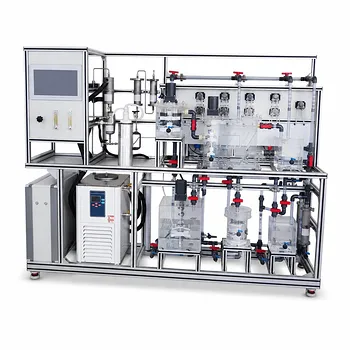
Steam distillation leverages a fundamental thermodynamic loophole. By introducing water vapor into a system with high-boiling, immiscible oils like limonene (bp 175.5–176.5°C), the mixture boils at a temperature far below 100°C, effectively vaporizing the oil without destroying it. In an educational pilot plant, this is achieved by passing live steam through biomass, then condensing and phase-separating the distillate.
The true thermodynamic advantage is that Dalton’s Law of Partial Pressures allows an immiscible liquid to vaporize when its own partial pressure equals just the difference between atmospheric pressure and the water vapor pressure—not its own standalone vapor pressure. For limonene, this shifts the effective boiling point below 100°C, protecting heat-sensitive aromatics while making the process demonstrably simple to study and control in a teaching lab.
The Thermodynamic Principle That Protects the Oil
Leveraging Dalton’s Law for Low-Temperature Boiling
Steam distillation works because water and the essential oil are essentially immiscible. In an immiscible mixture, each component behaves as if it were alone, contributing its own vapor pressure independently.
At any given temperature, the total vapor pressure is ( P_{\text{total}} = P_{\text{water}} + P_{\text{oil}} ). The mixture will boil and begin to distill the moment this total equals the surrounding atmospheric pressure (usually 760 mmHg).
This means the oil can begin to distill at a temperature where ( P_{\text{water}} ) is already high but ( P_{\text{oil}} ) is still far below 760 mmHg. For limonene, which alone requires 175.5–176.5°C to reach 760 mmHg, co-distillation with water brings the boiling point down to around 95–98°C, well below both its own degradation threshold and the boiling point of water.
Why This Avoids Thermal Degradation
Many essential oils, including limonene-rich orange peel extract, are rich in volatile terpenes and aldehydes that readily oxidize, polymerize, or rearrange at high temperatures.
By operating under 100°C, steam distillation preserves the delicate flavor and fragrance profile. The oil vaporizes alongside water, never experiencing the excessive heat that would occur if it were heated to its normal boiling point alone.
This is a latent heat advantage too. The injected steam not only provides the heat of vaporization but also lowers the effective vaporization temperature of the oil, reducing the overall energy load on the system while protecting the product.
Configuring the Phenomenon in an Educational Pilot Plant
Core Components of a Teaching-Ready Setup
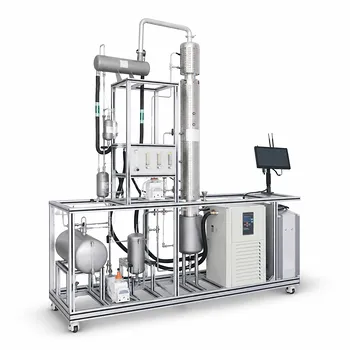
An educational steam distillation unit is designed to make the thermodynamic principle visible and measurable. Its anatomy typically includes:
- Steam generator: Produces a controllable flow of saturated steam.
- Biomass vessel (extraction column): Holds the plant material (e.g., fresh orange peel). Steam enters from the bottom or top depending on the variant.
- Condenser: Cools the mixed vapor stream back into a liquid phase.
- Decanter (phase separator): Exploits density differences to continuously separate the lighter limonene oil from the heavier water.
Many teaching plants also incorporate thermocouples at key points—steam inlet, vapor head, condenser outlet—to log temperature profiles and verify that the distillation temperature stays below 100°C.
What Students Measure and Calculate
The hands-on configuration turns an abstract thermodynamic law into a multi-layered experiment.
Students can:
- Vary the steam injection rate and correlate it with the distillation rate and oil recovery.
- Calculate energy balances, comparing the latent heat supplied by the steam with the sensible and latent heat absorbed by the plant material and the condensing products.
- Determine the steam-to-oil ratio—a direct practical metric of process efficiency.
- Measure the recovery rate and purity of limonene by analyzing the decanted oil volume over time.
- Validate Dalton’s Law by comparing observed boiling temperatures with theoretical values derived from published vapor pressure curves.
The pilot plant often includes a bypass valve or flow meter to quantify steam consumption, turning the unit into a tool for teaching mass and energy conservation, not just extraction.
Process Modifications for Advanced Studies
Standard steam distillation can leave behind high-boiling or nonvolatile valuable compounds. To broaden the educational scope, the same pilot plant can be adapted to demonstrate:
- Vacuum steam distillation: Lowering the total pressure further reduces the boiling temperature, protecting even more sensitive bioactives.
- Co-solvent addition: Introducing a small amount of ethanol or other volatile solvent can alter the relative volatility and improve extraction of less volatile fractions.
- Hydrodiffusion (top‑down steam injection): Steam flows downward through the bed of plant material, which gently releases aromatic oils at reduced temperatures and can improve yield for certain botanicals.
These modifications teach students the concept of thermal protection by boiling point depression, and how process engineers balance yield, energy cost, and product quality.
Understanding the Trade-offs and Limitations
Where Standard Steam Distillation Falls Short
While highly effective for limonene, steam distillation is not a universal solution.
Lower selectivity for polar or high-boilng compounds can be a drawback. Many valuable bioactive phenolics, flavonoids, or tannins remain in the waste residue because they are not sufficiently volatile even with steam. This leftover biomass may still hold recoverable value for cosmetics or nutraceuticals, driving interest in hybrid processes.
Water‑phase solubility losses can occur. A fraction of the essential oil dissolves in the co‑distilled water, reducing overall yield and requiring careful decanter design or a secondary extraction.
Energy cost from latent heat is another factor. All that steam must be generated and then condensed, so for large‑scale operations, the steam‑to‑feed ratio is a critical economic variable that student experiments can directly quantify.
Avoiding Common Misconceptions
A common misunderstanding is that the oil itself “boils at a lower temperature because of water.” The oil does not boil at a lower temperature in isolation; it co‑distills with water because the mixture’s boiling point is lower than either pure component’s. This is not an azeotrope—the vapor composition is proportional to the partial pressures, and the two liquids remain immiscible upon condensation.
Students also often confuse steam distillation with fractional distillation. There is no multicomponent rectification happening here; the separation depends entirely on the immiscibility of the liquids and the subsequent mechanical phase split in the decanter.
Making the Right Choice for Your Educational or Research Goal
Your choice of configuration depends entirely on what learning outcome or extraction target you prioritize.
- If your primary focus is demonstrating Dalton’s Law with a clear, visual experiment: Use a basic steam distillation setup with orange peel, a glass decanter, and temperature probes at the vapor head. Let students map the actual boiling temperature against their theoretical calculations.
- If your primary focus is exploring thermal protection strategies for highly sensitive bioactives: Incorporate a vacuum pump to operate under reduced pressure, and compare yields of a thermally labile marker compound (like linalool) under different pressure regimes.
- If your primary focus is process optimization and industrial relevance: Design experiments that vary steam flow rate, bed geometry, and co‑solvent percentage, and have students calculate steam‑to‑oil ratios, energy consumption, and overall cost per gram of oil.
- If your primary focus is broadening the unit operations curriculum: Integrate downstream analysis—GC‑MS for purity, Karl Fischer for moisture content—to close the loop between industrial extraction and analytical chemistry.
Steam distillation’s power lies in its ability to turn an elegant thermodynamic principle into a tangible, forgiving, and deeply instructive pilot‑scale operation.
Summary Table:
| Component | Key Function | Educational Value / Learning Metric |
|---|---|---|
| Steam Generator | Produces controllable saturated steam to heat the system | Energy balance calculation & latent heat analysis |
| Biomass Vessel | Holds plant material (e.g., orange peel) for extraction | Flow rate study & pressure drop observation |
| Condenser | Cools mixed vapor back into liquid phase | Condensation efficiency & heat transfer calculations |
| Decanter | Separates lighter limonene from water using density differences | Direct yield measurement & immiscible phase separation study |
Bring Chemical Thermodynamics to Life in Your Laboratory
Are you looking to enhance hands-on learning for your students or researchers? LABPARK provides premium Educational and Vocational Unit Operations Pilot Plants in chemical engineering, bioprocess & biotech, and environmental & water treatment for universities, research institutes, and enterprises.
Our steam distillation pilot plants allow students to easily visualize Dalton's Law, calculate energy balances, and master essential extraction techniques.
Contact LABPARK today to discuss your laboratory requirements and receive a customized quote!
Related Products
- Multi-Modal Distillation Unit Operations Training Pilot Plant
- Multi-Functional Special Distillation Educational Pilot Plant
- Continuous Sieve-Plate Distillation Pilot Plant for Unit Operations Laboratory Education
- Dual-Mode Rectification Pilot Plant for Practical Training Unit Operations
- Continuous Batch Extractive Distillation Educational Pilot Plant
People Also Ask
- How can energy balance equations for condensers & reboilers be validated experimentally? Guide
- What are the primary reflux ratio control strategies? Master Distillation Unit Operations
- Why is vacuum operation capability an essential feature for a distillation unit operations pilot plant? Unlock Efficiency
- How does catalyst water concentration affect distillation pilot plant design? Key separation train choices.
- How can real-time carbon number prediction improve distillation pilot plants? Optimize control.