Knowledge Chemical Engineering Education What are the technical advantages of configuring multi-stage compression in gas handling unit operations pilot plants?
Author avatar

Tech Team · LABPARK

Updated 1 month ago

What are the technical advantages of configuring multi-stage compression in gas handling unit operations pilot plants?


Multi-stage compression is not just an industrial best practice—it is the defining architecture that transforms a gas handling pilot plant from a simplistic, dangerous demo into a precise, educational, and professionally relevant tool. The technical advantages are immediate and interconnected: it delivers superior temperature control, slashes energy consumption by approaching isothermal conditions, maximizes the volumetric efficiency of each cylinder, and avoids the structural and safety nightmares of single-stage, high-ratio compression. In a pilot plant setting, these benefits are amplified because they make the underlying thermodynamic principles measurable, visual, and safe for operators.

A pilot plant with multi-stage compression and interstage cooling does far more than move gas; it becomes a transparent window into real-world compressor engineering. The core insight is that the primary advantages—thermal safety, energy savings, and mechanical prudence—are the very things that allow students and engineers to isolate, quantify, and optimize the fundamental unit operation without the hazards and costs of a full-scale plant.

The Fundamental Thermodynamic Advantage

Why Single-Stage Fails at High Ratios

When a gas is compressed rapidly in a single stage, the compression ratio skyrockets. This leads to two critical problems. First, the discharge temperature can easily exceed the limits of lubricating oils, causing degradation or even combustion. Second, the process drifts sharply away from the ideal isothermal path, making the work input far higher than theoretically necessary.

The result is a pilot plant that is both dangerous and energetically wasteful. It misrepresents professional engineering practice.

Approaching the Isothermal Ideal with Intercooling

Multi-stage compression solves this by breaking the total pressure rise into smaller, more manageable steps. After each stage, the gas is routed through an intercooler, which rejects heat and shrinks its volume. This cooling step is the critical enabler.

The overall work input plummets because entering a subsequent stage with a cooler, denser gas requires significantly less energy. The entire compression train more closely approximates isothermal compression, which is the theoretical minimum-work path for a gas. In a pilot plant, measuring the temperature drop across each intercooler and the resulting stage work provides a direct, tangible demonstration of this principle.

Operational and Structural Imperatives

Keeping Volumetric Efficiency High

Every compressor cylinder has a clearance volume. When the compression ratio per stage is high, re-expansion of trapped gas in that clearance space consumes a larger fraction of the intake stroke, drastically reducing the amount of fresh gas drawn in. This loss of volumetric efficiency undermines throughput.

Multi-stage compression keeps the compression ratio of each individual cylinder low. As a result, re-expansion effects are minimized, and each cylinder can operate at its peak volumetric efficiency. This is crucial in a pilot plant where accurate material balances and consistent flow rates are required for meaningful experimental data.

Eliminating the Need for Over-Engineered Cylinders

Ultra-high discharge pressures from a single stage demand cylinder walls of immense thickness to contain the stress. The necessary materials and designs become exotic, expensive, and entirely unrepresentative of standard industrial reciprocating compressors.

A multi-stage design gracefully spreads the pressure load across several cylinders, each operating within a moderate pressure band. This allows the pilot plant to use conventional materials and designs, making it safer, more affordable, and a faithful scaled-down replica of industrial setups. The equipment itself teaches proper structural design philosophy.

Understanding the Trade-offs

The Price of Added Complexity

The advantages of multi-stage compression are not free. The most immediate trade-off is increased system complexity. Each stage requires its compressor cylinder, intercooler, oil-water separator, and the associated piping, valves, and instrumentation.

This ancillary equipment introduces flow resistance and interstage pressure drops. While small relative to the energy savings, these losses must be accounted for in precise demonstrations. The pilot plant also becomes physically larger and demands more sensors to monitor each stage, increasing the initial capital outlay.

Educational Overload vs. Invaluable Data

A single-stage setup is undeniably simpler for teaching the basic concept of a pressure-volume diagram. A multi-stage train, however, forces students to grapple with interstage balances, dew point considerations, and system-level optimization. For some introductory goals, this complexity can distract from core principles.

However, for any curriculum focused on industrial practice, this added complexity is the whole point. It allows students to perform detailed energy balances across each stage, calculate the isothermal efficiency of the entire train, and tangibly verify how interstage heat rejection directly saves power. This is the difference between a toy and a serious unit operations tool.

Making the Right Choice for Your Pilot Plant

Your decision should hinge on what you need the pilot plant to achieve. The architecture must serve the learning or research goal.

  • If your primary focus is basic thermodynamic demonstration and low cost: A carefully limited single-stage setup may suffice, but you must be prepared to accept dangerously high discharge temperatures or extremely low compression ratios that limit the range of teachable principles.
  • If your primary focus is industrial relevance, safety, and energy analysis: Multi-stage compression with intercooling is mandatory. It allows you to safely explore realistic pressure ratios while turning the compressor from a black box into a fully instrumented, transparent system for studying thermal efficiency.
  • If your primary focus is precise process data and faithful scale-down: Multi-staging is the only way to achieve representative volumetric efficiencies and discharge conditions, ensuring that the data students collect translates directly to the behavior of real-world, large-scale units.

Ultimately, configuring a pilot plant for multi-stage compression is an investment in safety, data integrity, and the depth of education. It transforms a simple gas mover into a powerful platform for mastering the thermodynamic and mechanical realities that define the chemical process industries.

Summary Table:

Feature Single-Stage Compression Multi-Stage Compression
Temperature Control High risk of overheating & oil degradation Safe control via interstage cooling
Energy Efficiency High work input (deviates from isothermal) Lower energy use (approaches isothermal ideal)
Volumetric Efficiency Low due to high clearance gas re-expansion High; minimized re-expansion effects
Safety & Design Requires heavy, over-engineered cylinders Uses standard materials; spreads pressure loads

Bring Industrial-Grade Precision to Your Lab

Are you looking to equip your laboratory with safe, highly efficient, and realistic gas handling systems? LABPARK provides state-of-the-art Educational and Vocational Unit Operations Pilot Plants in chemical engineering, bioprocess & biotech, and environmental & water treatment for universities, research institutes, and enterprises.

Our custom-engineered pilot plants featuring advanced multi-stage compression guarantee safe operation, precise thermodynamic data collection, and a hands-on training experience that matches real-world industrial standards.

Contact LABPARK today to discuss your laboratory requirements and receive a customized technical solution!

Related Products

People Also Ask

Related Products

Fixed-Bed Chemical Reaction and Gas Dust Tar Removal Unit Operations Pilot Plant

Fixed-Bed Chemical Reaction and Gas Dust Tar Removal Unit Operations Pilot Plant

Integrated educational pilot plant for studying catalytic gas-solid reactions and downstream gas purification. Features dual fixed-bed reactor, three-stage heating, and touchscreen control for hands-on engineering training. Ideal for chemical and environmental engineering curricula.

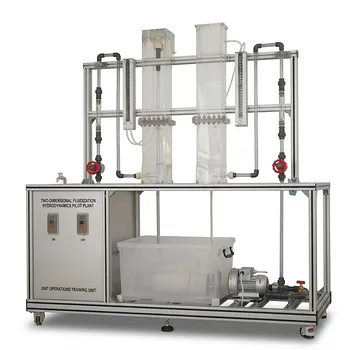
Two-Dimensional Fluidization Hydrodynamics Educational Pilot Plant for Unit Operations Training

Two-Dimensional Fluidization Hydrodynamics Educational Pilot Plant for Unit Operations Training

Explore gas-solid and liquid-solid fluidization hydrodynamics with our transparent 2D educational pilot plant. Ideal for chemical engineering unit operations labs, it demonstrates fixed to fluidized bed regimes, measures pressure drop, and integrates QR-code digital learning for enhanced student training.

Dual-Mode Gas Absorption and Desorption Unit Operations Training Pilot Plant

Dual-Mode Gas Absorption and Desorption Unit Operations Training Pilot Plant

Industrial-scale pilot plant for gas absorption and desorption training in chemical engineering. Features dual-mode operation with real and simulated materials, transparent columns for flow visualization, and customizable design. Supports independent or combined loops for hands-on unit operations experiments.

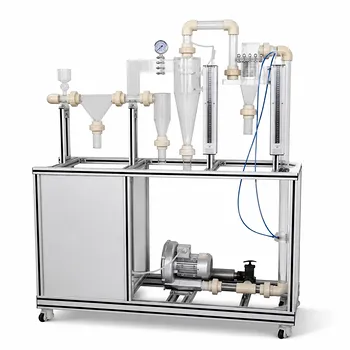
Gas-Solid Heterogeneous Separation Demonstration Educational Unit Operations Pilot Plant

Gas-Solid Heterogeneous Separation Demonstration Educational Unit Operations Pilot Plant

Comprehensive visual transparent gas-solid separation pilot plant for chemical engineering labs. Demonstrates gravity settling inertial settling cyclone and bag filter technologies. Enables real-time analysis of fluid-particle mechanics pressure drop and collection efficiency. Ideal for undergraduate unit operations courses.

Gas Phase Mixing and Residence Time Distribution Determination Educational Unit Operations Pilot Plant

Gas Phase Mixing and Residence Time Distribution Determination Educational Unit Operations Pilot Plant

Integrated lab system for gas-phase mixing and RTD determination. Supports pulse and step tracer methods with dual CSTR and PFR reactors, industrial components, and PC data logging. Provides hands-on study of non-ideal flow and reactor behavior for university students.

Educational Unit Operations Pilot Plant for Intraparticle Diffusion Effective Factor Measurement

Educational Unit Operations Pilot Plant for Intraparticle Diffusion Effective Factor Measurement

Designed for chemical engineering university labs, this pilot plant allows hands-on determination of catalyst particle intraparticle diffusion effective factors and gas-solid reaction kinetics using a fixed-bed tubular reactor with industrial touchscreen control, bridging theory and practical reactor design.

Multimodal Absorption and Desorption Pilot Plant for Unit Operations Training

Multimodal Absorption and Desorption Pilot Plant for Unit Operations Training

Multimodal absorption and desorption pilot plant for higher education labs. Bridges theory and industrial practice with transparent packed columns, three operational modes (real-material, simulated, semi-physical), and SCADA control. Students explore mass transfer, column hydraulics, and process control. Customizable.

Absorption and Desorption Educational Unit Operations Pilot Plant

Absorption and Desorption Educational Unit Operations Pilot Plant

Dual packed column absorption and desorption pilot plant for chemical engineering education, offering real-time mass transfer coefficient measurement, durable mobile frame, industrial touch-screen interface, and customizable design for varied laboratory curricula, enabling hands-on study of gas absorption and stripping.

Dual-Mode Rectification Pilot Plant for Practical Training Unit Operations

Dual-Mode Rectification Pilot Plant for Practical Training Unit Operations

Industrial-scale dual-mode rectification pilot plant for chemical engineering practical training. Features real-material and simulated-material operation modes, sieve-plate column with sight glasses for visual observation of hydrodynamics, and customizable SCADA control for safe, hands-on learning of unit operations and mass transfer.

Multi Pump Fluid Transport Process Piping Unit Operations Training Pilot Plant

Multi Pump Fluid Transport Process Piping Unit Operations Training Pilot Plant

Industrial-scale multi-pump pilot plant for unit operations training in fluid transport and process piping, featuring real-material and semi-physical simulation modes, comprehensive pump and flowmeter calibration, and safety-enhanced two-tier platform, bridging academic theory and industrial practice for chemical engineering education.

Multi-Modal Distillation Unit Operations Training Pilot Plant

Multi-Modal Distillation Unit Operations Training Pilot Plant

Multi-modal distillation pilot plant for practical unit operations training in chemical engineering education. Features real, analog, and semi-physical simulation modes, industrial construction, customizable for university labs. Hands-on fractionation columns, SCADA control, safety systems. Includes sight glasses, sampling ports, closed-loop recycling.

Bench Scale Dual Column Gas Separation and Capture Educational Pilot Plant

Bench Scale Dual Column Gas Separation and Capture Educational Pilot Plant

This dual-column educational pilot plant provides hands-on teaching of gas adsorption, separation, and capture processes. It features stainless steel columns, regeneration up to 400°C, and a 15.6-inch touchscreen PLC for TSA and PSA studies in chemical engineering curricula, process simulation.

Multi-Reactor Educational Pilot Plant for Reaction Engineering Unit Operations

Multi-Reactor Educational Pilot Plant for Reaction Engineering Unit Operations

Integrated bench-scale educational pilot plant for chemical engineering teaching featuring fixed bed fluidized bed and stirred tank reactors with web-based digital twin controls and safety interlocks for hands-on unit operations and reaction engineering comparative studies in one compact system.

Comprehensive Fluid Mechanics Educational Unit Operations Pilot Plant

Comprehensive Fluid Mechanics Educational Unit Operations Pilot Plant

Hands-on fluid mechanics pilot plant for engineering education covering over 13 principles including pipe flow, minor losses, flowmeter calibration, and pump performance with industrial-grade components, smooth and rough piping, venturi and orifice flowmeters, and centrifugal pump testing and analysis.

Solid Waste Pyrolysis and Refining Educational Pilot Plant for Unit Operations

Solid Waste Pyrolysis and Refining Educational Pilot Plant for Unit Operations

This pilot plant for solid waste pyrolysis and refining integrates pyrolysis, separation, distillation, and catalytic hydrogenation into one educational unit. It provides visual process observation, smart data logging, and industrial safety for hands-on learning of engineering unit operations.

Dual Mode Heat Transfer Pilot Plant for Unit Operations Training

Dual Mode Heat Transfer Pilot Plant for Unit Operations Training

Engineering-scale dual-mode heat transfer pilot plant for hands-on unit operations training in chemical engineering. Features real and simulated modes, multiple heat exchanger types, comprehensive coefficient determination, and advanced process control with data acquisition for engineering students and researchers.

Natural Product Extraction Unit Operations Training Pilot Plant

Natural Product Extraction Unit Operations Training Pilot Plant

Integrated natural product extraction pilot plant for chemical engineering training bridges theory and industrial practice with modular extraction and evaporation/concentration units, hybrid touchscreen and manual control, realistic process simulation, and self-contained softened water and vacuum utilities.

Thermal Desorption Exhaust Gas and Tail Water Treatment Educational Pilot Plant

Thermal Desorption Exhaust Gas and Tail Water Treatment Educational Pilot Plant

Bench-scale educational pilot plant for treating thermal desorption exhaust gas and tail water integrates condensation, Fenton oxidation, precipitation, filtration, and carbon adsorption. Ideal for chemical engineering and environmental labs, teaching unit operations, process control, and real-time data analysis.

100L Continuous Loop Hydrogenation Educational Unit Operations Pilot Plant

100L Continuous Loop Hydrogenation Educational Unit Operations Pilot Plant

This 100L continuous loop hydrogenation pilot plant is designed for chemical engineering education, featuring 316 stainless steel construction, advanced gas-liquid mass transfer components, explosion-proof safety systems, and a 15.6-inch touchscreen with 5G connectivity, cloud data logging, bridging theory and industry.

Fixed Bed Gas Solid Catalytic Reaction Educational Pilot Plant

Fixed Bed Gas Solid Catalytic Reaction Educational Pilot Plant

Fixed-bed gas-solid catalytic reaction unit operations pilot plant for chemical engineering education. Features split-furnace, mass flow controllers, PID control, safety interlocks. Ideal for heterogeneous catalysis, reactor dynamics, catalyst evaluation studies. Fully customizable configurations for university laboratories and academic research.


Leave Your Message