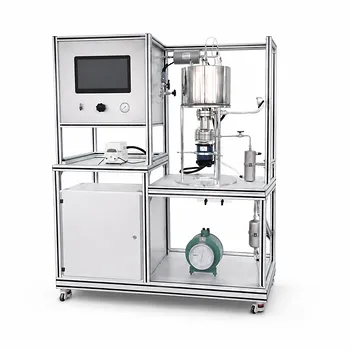
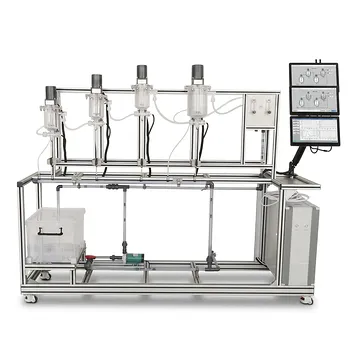
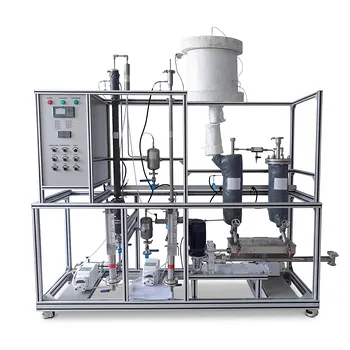
Here’s the hard truth: demonstrating propylene hydroformylation in a pilot reactor is less about simply running a reaction and more about mastering a delicate balancing act between extreme heat release and fleeting kinetic opportunities. The primary thermal challenge is managing the highly exothermic main reaction (∆H = -123.8 kJ/mol) to prevent dangerous temperature excursions that degrade catalyst performance and selectivity. The kinetic challenge is to control the subtle competition between n-butyraldehyde and isobutyraldehyde formation, which is exquisitely sensitive to temperature, catalyst state, and mass transfer rates.
In a pilot hydroformylation reactor, thermal control isn’t just about safety—it’s the direct lever for kinetic selectivity. The moment local temperatures drift, the reaction pathway shifts, producing more branched aldehyde and potentially triggering a runaway. Effective demonstration requires integrating rapid heat removal, precise temperature logging, and a reactor design that allows students and researchers to see these dynamic couplings in real time.
The Exothermic Core of Hydroformylation
Propylene hydroformylation is a gas-liquid reaction where propylene and synthesis gas (CO/H₂) react in a liquid solvent containing a soluble rhodium or cobalt catalyst. The reaction liberates 123.8 kJ of heat per mole of propylene converted. On a pilot scale, even small swings in feed rate can generate enough heat to raise the reactor temperature by tens of degrees in seconds.
The Reaction Selectivity Stakes
The two parallel pathways—linear (n-butyraldehyde) and branched (isobutyraldehyde)—have different activation energies and respond differently to temperature. A rise of just 10–15°C can shift the n/iso ratio from >10:1 to <5:1, significantly reducing the value of the product stream.
Why This Matters in a Pilot Plant Context
A pilot reactor exists to test scalable conditions, not just achieve a single high-yield run. The thermal signature of the reaction must be captured accurately to develop a kinetic model that predicts industrial-scale outcomes. If the pilot data contains uncorrected temperature gradients or lag, the derived kinetics will be misleading and unscalable.
Thermal Control Challenges: Taming the Heat
The pilot reactor must rapidly remove the heat of reaction while maintaining a uniform temperature profile throughout the liquid phase. This is far harder than it sounds because the reaction rate is highest where the dissolved gas concentration is greatest—near the gas-liquid interface.
Managing Hot Spots and Runaway Potential
A single cooling jacket is rarely sufficient. Exothermic reactions of this magnitude can form localized hot spots in the bulk liquid, especially if the agitation is not highly efficient. Internal cooling coils or high-flow-rate recycling through an external heat exchanger become essential to flatten temperature gradients.
Instrumentation and Response Time
Precise temperature logging—using multiple thermocouples positioned at different radial and axial points—is non-negotiable. The data must have sub-second resolution to capture incipient runaway conditions. Students and researchers rely on this data to see how a step change in one parameter ripples through the thermal field, making the pilot reactor a teaching tool as much as a data collector.
Scaling Down Heat Transfer Limitations
In a pilot reactor, the surface-area-to-volume ratio is much higher than in a full-scale unit. This can mask heat transfer constraints that will appear at scale. A pilot demonstration must intentionally reduce jacket temperatures or use diluents to simulate the poorer heat removal of larger vessels, otherwise the kinetic data won’t translate.
Kinetic Control: Steering the Selectivity
Kinetic challenges in propylene hydroformylation revolve around managing the delicate interplay between intrinsic catalytic rates and physical transport phenomena. The pilot reactor must be designed to reveal this interplay, not obscure it.
Gas-Liquid Mass Transfer: The Hidden Kinetic Bottleneck
The reaction consumes dissolved CO and H₂ at the active catalyst site. If the gas-to-liquid mass transfer rate is too slow, the liquid becomes depleted in reactants, artificially lowering the rate and altering the CO/H₂ ratio at the catalyst—directly affecting selectivity. High-shear gas dispersion impellers and carefully controlled sparging rates are critical to keep the liquid phase near saturation.
Temperature as a Selectivity Switch
The activation energy difference between the linear and branched pathways means that lower temperatures favor the desired n-aldehyde, but also reduce overall reaction rate. A pilot reactor must demonstrate that precise temperature control (often within ±0.5°C) can hold the n/iso ratio constant across varying throughputs. This requires not just powerful cooling but also a control system that anticipates exothermic spikes from flow rate changes.
Catalyst Deactivation Kinetics
Prolonged operation at elevated temperatures accelerates catalyst decomposition and clustering. A subtle, creeping loss of activity can be misinterpreted as a change in intrinsic kinetics. The demonstration must include periodic kinetic checks (using a standard test run) to decouple catalyst deactivation from process variable changes.
Understanding the Trade-offs
No pilot reactor configuration is perfect. The goal is to make trade-offs explicit so that the data set is useful for scale-up.
Temperature Uniformity vs. Agitation-Induced Foaming
Vigorous mixing homogenizes temperature and improves mass transfer, but it can create stable foams in the reactor that cause liquid carryover and pressure fluctuations. In a demonstration, you must select an agitation regime that balances heat removal with foam control, often requiring additive testing or headspace modifications.
High-Resolution Logging vs. Sensor Lag
Placing thermocouples in thermowells protects them but introduces a 1–3 second lag. Direct-exposed, fast-response probes give real-time thermal data but risk corrosion and catalyst poisoning. The pilot reactor teaches that one often trades measurement accuracy for durability and must compensate via dynamic compensation algorithms.
Scalable Kinetics vs. Educational Clarity
For research scaling, you want dilute catalyst concentrations and long residence times to mimic industrial bubble column behavior. For education, you may want faster conditions that yield results within a lab period. A well-designed pilot cell lets you toggle between these modes while clearly documenting the consequences on apparent kinetics.
Making the Right Choice for Your Goal
After understanding these intertwined thermal and kinetic challenges, the specific design and operating choices for a pilot hydroformylation reactor should align with your primary objective.
- If your primary focus is kinetic data for scale-up: Prioritize direct-immersion fast-response thermocouples, external recycle cooling with a matched residence time, and deliberate operation at heat transfer limitations to mimic plant conditions. Log everything at sub-second intervals and validate mass transfer coefficients daily.
- If your primary focus is education and safety demonstration: Use robust thermowell-protected sensors, a transparent reactor shell for visualizing gas dispersion, and a conservative cascade control that simulates runaway without real danger. Emphasize the cause-and-effect narrative between temperature excursions and selectivity shifts.
- If your primary focus is catalyst screening under isothermal conditions: Invest in a high-capacity internal coil or jacketed sectioned reactor that can absorb rapid fluctuations. Run at lower catalyst loadings to suppress the exotherm per unit volume, sacrificing raw rate for perfect temperature stability.
Ultimately, a successful pilot demonstration of propylene hydroformylation converts a dangerous thermal liability into a precise, visible tool: every degree of temperature control becomes a degree of freedom to optimize selectivity, and every kinetic data point tells a story about what will happen at scale.
Summary Table:
| Challenge Category | Key Issues & Risks | Design & Mitigation Solutions |
|---|---|---|
| Thermal Control | • Highly exothermic reaction (\Delta H = -123.8 kJ/mol) • Runaway risks and localized hot spots • Scale-down heat transfer limitations |
• High-flow external recycling / heat exchangers • Multi-point, fast-response thermocouples • Advanced temperature cascade control |
| Kinetic Control | • Sensitive $n$/$iso$ product ratio selectivity • Gas-liquid mass transfer bottlenecks • High-temperature catalyst deactivation |
• High-shear gas dispersion impellers • Ultra-precise temperature control (\pm0.5°C) • Regular baseline kinetic calibration runs |
Empower Your Research and Education with LABPARK
Are you looking to safely and effectively demonstrate complex chemical processes like hydroformylation? LABPARK provides state-of-the-art Educational and Vocational Unit Operations Pilot Plants in chemical engineering, bioprocess & biotech, and environmental & water treatment.
We help universities, research institutes, and enterprises bridge the gap between laboratory scale and industrial reality with high-precision control systems, robust safety configurations, and clear visualization.
Contact LABPARK today to find the perfect pilot plant solution to elevate your teaching and research capabilities!
Related Products
- Fixed-Bed Chemical Reaction and Gas Dust Tar Removal Unit Operations Pilot Plant
- Fixed Bed Gas Solid Catalytic Reaction Educational Pilot Plant
- Internal Circulation Gradient Free Catalytic Reaction Educational Pilot Plant
- Fluidized Bed Gas Solid Catalytic Reaction Educational Pilot Plant
- 100L Continuous Loop Hydrogenation Educational Unit Operations Pilot Plant
People Also Ask
- When to transition from PID to adaptive control in pilot plants? Key process indicators.
- How do deviations in estimating latent heat impact pilot plant thermal systems? Avoid hardware mis-sizing.
- Why Compare Predicted and Experimental Excess Enthalpy? Key to Accurate Pilot Plant Scale-up
- Why Use PTFE & Hastelloy in Chemical Pilot Plants? Prevent Corrosion & Ensure Safety
- How to study gasification in pilot plants? Compare exit gas composition & efficiency