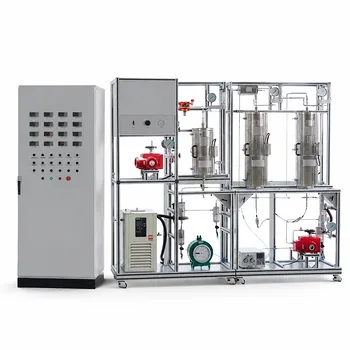
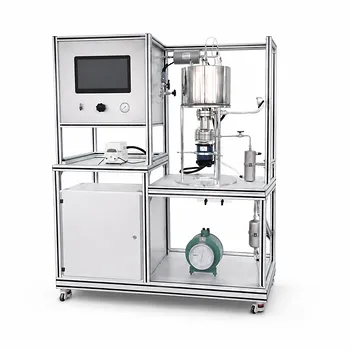
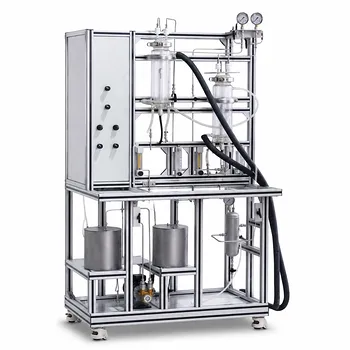
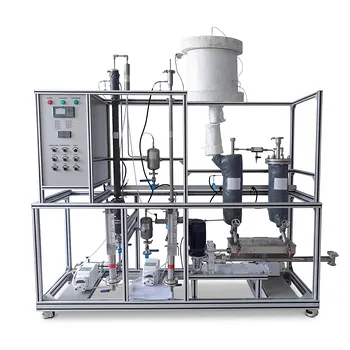
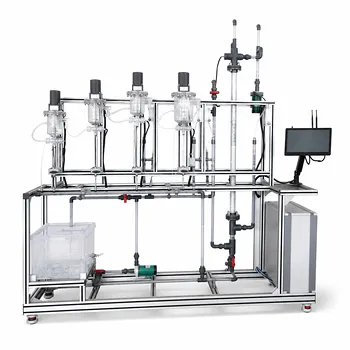
Heat transfer design is not just about surface area—it's about geometry and movement. For pilot-scale polymerization reactors, the greatest design priority is preventing material buildup on heat transfer surfaces. This directly answers the surface need: the primary consideration is to use smooth heat transfer surfaces (like jacketed vessels) combined with robust, continuous agitation that sweeps the viscous fluid across the wall. Internal coils and corrugated surfaces almost always fail because they create dead zones where polymer stagnates, fouls, and insulates the very surface meant to control temperature. The result is catastrophic for product quality, leading to uneven molecular weight distribution and potential thermal runaway.
Preventing fouling and ensuring uniform product quality in a pilot polymerization reactor is a single, intertwined challenge. It hinges on eliminating stagnant regions. The design must treat the heat transfer surface and the agitator as a unified system where the impeller continuously scrapes or wipes a smooth surface, denying any opportunity for material to reside and degrade.
Why Standard Heat Transfer Designs Fail in Polymerization
The Dead Zone Problem with Internal Coils and Corrugations
Most general-purpose reactor designs prioritize surface area. They add internal helical coils or dimpled jackets to maximize heat transfer. For polymerizations, this logic is inverted. These complex geometries inevitably produce low-velocity zones where the highly viscous reaction fluid becomes trapped. In these dead zones, the fluid is not refreshed and remains in contact with the hot or cold surface.
This stagnant material continues to react, generating its own heat which cannot be removed effectively. The polymer then degrades or crosslinks, forming an insulating crust. This fouling layer rapidly reduces the overall heat transfer coefficient, making temperature control impossible. Meanwhile, the continuous sweeping of other regions leads to a different thermal history, producing polymers with varying chain lengths. The final product has a non-uniform molecular weight distribution, a direct failure in quality.
How This Directly Sabotages Product Quality
Polymerization reactions are highly exothermic. The rate of reaction and the final chain length are exquisitely sensitive to local temperature. A temperature gradient of just a few degrees can lead to vastly different polymerization rates in different parts of the reactor. The polymer formed in a hot spot will have a low molecular weight, while polymer formed in a cold dead zone will have a high molecular weight. Because these zones are not mixed back into the bulk efficiently, the final product is an unpredictable blend, often with poor mechanical properties and performance.
The Unified Solution: Smooth Surfaces and Sweeping Agitation
The Core Design Principle: No Stagnant Zones
The foundational rule is to use a smooth, unobstructed heat transfer surface, typically a simple jacket welded to the vessel wall. There are no internal coils, baffles, or crevices where material can lodge. This geometry alone is insufficient, however. The surface must be continuously wiped by a special agitator designed to scrape the wall. This creates a thin, moving film that guarantees very high local velocity at the wall, eliminating any chance for material to stop moving and begin the fouling process. The combination ensures every volume element of the reaction mass experiences the same thermal history, which is the very definition of uniform product quality.
Choosing the Right Agitator for Wall Sweeping
Standard turbines or propellers fail in high-viscosity polymerizations. They create a spinning pool with a stagnant layer near the wall. The correct impeller types for this duty are close-clearance designs. An anchor agitator scrapes the entire vessel wall gently. A helical ribbon impeller provides both wall wiping and excellent top-to-bottom bulk pumping in very high viscosities. These agitators must be driven by a high-torque, variable-speed motor capable of handling the rising load as viscosity increases exponentially. The power and speed must be calibrated to maintain the sweeping action without causing excessive shear that could mechanically degrade the polymer chains.
Managing the Deep Need: Viscosity and Heat Transfer
The Vicious Cycle of Rising Viscosity
As the reaction progresses, viscosity can skyrocket from a few centipoise to over 600 Pa·s, as seen in melt-phase polycarbonate processes. This dramatic increase creates a critical design challenge. The heat transfer coefficient on the process side is inversely related to the film thickness and boundary layer resistance, both of which are dominated by viscosity. A high viscosity thickens the stagnant boundary layer, even with agitation. The only way to combat this is to physically reduce the boundary layer thickness by mechanically scouring the wall. This is why a close-clearance wiping agitator is non-negotiable—it physically removes the insulating film.
The Danger of Auto-Acceleration and Thermal Runaway
Many bulk polymerizations suffer from the gel effect, or auto-acceleration. As viscosity rises, the termination rate between long radical chains drops sharply, while propagation continues. The reaction rate spikes, generating heat faster than ever, precisely when the ability to remove heat is plummeting due to high viscosity. This is the classic thermal runaway scenario. A pilot reactor's heat transfer system must be designed for this worst-case peak in heat generation. A simple jacket with a wiping agitator provides a predictable, fouling-free path for heat removal, giving operators a fighting chance to control the exotherm through rapid, responsive cooling and feed adjustments.
Understanding the Trade-offs: Bulk vs. Solution Polymerization
The Bulk Polymerization Path: Ultimate Purity, Ultimate Challenge
Bulk polymerization uses no solvent, yielding a very pure product. However, this directly amplifies the heat transfer and viscosity nightmare. The pilot plant must accept the extreme design discussed so far: heavy-duty, high-torque agitators and jacketed vessels with precise surface wiping. The trade-off for that purity is a reactor that is mechanically complex and expensive, with a high power-to-volume ratio. You are fighting nature directly, trying to keep a viscous, self-heating mass uniformly mixed.
The Solution Polymerization Path: Trading Purity for Process Control
Adding a solvent drastically reduces viscosity, making mixing and heat dissipation far easier. A simple jacket and a standard turbine agitator might suffice for temperature control. The fouling risk plummets. However, this relief comes at a significant cost. The entire pilot plant flow sheet must now include downstream solvent recovery units. This means distillation columns, condensers, and reboilers, which require capital, energy, and operational complexity. You also must now purify the final polymer to remove residual solvent, and solvent purity itself can become a new variable affecting product quality. The deep need is to decide which burden your pilot plant is designed to bear: an extremely demanding reactor or a complex post-reaction purification train.
How to Apply This to Your Pilot Reactor Design
The best design choice is not a one-size-fits-all solution. It depends on the core objective you are optimizing for in your pilot program.
- If your primary focus is maximizing heat transfer surface area: You must critically re-evaluate. In polymerization, adding coils does more harm than good. Instead, optimize the heat transfer coefficient by maximizing wall-wiping effectiveness with a high-torque, close-clearance agitator.
- If your primary focus is achieving the highest polymer purity: Accept the mechanical burden of a bulk process. Invest in a jacketed, smooth-surface reactor with a helical ribbon or anchor agitator and a powerful drive capable of handling the expected viscosity and gel effect peak.
- If your primary focus is ease of process control and a broader operating window: Choose solution polymerization. Design your pilot plant with the solvent recovery and purification unit operations as a central, integrated part of the workflow, not an afterthought.
- If your primary focus is studying the reaction kinetics independent of heat transfer limitations: Run the reaction in a micro-reactor or a very thin-film device. For a stirred pilot vessel, dilute the system with solvent to push the heat transfer challenge far beyond the regime where it limits your data, ensuring the reaction is kinetically controlled.
Every element of a polymerization pilot plant must serve the singular goal of creating a homogeneous, time-invariant thermal history for every reacting molecule. The smooth swept surface is the definitive implementation of that goal.
Summary Table:
| Parameter | Bulk Polymerization | Solution Polymerization |
|---|---|---|
| Viscosity & Fouling | Extreme viscosity, high risk of fouling & runaway | Lower viscosity, significantly reduced fouling risk |
| Reactor Design | Jacketed vessel with close-clearance sweeping agitator | Jacketed vessel with standard turbine agitator |
| Downstream Needs | Direct product recovery (no solvent) | Complex solvent recovery & purification units required |
| Best For | Maximum product purity applications | Easier process control and wider operating windows |
Optimize Your Pilot-Scale Processes with LABPARK
Designing polymerization reactors requires overcoming complex heat transfer and viscosity challenges. LABPARK offers specialized Educational and Vocational Unit Operations Pilot Plants in chemical engineering, bioprocess & biotech, and environmental & water treatment.
Whether you are a university, research institute, or enterprise, we deliver custom-engineered pilot solutions that ensure precise temperature control, eliminate fouling, and guarantee uniform product quality.
Ready to elevate your research and scale-up capabilities? Contact LABPARK today to discuss your pilot plant requirements.
Related Products
- Polymerization Granulation and Pellet Processing Educational Unit Operations Pilot Plant
- Methanol Synthesis and Catalyst Performance Evaluation Educational Unit Operations Pilot Plant
- Micro-Scale Gas-Solid Catalytic Reaction Educational Pilot Plant
- Ethylbenzene Dehydrogenation Educational Unit Operations Pilot Plant
- Carbon Dioxide Hydrogenation Methanol Synthesis Educational Unit Operations Pilot Plant
People Also Ask
- How do educational unit operations pilot plants address safety and waste management when scaling up?
- How do educational unit operations pilot plants bridge theory and design? Bridge the Engineering Gap
- Why Compare Predicted and Experimental Excess Enthalpy? Key to Accurate Pilot Plant Scale-up
- When to transition from PID to adaptive control in pilot plants? Key process indicators.
- How to study gasification in pilot plants? Compare exit gas composition & efficiency