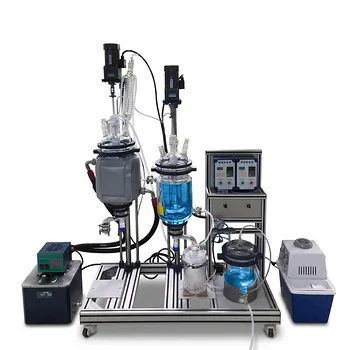
The two foundational experimental methods for measuring MSZW in a pilot-scale crystallizer are the cooling rate method and the nucleation induction time method. Both rely on in-situ particle detection—such as turbidity sensors or laser scattering probes—to identify the precise moment of crystal birth under controlled conditions. By mapping this onset of nucleation across varying cooling rates or supersaturation levels, operators can define the metastable zone boundary and establish a safe, reproducible operating window.
The cooling rate method extrapolates crystallization temperatures back to a zero-rate limit to find the thermodynamic metastable limit, while the induction time method identifies the asymptote in a plot of time-to-nucleate against supersaturation. Understanding the fundamental difference between these methods—kinetic dependence versus thermodynamic asymptote—is essential for designing a robust crystallization process in any pilot plant.
The Cooling Rate Method: Extrapolating to the True Metastable Limit
This method directly mimics the dynamic cooling profile of a real batch crystallization. It answers the practical question: "At what temperature will the solution nucleate if I cool at a given speed?"
How It Works
A saturated solution is cooled at a series of constant, precisely controlled rates, typically ranging from 0.1 °C/min up to 1 °C/min.
The temperature at which the first crystals appear is recorded for each cooling rate.
By plotting the crystallization temperature against the cooling rate and fitting the data linearly, the metastable limit is found by extrapolating to a 0 °C/min cooling rate.
Detecting Crystallization Onset
Accurate detection is the heart of the experiment.
Turbidity probes measure changes in light transmission; a sudden drop signals the appearance of solid particles.
Direct laser scattering offers a step-change in sensitivity: a He-Ne laser beam scatters off the very first crystal nuclei, causing a sharp, unambiguous drop in detector power—identifying the nucleation point well before it becomes visible to a turbidity sensor.
Uncovering the Kinetic Component
At higher cooling rates, the solution must reach greater supersaturations before nucleation can occur, artificially widening the apparent MSZW.
The extrapolation to a 0 °C/min cooling rate removes this kinetic penalty, revealing the thermodynamic metastable limit where a solution would nucleate if given infinite time.
This makes the method particularly valuable for generating a kinetically independent process design boundary.
The Nucleation Induction Time Method: Probing Supersaturation Limits Isothermally
This method isolates the time-dependent nature of nucleation. It’s built for versatility and deep kinetic insight.
Principle and Procedure
A saturated solution is rapidly brought to a specific, pre-determined supersaturation—through fast cooling, antisolvent addition, reactive chemistry, or evaporation—and then held isothermally.
The time elapsed from reaching that supersaturation to the first detection of particles is the induction time.
By repeating this at different supersaturation levels, a curve of induction time versus supersaturation is generated.
Determining the Metastable Limit
The plot reveals a critical asymptote.
As supersaturation decreases, induction time rises exponentially toward infinity.
The supersaturation at this asymptote defines the metastable limit—the boundary below which a solution will remain free of spontaneous nucleation for a practically infinite time.
Unmatched Versatility
Because the driving force is supersaturation itself (not cooling rate), this method works identically for cooling, antisolvent, reactive, and evaporative crystallizations.
It decouples the measurement from the specific technique used to generate supersaturation, making it the gold standard for processes where cooling is not the primary driving force.
Understanding the Trade-offs and Practical Limitations
Both methods generate a MSZW, but they often yield slightly different boundaries. Recognizing why is critical for applying the data.
The cooling rate method detects a nucleation event under a continuously changing driving force. If not extrapolated properly, the result is a kinetic, process-specific window, not a true thermodynamic limit. It is also sensitive to probe response time—a slow turbidity sensor can miss the earliest nuclei, understating the MSZW.
The induction time method assumes an instantaneous jump to supersaturation. In pilot plants, finite mixing, heat transfer, and mass transfer create a lag, making the measured induction time longer than the intrinsic nucleation time. This can shift the apparent asymptote, yielding a slightly wider safe zone.
Stochastic nucleation also plays a role. At very low supersaturations, nucleation becomes a rare, probabilistic event. Multiple repeats are needed to capture the true induction time distribution, which can be time-consuming and material-intensive.
Making the Right Choice for Your Pilot Plant Goal
Selecting the most appropriate method depends on what problem you are solving. Use the following guidance to align your experiment with your objective.
- If your primary focus is to define a simple, kinetic process window for a cooling crystallizer: The cooling rate method, especially when combined with turbidity probes, will give you a direct, actionable boundary for your specific cooling profile.
- If your primary focus is to establish a thermodynamic metastable limit independent of cooling speed: The cooling rate method with extrapolation to zero-rate is your tool. Prioritize the use of a direct laser scattering detector for the highest accuracy.
- If your primary focus is on antisolvent, reactive, or evaporative crystallization: The nucleation induction time method is non-negotiable. It works regardless of the driving force and will give you a true supersaturation-based operating window.
- If your primary focus is to generate robust kinetic data for scale-up: The induction time method, parameterized with supersaturation, provides fundamental nucleation kinetics that translate far more reliably across vessel scales than rate-dependent cooling curves.
The choice between a cooling rate and an induction time measurement is not about which is "better"—it is about matching the physical measurement principle to the fundamental question your process is asking.
Summary Table:
| Method | Driving Force | Key Benefit | Best Suited For |
|---|---|---|---|
| Cooling Rate | Temperature (Dynamic cooling) | Finds thermodynamic limit via extrapolation | Cooling crystallization & simple process windows |
| Induction Time | Supersaturation (Isothermal) | Decoupled from cooling; yields fundamental kinetics | Antisolvent, reactive, & evaporative crystallization |
Optimize Your Crystallization Unit Operations with LABPARK
Are you looking to enhance research and hands-on training in crystallization processes? LABPARK provides state-of-the-art Educational and Vocational Unit Operations Pilot Plants in chemical engineering, bioprocess & biotech, and environmental & water treatment. Designed for universities, research institutes, and enterprises, our solutions help you easily demonstrate advanced concepts like MSZW determination.
Get in touch with our engineering experts to discuss your laboratory requirements — Contact LABPARK Today!
Related Products
- Multi Functional Membrane Crystallization Educational Unit Operations Pilot Plant
- Potassium Salt Thermal Dissolution and Crystallization Separation Educational Unit Operations Pilot Plant
- Multi-Modal Distillation Unit Operations Training Pilot Plant
- Dual-Mode Rectification Pilot Plant for Practical Training Unit Operations
- Multi-Reactor Educational Pilot Plant for Reaction Engineering Unit Operations
People Also Ask
- Control Crystallization Pilot Plant Secondary Nucleation: 4 Key Adjustments
- Why is precise temperature control critical in crystallization pilot plants? Key to Scale-Up Success
- What key factors should be considered when configuring a crystallization unit operations pilot plant?
- What are the benefits of integrating online PAT tools like ATR-FTIR into crystallization unit operations pilot plants?
- How to use crystallization pilot plant agitation speed to identify diffusion vs reaction growth?