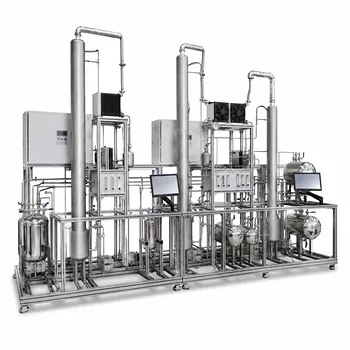
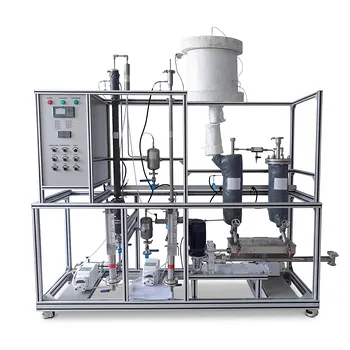
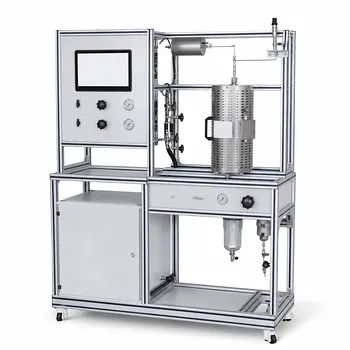
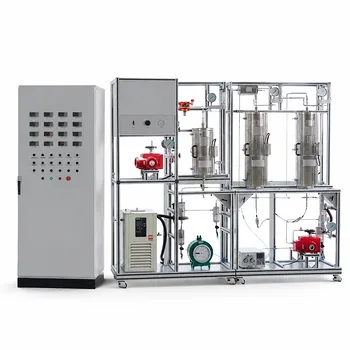
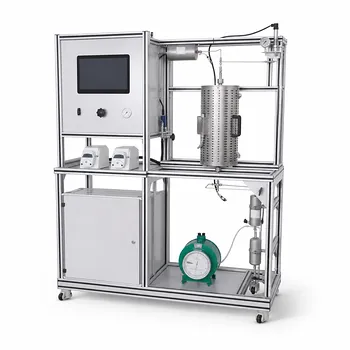
The core separation sequence of an olefins plant is the blueprint you must follow to teach the purification of hydrocarbon cracking products.
A pilot plant must simulate the progressive cooling and distillation of cracked gas to isolate valuable products like ethylene and propylene. The essential downstream unit operations are multi-stage gas compression, acid gas removal via absorption, cryogenic demethanization, and a cascading series of fractional distillation columns—specifically deethanizers, depropanizers, and critical high-purity C2 and C3 splitters.
A teaching pilot plant doesn't just separate chemicals; it distills the complex thermodynamic principles of industrial purification into observable, operable steps. The fundamental goal is to demonstrate how precise manipulation of pressure and cryogenic temperatures overcomes challenging azeotropes and relative volatilities to achieve polymer-grade purity from a simple gas mixture.
The Core Separation Train for Cracked Gas
To understand why these specific unit operations are needed, you must first see the cracked gas as a multi-component mixture with extreme boiling point differences. The sequence is a logical progression from bulk removal to high-purity finishing. Each step addresses a distinct thermodynamic or chemical hurdle.
Step 1: Multi-Stage Gas Compression
The first hurdle is the physical state of the cracked gas, which is at near-atmospheric pressure. All downstream separation techniques require the components to be in a liquid state for efficient thermal separation.
The purpose of compression is to raise the gas pressure sufficiently to enable liquefaction at the subsequent cryogenic temperatures. A multi-stage compressor with inter-stage cooling is used to progressively increase pressure. This staged approach minimizes the high energy costs and thermal degradation risks associated with single-stage compression. It directly sets the pressure baseline for the entire separation train, teaching the direct link between phase behavior and energy input.
Step 2: Acid Gas Removal via Absorption
Before the gas enters the cryogenic section, chemically active impurities must be removed. Carbon dioxide and hydrogen sulfide can freeze at cryogenic temperatures, physically plugging the cold-box heat exchangers.
A chemical absorption column, typically using an amine solution or a caustic wash, is non-negotiable. This unit operation teaches the principle of reactive mass transfer—where a chemical reaction in the liquid phase enhances the physical absorption rate. Controlling the solvent circulation rate and concentration to meet a strict outlet specification demonstrates the critical interaction between upstream pre-treatment and downstream reliability.
Step 3: Deep-Cooling Separation (Demethanization)
This is the heart of the process and the primary teaching opportunity for low-temperature thermodynamics. After compression, drying, and chilling, the stream enters a demethanizer column.
This unit operation separates hydrogen and methane, the lightest components, from the valuable C2+ hydrocarbons. Operating at cryogenic temperatures (as low as -145°C), it is the coldest point in the plant. It teaches students how relative volatility changes at extreme lows, requiring high reflux ratios and turbo-expanders to generate the necessary refrigeration. Managing this single column's pressure and temperature profile defines the energy efficiency of the entire pilot plant.
Fractional Distillation: The Cascading Purification
With the light ends removed, the remaining liquid mixture is sent to a logical sequence of distillation columns. Each column progressively narrows the separation task based on carbon number, ultimately leading to high-purity separations of chemically similar species.
The Deethanizer and C2 Splitter
The first fractionator in the warm-end sequence is the deethanizer. Its function is to make a clean cut between C2 and lighter hydrocarbons from the C3+ fraction.
The overhead product, a mixture of ethane and ethylene, then proceeds to the most energy-intensive column in the plant: the C2 splitter. This super-fractionator is the ultimate test of distillation design, requiring over 100 theoretical stages due to the very low relative volatility between ethane and ethylene. Operating it in a pilot plant setting provides a powerful demonstration of how high reflux ratios and stage counts translate directly to polymer-grade ethylene purity.
The Depropanizer and C3 Splitter
The bottom stream from the deethanizer flows to the depropanizer. This column makes an analogous cut, separating C3 hydrocarbons from the C4+ and aromatic components.
The overhead C3 mixture then goes to the C3 splitter to separate propylene from propane. While less energy-intensive than the C2 splitter, this column still requires a high number of stages. It teaches the same principles of tight fractionation but for a different chemical pair, reinforcing the universal design rules around relative volatility. The bottoms product from the depropanizer contains the butadiene and aromatics, which can be the feed for a separate BTX recovery module via liquid-liquid extraction.
Understanding the Trade-offs of a Teaching Pilot Plant
Replicating an industrial olefins separation sequence at pilot scale requires critical compromises. The goal is pedagogical clarity, not volumetric output.
A fully cryogenic demethanizer with a turbo-expander is complex and costly to operate safely in a university setting. Therefore, a common and justifiable trade-off is to simulate the deep-cooling effect operationally.
- The Simulation Approach: The high-pressure pilot plant may use a non-cryogenic model fluid with similar boiling point differences to demonstrate the column's separation mechanics without the physical risk of cryogenic temperatures.
- Purity vs. Simplicity: Each industrial column serves multiple functions (e.g., pasteurization sections). A teaching pilot plant often strips these down to their core separating function—the main feed, a distillate, and a bottoms product—to make the mass balance clear.
- Feasibility: A true, fully integrated C2 splitter is physically very tall. A pilot-scale version must logically reduce the number of theoretical stages, which directly results in a lower product purity. The teaching value then shifts to demonstrating the impact of a reduced stage count rather than achieving perfect, industrial-grade purity.
Making the Right Choice for Your Educational Goals
When designing or selecting a pilot plant, align the specific unit operations with your primary educational objectives.
- If your primary focus is basic distillation principles: Ensure the plant features a fully functional, heavily instrumented depropanizer. It operates at moderate pressures and temperatures, making it the safest and most robust column for teaching reflux ratio, feed tray location, and column dynamics.
- If your primary focus is advanced process control and energy optimization: A fully featured C2 splitter simulation or a cryogenically capable cold box is essential. The slow dynamics and high energy coupling of these units provide the ultimate challenge for multi-variable control strategies.
- If your primary focus is an integrated process overview: Choose a modular system that connects a simulated gas feed to a compression step, an absorber, and two consecutive fractionators. This end-to-end configuration teaches how a pressure drop in one unit cascades to destroy purity in the next, a lesson more valuable than any single column's operation.
Ultimately, the most effective pilot plant is not necessarily the most complex one, but the one whose integrated unit operations most transparently reveal the physics of separation.
Summary Table:
| Unit Operation | Key Function | Educational Focus |
|---|---|---|
| Multi-Stage Compression | Raises gas pressure for downstream liquefaction | Phase behavior, phase equilibrium, and compression energy |
| Acid Gas Removal | Removes acid gases (CO2, H2S) using absorption columns | Reactive mass transfer and process pre-treatment |
| Demethanization | Separates light gases (H2, CH4) at cryogenic temperatures | Low-temperature thermodynamics and refrigeration cycles |
| Fractional Distillation | Splits similar hydrocarbons (C2/C3 splitters, deethanizer) | Relative volatility, reflux ratios, and stage efficiency |
Elevate Your Chemical Engineering Curriculum with LABPARK
Bring complex industrial separation sequences to life in your laboratory. LABPARK provides state-of-the-art Educational and Vocational Unit Operations Pilot Plants in chemical engineering, bioprocess & biotech, and environmental & water treatment designed specifically for universities, research institutes, and enterprises.
Ready to enhance your students' hands-on training with safe, reliable, and highly instrumented pilot plants? Contact us today to discuss your project requirements!
Related Products
- Methane Cracking Educational Unit Operations Pilot Plant
- Green Anhydrous Ethanol Purification Extractive Distillation Unit Operations Training Pilot Plant
- Steam Methane Reforming Hydrogen Production and Purification Educational Pilot Plant
- Ion Exchange Water Purification Educational Pilot Plant for Engineering Unit Operations
- Fixed-Bed Chemical Reaction and Gas Dust Tar Removal Unit Operations Pilot Plant
People Also Ask
- How do ethane vs naphtha cracking influence teaching pilot plant analytical configurations? Key Design Guide
- How can flow-NMR be integrated with pilot plant reactors to monitor kinetics? A Complete Guide
- How do cracking temperature and residence time affect olefin yield? Pilot Plant Guide
- How are utility consumption rates integrated into chemical pilot plant economic evaluations?
- How should OSBL investments be estimated? Key Steps to Avoid Budget Overruns in Pilot Plant Projects