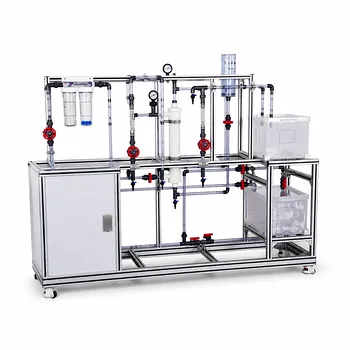
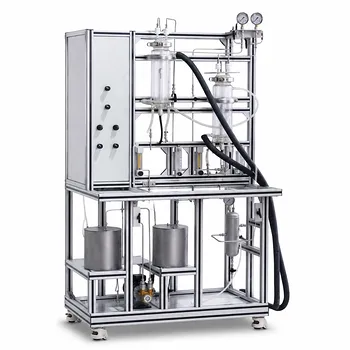
The defining difference between diaphragm and ion-exchange membrane electrolysis cells in an educational pilot plant comes down to product purity and energy logistics. Diaphragm cells produce a dilute, salt-contaminated caustic soda stream—typically around 10% NaOH—that demands enormous downstream thermal energy (roughly 5 tons of steam per ton of 30% NaOH product) just to concentrate and separate. In contrast, membrane cells directly yield a high-purity, high-strength NaOH solution (32–35% NaOH), dramatically slashing both thermal energy for concentration and electrical energy consumption per ton of product.
While the ion-exchange membrane route dominates modern industry with vastly superior energy efficiency and product quality, diaphragm systems still offer unmatched pedagogical simplicity for teaching fundamental mass-transfer principles. The right choice for an educational plant depends on whether you need a hands‑on demonstration of basic electrochemical concepts or an industrially representative, high-performance unit.
Product Output: Purity, Concentration, and Downstream Demands
The most immediate difference between the two technologies is what comes out of the cell and how much additional work that output requires.
Diaphragm Product: A Dilute, Impure Starting Point
In a diaphragm cell, a microporous separator allows convective flow of the anolyte across the cathode chamber. This means the sodium hydroxide solution that forms is not only weak (10–12% NaOH) but also heavily contaminated with sodium chloride—often as high as 1–2% (around 10,000 mg/L salt).
To turn this into a commercially useful chemical, you must evaporate off large amounts of water and crystallize out the salt. That purification sequence is energy-intensive and adds unit operations beyond the electrolysis itself.
Membrane Product: High-Strength, High-Purity NaOH Directly from the Cell
An ion-exchange membrane cell uses a highly selective cation-exchange membrane (typically with fluorosulfonate functional groups) that blocks convective flow and passes only sodium ions. The result is a much cleaner product: caustic soda at 32–35% NaOH with negligible salt content—around 30 mg/L of chloride.
Because the output concentration is already near technical‑grade specifications, the thermal load for final concentration drops drastically. What leaves the cell is a finished or near‑finished product, not a salt‑laden dilute stream.
Energy Utility: Electrical Consumption and Thermal Logistics
While both cells run on electricity, the total energy picture involves much more than just the power meter.
The Hidden Thermal Energy Penalty of the Diaphragm Cell
The dilute, impure nature of diaphragm‑cell catholyte creates a massive downstream thermal burden. Concentrating 10% NaOH up to a marketable 30% solution consumes approximately 5 tons of steam per ton of 30% caustic soda. In an educational plant, that steam demand translates directly into operational cost, boiler capacity, and safety system complexity.
Even if electrical consumption appears comparable as a cell‑to‑cell metric, the overall plant energy balance is dominated by the thermal separation steps required only by the diaphragm route.
Electrical Energy Advantage of Membrane Cells
The ion‑exchange membrane cell is inherently more electrically efficient. The membrane’s ability to suppress back‑migration and unwanted side reactions lowers cell voltage, bringing total electrical energy consumption to about 75–80% of that needed by an equivalent diaphragm cell. Combined with the near‑elimination of downstream steam use, the membrane process achieves a significantly lower total energy cost per ton of NaOH.
For an educational pilot plant, this means students can directly measure and compare the two energy footprints, illustrating why membrane technology is the modern industrial standard.
Educational Plant Considerations: Bridging Fundamentals and Modern Practice
Beyond product specs and utility bills, the choice between these cells reflects the learning objectives you want to prioritize.
Why Diaphragm Cells Still Matter in a Teaching Laboratory
Diaphragm systems are structurally simpler and more forgiving of feed brine quality. The clearly visible mass‑transfer limitations (dilution, salt contamination) make the fundamental concepts of convective transport, diffusion, and electro‑osmosis easy to demonstrate. Students can physically see the need for subsequent evaporation and crystallization, which connects electrolysis to classic unit operations.
A diaphragm pilot plant, therefore, serves as an excellent platform for basic electrochemical engineering education and for showing why industry moved away from this approach.
Membrane Cells as a Platform for Advanced Process Intensification
An ion‑exchange membrane unit puts modern green chemistry and process intensification front and center. Students can study:
- How selective cation transport enables in‑situ product separation.
- The impact of brine purity on membrane life and cell performance.
- How process integration (e.g., using cell heat for evaporation) is enabled by higher‑grade output.
Because membrane cells mirror current industrial best practice, they prepare students for real‑world plant operations and energy‑efficiency audits.
Understanding the Trade‑Offs
No technology is universally better; both carry practical constraints that matter in an educational setting.
- Brine quality sensitivity: The ion‑exchange membrane is easily fouled by calcium and magnesium ions. This demands a rigorous upstream brine purification system—ion‑exchange softeners, precipitation units—that adds capital and maintenance. Diaphragms tolerate much rougher brine, simplifying the plant layout.
- Operational complexity: Membrane cells require precise differential pressure control and strict startup/shutdown protocols to avoid damaging the delicate polymer film. A diaphragm cell is mechanically robust and can be operated more freely during student experiments.
- Asbestos‑free, not worry‑free: Historical diaphragm cells used asbestos—an environmental and safety red flag. Modern educational units use non‑asbestos diaphragms, but the inherent salt‑contamination issue remains.
- Energy cost vs. capital cost: The membrane unit’s lower lifetime operating costs are clear, but its higher initial investment and sensitivity may not be justified if your main goal is demonstrating simple electrochemical mass‑transfer rather than running an efficient mini‑plant.
Making the Right Choice for Your Educational Goal
Your selection should map directly to the learning outcomes you want to achieve.
- If your primary focus is demonstrating basic electrochemical engineering and mass‑transfer limitations: A diaphragm cell offers a forgiving, visually intuitive platform. Students can measure concentration polarization, salt crossover, and the energy penalty of evaporation in a straightforward system.
- If your primary focus is teaching modern, energy‑efficient industrial processes: The ion‑exchange membrane pilot plant is the clear choice. It enables the study of high‑purity production, lower total energy consumption, and the critical role of brine quality—mirroring the technology that now produces the vast majority of the world’s chlorine and caustic soda.
- If your primary focus is minimizing facility energy bills and waste neutralization costs: The membrane route will dramatically reduce steam load and salt waste disposal, even if the initial equipment cost is higher. Over the life of an active educational lab, these savings often dominate.
Ultimately, the best educational plant often combines both: a simple diaphragm cell to ground students in fundamentals, and a membrane cell to showcase the high‑efficiency, high‑purity endpoints of modern chemical engineering.
Summary Table:
| Feature | Diaphragm Cell | Membrane Cell |
|---|---|---|
| NaOH Concentration | 10–12% (Dilute) | 32–35% (High-strength) |
| Purity (NaCl Crossover) | Low (~1–2% salt contamination) | High (Negligible, ~30 mg/L) |
| Thermal Energy (Steam) | High (~5 tons steam/ton NaOH) | Very Low |
| Electrical Efficiency | Standard | High (75–80% energy of diaphragm) |
| Brine Quality Needs | Low (Tolerant of impurities) | High (Requires strict purification) |
Elevate Your Chemical Engineering Lab with LABPARK
Are you looking to bridge the gap between classroom theory and modern industrial practice? LABPARK provides advanced Educational and Vocational Unit Operations Pilot Plants in chemical engineering, bioprocess & biotech, and environmental & water treatment. Designed specifically for universities, research institutes, and enterprises, our pilot plants allow students to gain hands-on experience with both fundamental mass-transfer technologies and modern, energy-efficient processes.
Ready to upgrade your lab's capabilities? Contact LABPARK today to request a quote or customize your pilot plant system!
Related Products
- Ion Exchange Water Purification Educational Pilot Plant for Engineering Unit Operations
- Alkaline Membrane Water Electrolysis Educational Pilot Plant Unit Operations Training System
- Water Electrolysis Hydrogen Production and Storage Educational Pilot Plant
- Electrolytic Hydrogen Production Educational Unit Operations Pilot Plant
- Electrochemical Water Treatment Educational Unit Operations Pilot Plant
People Also Ask
- How to Prevent Ion Exchange Channeling? Expert Solutions for Pilot Plants
- How does ion exchange work in water treatment pilot plants? Cost & process guide.
- What operational precautions should lab operators take for resin volume changes and air pockets? Key Guide
- How to use ion exchange pilot plants to verify alkalinity? A hands-on guide for engineering students.
- Why does iron degrade cation resin & how to demonstrate capacity recovery? Step-by-Step Lab Guide