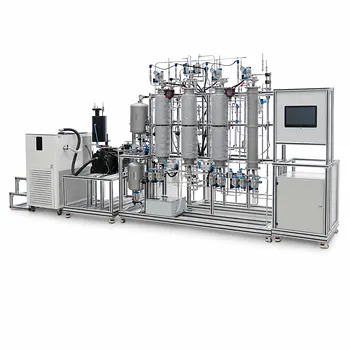
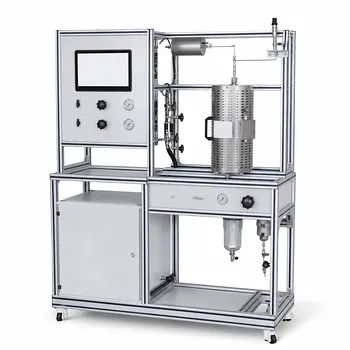
The heart of gasifier selection is a choice between residence time, temperature gradient, and hydrocarbon content in the product gas. Moving bed, fluidized bed, and entrained flow gasifiers diverge fundamentally in how they bring solid fuel and gasifying agent together. Moving beds rely on counter-current flow (coal falls down, gas rises), creating a wide temperature gradient that preserves methane and oils. Fluidized beds use intense back-mixing to suspend crushed coal in an almost isothermal bed, giving great feedstock flexibility. Entrained flow reactors mix fine dust and oxidant co-currently at ultra‑high temperatures, achieving complete carbon conversion but cracking all hydrocarbons to CO and H₂. In a chemical engineering pilot plant, these differences directly determine the required feeding equipment, reactor heating, and downstream syngas cleaning.
The true differentiator isn’t just the gas–solid contact pattern—it’s the resulting temperature profile and its impact on methane retention. Moving beds deliver high cold gas efficiency with simple scale‑up, fluidized beds provide thermal uniformity for reactive coals, and entrained flow units maximize conversion at the cost of extreme operating conditions. Each dictates a unique pilot plant design envelope that teaches critical scale‑up and operability lessons.
The Core Operating Principles: Gas–Solid Contact and Temperature Zones
Moving Bed: Counter‑Current Flow and a Steep Thermal Gradient
Moving bed gasifiers (often called fixed‑bed but with descending solids) push coal in from the top while steam, oxygen, or air enters from the bottom. The counter‑current arrangement creates distinct zones—drying, pyrolysis, gasification, and combustion—stacked vertically. As a result, the bed temperature rises gradually from top to bottom, peaking around 1200 °C in the combustion zone near the grate, while the exit gas leaves relatively cool (700–900 K). This long residence time and temperature gradient allow methane and higher hydrocarbons to survive, giving syngas higher heating value and cold gas efficiencies of 81–88%.
Fluidized Bed: Intense Back‑Mixing for Uniform Conditions
Fluidized beds suspend crushed coal (<5 mm) in an upward‑flowing stream of gasifying agent. Vigorous solids mixing wipes out axial temperature differences, producing an almost isothermal bed (typically 1250–1400 K). This uniform environment makes them exceptionally tolerant of highly reactive or varying feedstocks, like low‑rank coals and biomass. Because the temperature is too low to completely crack methane, some hydrocarbons remain, resulting in cold gas efficiencies of 81–85%—similar to moving beds. However, the back‑mixed flow pattern complicates residence time distributions, making kinetic modeling a more advanced exercise.
Entrained Flow Bed: Co‑Current Flow at Extreme Temperatures
Entrained flow gasifiers inject coal dust (<0.1 mm) and the gasifying agent together, so solids and gas travel co‑currently through a short, high‑temperature zone. Operating at 1600–2200 K, these reactors achieve the fastest kinetics and almost complete carbon conversion. At such temperatures, all methane and tars are cracked into CO and H₂, leaving a very clean but lower‑heating‑value syngas (cold gas efficiency 74–81%). The molten ash (slag) flows out the bottom, requiring a whole layer of refractory and quench design.
How These Differences Translate into Pilot Plant Design
Feedstock Preparation and Handling
The three technologies demand radically different particle size profiles. Moving bed pilot plants must handle large lump coal (5–50 mm) via lock hoppers and mechanical grates, while fluidized beds need crushers to produce <5 mm particles and screw feeders that can withstand pressure. Entrained flow rigs require ultra‑fine grinding and pneumatic dense‑phase conveying of dust that is often more like flour. In a university pilot plant, having all three feed systems side by side teaches the importance of particle size for pressure drop, fluidization velocity, and reactor stability.
Reactor Heating and Temperature Management
The heating strategy flows directly from the temperature profile. Moving bed units must manage a steep thermal gradient with internal cooling or refractory lining to protect the vessel. Fluidized beds demand a uniform heat supply, often through preheated gas and external heating jackets, but their excellent heat transfer eliminates hot spots. Entrained flow reactors require extreme heat input (often via an oxygen‑enriched burner) and active slag tapping systems. For educational settings, moving and fluidized beds are preferred for their safer, lower‑temperature envelopes, while entrained flow setups illustrate industrial‑grade slagging operation.
Downstream Syngas Handling and Cleanup
The gas exit conditions define the cleanup train. Moving bed syngas exits at low temperatures (700–900 K) but contains tars and oils; a pilot plant must include tar condensation and scrubbing steps. Fluidized bed syngas leaves hotter and carries fine char and ash, demanding cyclones and hot‑gas filtration. Entrained flow gas produces a very hot, particle‑free stream but requires a high‑temperature quench to freeze the composition and handle slag. Thus, a comprehensive pilot plant with multiple reactors can illustrate the full range of separation technologies.
Performance Metrics: Cold Gas Efficiency and Product Gas Makeup
Why Moving Beds Produce More Methane
In a moving bed, the fuel travels slowly through a descending temperature profile. The early devolatilization zone releases volatiles that have time to react in lower‑temperature regions, preserving methane. This methane contributes directly to the gas’s heating value, boosting cold gas efficiency to the high 80s. For pilot plant studies, moving beds are ideal for syngas upgrading demonstrations, such as SNG production, because the raw gas already contains significant CH₄.
The Efficiency Penalty of Complete Carbon Conversion
Entrained flow reactors sacrifice methane for complete carbon burnout. At >1600 K, CH₄ is steam‑reformed or cracked, so the product gas is nearly pure CO and H₂. This lowers the cold gas efficiency to 74–81%, but maximizes syngas yield per unit of carbon. For a pilot plant focused on Fischer‑Tropsch or chemical synthesis, this clean, methane‑free syngas can be an advantage, even if the overall thermal efficiency is lower. Students can measure the trade‑off firsthand.
Understanding the Trade‑offs for Research and Training
Operational Complexity and Scale‑Up Behavior
Moving bed gasifiers, analogous to fixed‑bed reactors, have stable hydrodynamics that allow scale‑up from pilot diameters of a few centimeters to industrial dimensions of several meters in a single step. Fluidized beds, however, suffer from complex gas–solid fluidization that changes with scale; they demand multi‑step piloting where each intermediate stage increases only by an order of magnitude. A pilot plant that houses both gives researchers unique insight into scale‑up risks—a lesson impossible to learn from one reactor type alone.
Feedstock Flexibility vs. Process Intensity
Fluidized beds accept a wider range of particle sizes and reactive fuels, including high‑moisture biomass, because the churning motion prevents agglomeration. Moving beds demand strong, non‑caking lumps and can plug if fines accumulate. Entrained flow reactors, while handling any coal, need costly pulverization and struggle with high‑ash fuels that erode equipment. A well‑designed pilot plant uses these contrasts to teach feedstock‑reactor compatibility as a core design principle.
Temperature Control and Safety
The intense back‑mixing in fluidized beds gives them superior temperature uniformity, eliminating hot spots that can melt ash or cause thermal run‑away. This makes them the safest choice for reactive materials and allows straightforward demonstration of isothermal kinetics. Moving beds, with their combustion zone at 1200 °C, require careful air/steam ratio control to avoid clinker formation. Entrained flow units push the limits of refractory materials and demand rigorous safety interlocks. Hence, pilot plant curricula often sequence from fluidized to moving to entrained flow as complexity increases.
Making the Right Choice for Your Pilot‑Plant Goal
Your training or research objective will guide which gasifier type to emphasise.
- If your primary focus is demonstrating syngas‑to‑SNG or studying methane formation: Choose a moving bed pilot plant. Its counter‑current gradient and low exit gas temperature preserve CH₄, letting you trace pyrolysis chemistry directly.
- If your primary focus is feedstock flexibility and uniform reaction kinetics: A fluidized bed is the clear winner. It handles everything from low‑grade coal to biomass, and the isothermal bed simplifies kinetics measurements and energy balances.
- If your primary focus is high‑temperature slagging, complete carbon conversion, or ash behaviour at extreme temperatures: An entrained flow unit is essential. It illustrates burner design, molten ash handling, and the true cost of achieving >99% carbon conversion.
- If your primary focus is scale‑up methodology and hydrodynamic education: You need both a moving (fixed‑like) bed and a fluidized bed in the same pilot hall. The contrast between a single‑step scale‑up and a multi‑stage scale‑up is a lesson that sticks for a lifetime.
Every gasifier technology teaches a different chapter of chemical engineering—the most powerful pilot plants hold all three volumes on the shelf.
Summary Table:
| Parameter | Moving Bed | Fluidized Bed | Entrained Flow |
|---|---|---|---|
| Flow Pattern | Counter-current | Back-mixed (Isothermal) | Co-current |
| Operating Temp | 700 - 1200 K (Exit) | 1250 - 1400 K | 1600 - 2200 K |
| Feed Size | 5 - 50 mm (Lump) | < 5 mm (Crushed) | < 0.1 mm (Pulverized) |
| Cold Gas Efficiency | 81% - 88% | 81% - 85% | 74% - 81% |
| Key Advantage | High methane retention | Great feedstock flexibility | Complete carbon conversion |
Accelerate Your Chemical Engineering Research & Training
Designing the right gasification or unit operations setup requires precise engineering. LABPARK provides premium Educational and Vocational Unit Operations Pilot Plants in chemical engineering, bioprocess & biotech, and environmental & water treatment. Tailored for universities, research institutes, and enterprises, our systems bridge the gap between classroom theory and industrial application.
Ready to equip your lab with state-of-the-art pilot plants? Contact LABPARK today to discuss your project requirements with our technical experts!
Related Products
- Fixed-Bed Chemical Reaction and Gas Dust Tar Removal Unit Operations Pilot Plant
- Dual-Mode Gas Absorption and Desorption Unit Operations Training Pilot Plant
- Micro-Scale Gas-Solid Catalytic Reaction Educational Pilot Plant
- Fixed Bed Gas Solid Catalytic Reaction Educational Pilot Plant
- Fluidized Bed Gas Solid Catalytic Reaction Educational Pilot Plant
People Also Ask
- When to transition from PID to adaptive control in pilot plants? Key process indicators.
- How do deviations in estimating latent heat impact pilot plant thermal systems? Avoid hardware mis-sizing.
- Why Compare Predicted and Experimental Excess Enthalpy? Key to Accurate Pilot Plant Scale-up
- Why Use PTFE & Hastelloy in Chemical Pilot Plants? Prevent Corrosion & Ensure Safety
- How to study gasification in pilot plants? Compare exit gas composition & efficiency