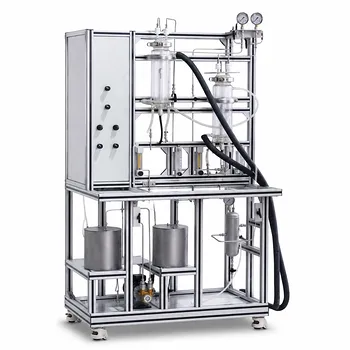
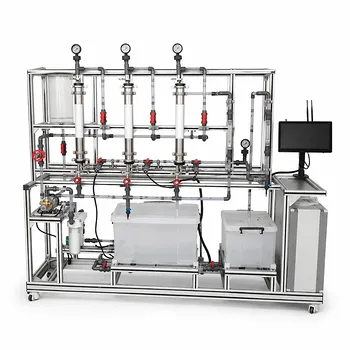
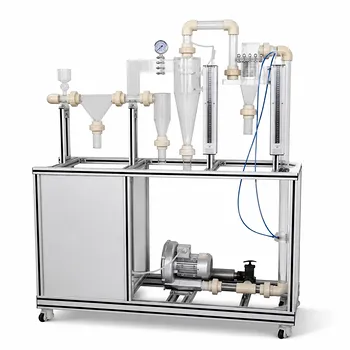
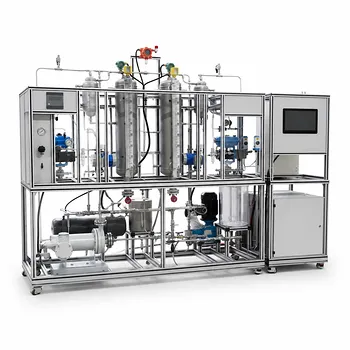
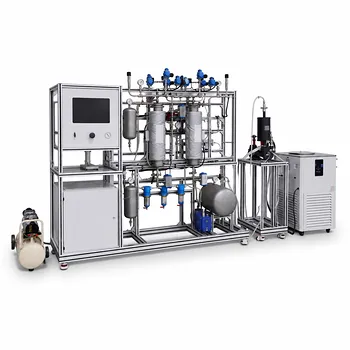
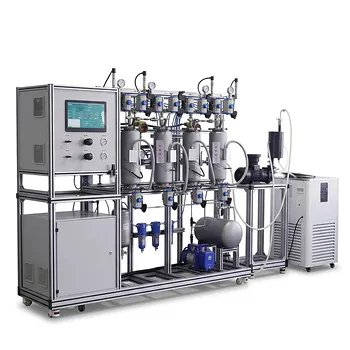
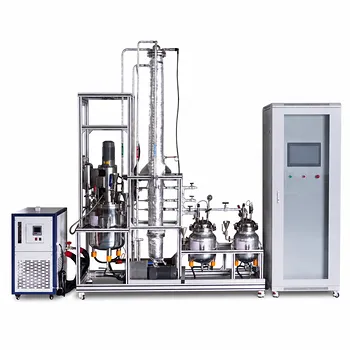
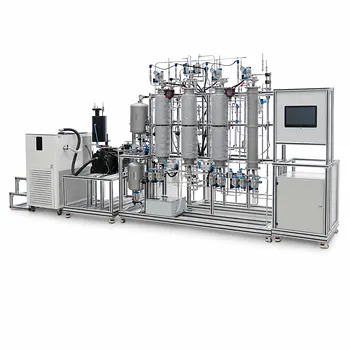
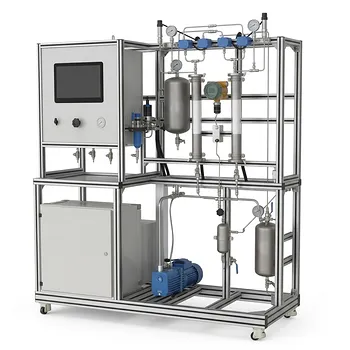
Integrating a membrane separation stage into a conventional multi-stage condensation pilot plant for solvent recovery delivers two decisive operational wins: it dramatically cuts energy consumption and eliminates process downtime caused by ice plugging. In any system where water vapor mixes with the solvent-laden off-gas, the deep-freeze condenser (often running at -70 °C or below) will eventually clog with ice, forcing a shutdown for defrost. Swapping that final freezing stage for a membrane separation step keeps the recovery process running around the clock without the energy penalty of extreme refrigeration.
The core advantage is simple but transformative: membrane separation works at ambient or moderate temperatures, sidestepping the sub-zero conditions that drive up energy bills and freeze plant operation. This single change turns an intermittent, energy-hungry process into a continuous, low-energy recovery line — and in a teaching pilot plant, it creates the perfect platform to contrast mass-transfer and thermal separation principles side by side.
The Hidden Weakness of Multi-Stage Condensation
The High Cost of Deep Refrigeration
Conventional solvent recovery trains often cascade from warm to progressively colder condensers. The final stage, operating at -70 °C or lower, is needed to meet strict emission limits or high recovery percentages — but it demands enormous electrical power. Each additional degree below ambient pushes the refrigeration cycle’s coefficient of performance down rapidly, making the last condenser the most energy-intensive link in the chain.
The Ice Blockage Downtime Dilemma
In the real world, off-gas streams almost always carry moisture. When that moist air hits a condenser surface held at deep sub-zero temperatures, water vapor freezes instantly. Ice layers build up on the heat-exchange surfaces, blocking flow, wrecking heat transfer, and eventually forcing a full plant shutdown for de-icing. These unplanned defrost cycles sap productivity, increase maintenance burden, and complicate process scheduling.
How Membrane Separation Transforms Solvent Recovery Operations
Ambient-Temperature Separation Eliminates Freezing
A vapor-selective membrane unit recovers the target solvent at far milder temperatures — often room temperature or just above. Because there’s no cryogenic surface, water vapor remains a gas and ice never forms. The system stays hydraulically open and thermally stable, enabling true continuous operation. Thin-film composite membranes with rubbery selective layers are particularly effective for this task, stripping organic vapors from a humid gas stream without ever dipping into the freeze zone.
Drastic Reduction in Energy Consumption
Membrane separation is a pressure-driven process that requires no phase change. Instead of condensing the solvent by brute-force cooling, the membrane accomplishes the same separation using a small partial-pressure difference across the film. This eliminates the huge thermal load of low-temperature refrigeration entirely, often slashing overall plant energy use by a significant margin. The pilot plant becomes a living demonstration that energy efficiency and high recovery rates are not mutually exclusive.
Uninterrupted Continuous Operation
Ripping out the defrost cycle removes the biggest barrier to steady-state performance. With the membrane module in place of the final condenser, the pilot plant can be run for extended periods without ever pausing to clear ice. This continuous operability not only boosts throughput in an industrial setting but also, in a teaching laboratory, gives students a stable baseline for studying mass-transfer phenomena.
Simplified Process Control and Modular Scalability
Membrane systems are inherently simple and compact. A skid holding a few spiral-wound or hollow-fiber modules can replace a bulky, heavily insulated cryogenic condenser and its associated refrigeration loop. The modular design makes it easy to scale up or reconfigure, an advantage that resonates in both pilot-scale research and future roll-outs.
The Bigger Picture: Operational Flexibility Beyond Freezing
Load-Shaving and Fluctuation Handling
While the primary focus with condensation trains is replacing the final freezing stage, membrane modules also shine in hybrid configurations. Installed ahead of an adsorption or condensation stage, a membrane unit can shave peak vapor loads, protecting downstream equipment from overload and smoothing out the effect of fluctuating inlet concentrations — a valuable secondary benefit in many industrial pilot plants.
Educational Insight into Process Intensification
Running a membrane module in series with conventional condensers gives students a direct, hands-on comparison of mass-transfer vs. thermal separation. They measure how a pressure-driven film can deliver the same endpoint as multi-stage condensation, reinforcing fundamental concepts in sustainability, process integration, and green engineering.
Understanding the Trade-offs and Limitations
Membrane Fouling and Permeate Flux Decline
No membrane lasts forever. Over time, trace particulates, oil mists, or polymerizable monomers can foul the surface, causing a gradual drop in permeate flux. In a pilot plant, teaching students to monitor pressure drops and recognize the early signs of fouling is just as valuable as showcasing the technology’s benefits.
Chemical Compatibility and Lifespan
Polymeric membranes have a finite chemical window. Aggressive solvents or extreme pH can swell or degrade the selective layer, requiring careful feed characterization. Regular replacement is part of the operational cost model — an important lesson in techno-economic analysis.
Selectivity and Recovery Boundaries
A single membrane stage cannot always match the extremely low residual concentrations that a -70 °C cold trap can achieve for certain components. In some cases, a small hybrid system with a mild condenser followed by a membrane stage is the optimal configuration, balancing energy savings against ultimate recovery percentage. Understanding where membranes work best — and where they hit their practical limit — is central to sound process design.
Making the Right Choice for Your Pilot Plant Goal
The decision to integrate a membrane stage hinges on what you want to demonstrate, optimize, or teach.
- If your primary focus is demonstrating energy-efficient solvent recovery: Replace the final sub-zero condenser entirely with a vapor-selective membrane module to showcase radical energy reduction and eliminate icing downtime.
- If your primary focus is teaching process integration and mass-transfer fundamentals: Keep a multi-stage condenser train but swap in a membrane stage for the coldest step — students can directly compare separation mechanisms, measure energy duty, and observe why ambient separation avoids freezing.
- If your primary focus is exploring hybrid process configurations: Install the membrane unit upstream of a condenser or adsorption bed to illustrate load-shaving, peak-handling, and the concept of protecting downstream equipment from fluctuations.
- If your primary focus is training operators on real-world membrane constraints: Design lab protocols that deliberately expose the membrane to challenging feeds, monitor fouling rates, and schedule cleaning cycles — building hands-on experience in long-term membrane management.
Replace the deep-freeze stage with intelligent membrane separation, and your pilot plant transforms from a stop-start energy drain into a smooth, sustainable model of modern process design.
Summary Table:
| Operational Feature | Conventional Multi-Stage Condensation | Membrane-Integrated System |
|---|---|---|
| Operating Temperature | Sub-zero (down to -70°C) | Ambient or moderate temperature |
| Energy Demand | High (intensive cryogenic refrigeration) | Low (pressure-driven, no phase change) |
| Process Continuity | Intermittent (stops for ice defrosting) | Continuous (no icing or plugging) |
| System Footprint | Bulky refrigeration loops | Compact, modular membrane skids |
Modernize Your Chemical Engineering Lab with LABPARK
Looking to demonstrate cutting-edge separation technologies in your curriculum or research? LABPARK provides advanced Educational and Vocational Unit Operations Pilot Plants in chemical engineering, bioprocess & biotech, and environmental & water treatment tailored for universities, research institutes, and enterprises.
Whether you need to teach membrane separation, multi-stage condensation, or hybrid process intensification, our custom-built pilot plants deliver reliable, hands-on learning experiences.
Contact LABPARK today to discuss your laboratory specifications and request a quote!
Related Products
- Photocatalytic Membrane Separation and Degradation Unit Operations Pilot Plant
- Multifunctional Membrane Separation Educational Pilot Plant with Ultrafiltration, Nanofiltration, Reverse Osmosis
- Ultrafiltration Membrane Separation Educational Pilot Plant
- Multi-Functional Membrane Separation Educational Pilot Plant for Unit Operations Lab
- Hollow Fiber Ultrafiltration Membrane Separation Educational Pilot Plant
People Also Ask
- What are the key differences in membrane configurations? Choose the Right Unit Operations Pilot Plant
- How Do Pervaporation, Vapor, and Gas Permeation Differ in Pilot Plants? Key Comparison
- What are the structural & performance trade-offs of flat-sheet, spiral-wound, & hollow-fiber membrane modules?
- Pervaporation vs. Vapor Permeation: Handling Suspended Solids in Membrane Pilot Plants
- How do PEI, PVDF, and PSU membranes compare in pilot plants? Find the best fit.