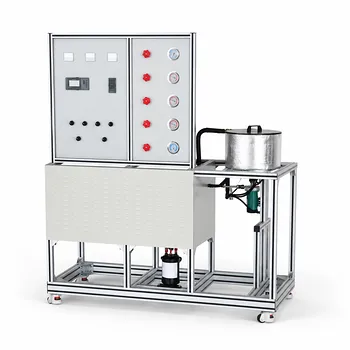
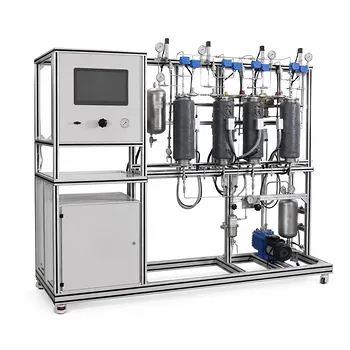
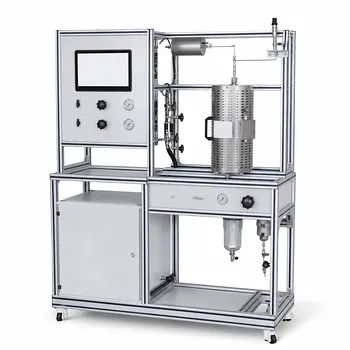
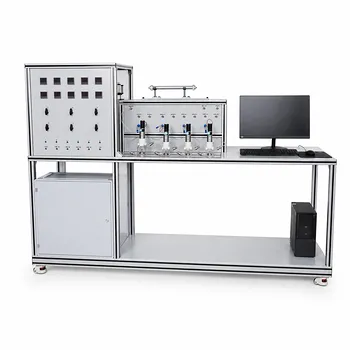
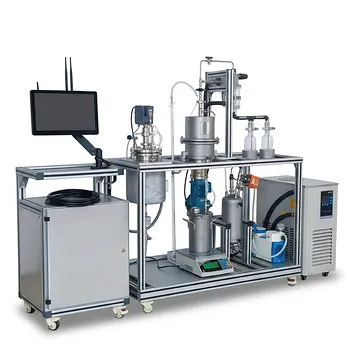
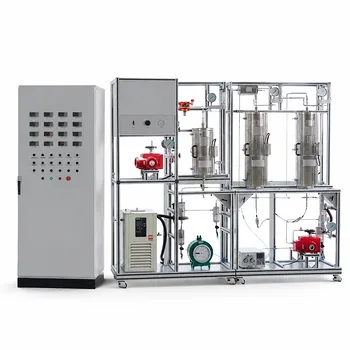
For a laboratory exploring intensified liquid-liquid transformations, a CPCR pilot unit operates exclusively with a biphasic liquid system and offers a step-change advantage through its unmatched stationary phase capacity. The reactor uses centrifugal force and column geometry to hold the catalyst-rich liquid stationary phase in place, while the mobile phase passes through as micro-droplets, dramatically boosting mass transfer and reaction efficiency without any solid support. This translates to faster development cycles, simplified catalyst handling, and highly efficient extraction in a single, gentle unit operation.
A CPCR pilot unit’s core operational value is its ability to retain a massive amount of liquid stationary phase—far beyond what a solid-supported column can offer—enabling continuous, high-efficiency liquid-liquid reaction and separation. Its fluid phase requirement is strict: you must work with two immiscible liquids of different densities, and the catalyst must reside in the stationary liquid.
The Fluid Phase Requirement: Strictly Liquid, Immiscible, and Density-Driven
The CPCR is not a “general-purpose” reactor. It solves a specific, valuable niche that demands absolute adherence to its fluid phase rules.
It Operates Entirely Without a Solid Support
The most fundamental requirement is that your entire process must be liquid-liquid. There is no packed bed, no adsorbent particles, no inert carrier. Both the reaction and the separation happen between two immiscible liquid phases. This means your catalyst, reactants, and products must all be soluble or dispersible in one of the two liquids.
Two Immiscible Liquids with a Clear Density Difference Are Essential
To create and sustain the counter-current extraction, you need two liquids that form a stable phase boundary. The centrifugal force field inside the column holds the denser (usually stationary) liquid in place against the flow of the lighter mobile phase. Without a sufficient density difference, phase separation will fail, and the stationary phase will wash out.
The Catalyst Must Live in the Stationary Liquid
The stationary phase is not just an inert separator; it typically contains the catalyst. This could be a dissolved homogeneous catalyst, an enzyme in an aqueous phase, or a phase-transfer agent. Because this phase is retained by physics, not adsorption, you gain enormous flexibility in catalyst choice and avoid the leaching or deactivation issues common with solid supports.
Operational Advantages That Matter in a Bioprocess or Chemical Engineering Lab
The CPCR pilot unit isn’t just a curiosity—it delivers tangible workflow and performance benefits that directly address the frustrations of liquid-liquid reaction development.
Massive Stationary Phase Capacity for Faster, More Efficient Reactions
The primary operational advantage is dramatically higher stationary phase volume compared to a traditional liquid-solid chromatographic reactor. In a standard column, only a fraction of the void space holds the active stationary phase. A CPCR can keep over 80% of the column volume as the stationary liquid. That capacity directly boosts residence time, interfacial area, and overall conversion in a single pass.
Micro-Droplet Flow Regime Maximizes Interfacial Mass Transfer
The mobile phase disperses into fine micro-droplets as it travels through the retained stationary liquid. This creates an enormous interfacial area per unit volume, shrinking the diffusion path for molecules moving between phases. For mass-transfer-limited reactions—like biphasic enzyme processes or reactive extractions—this can increase conversions by an order of magnitude compared to stirred tanks or membrane contactors.
Gentle Processing Without Heat or Shear Stress
Because the separation relies on liquid-liquid partitioning under mild centrifugal force, the CPCR operates at low shear and near-ambient temperature (unless temperature control is added). This is especially valuable in bioprocess labs working with sensitive biomolecules, proteins, or whole cells that would denature or lose activity on a solid adsorbent surface or under aggressive mixing.
Simplified Catalyst Recycling and Scale-Up Logic
The catalyst is confined to the stationary liquid, so you can run continuously without catalyst recovery steps. There is no need to immobilize enzymes on expensive beads or to filter out suspended catalysts. When you scale the process, the principle stays the same: more centrifugal discs or larger diameter columns to increase throughput. This drastically cuts method development time.
Direct Observation and Educational Value
For a pilot or academic lab, the transparent housing often seen on CPCR units lets researchers visually track phase behavior, droplet formation, and band movement in real time. This direct feedback accelerates troubleshooting and makes it an exceptional teaching tool for liquid-liquid extraction, partition chromatography, and process intensification concepts.
Common Pitfalls and Honest Trade-offs
No technique is universal. Understanding where a CPCR falls short is essential to using it wisely.
- Not for Single-Phase or Solid-Catalyzed Processes: If your chemistry requires a solid catalyst, a supported enzyme bed, or operates in a single organic solvent, a CPCR simply cannot be used.
- Density Matching Can Fail: Emulsion-forming mixtures, highly viscous biopolymer solutions, or systems with density inversion at certain compositions can cause phase bleed or column failure.
- Pressure Limits and Throughput: Pilot-scale CPCRs operate at moderate centrifugal fields. Very high flow rates may overcome the phase retention force, limiting maximum throughput and requiring careful operating point optimization.
- Catalyst Leakage Risk: While the stationary phase is retained, the tiniest solubility of your catalyst in the mobile phase will lead to slow, continuous loss. A separate catalyst scavenging step is sometimes needed downstream.
Making the Right Choice for Your Lab’s Goals
The decision to invest time in a CPCR pilot unit depends entirely on the nature of your process and your development priorities.
- If your primary focus is liquid-liquid reactions with a recyclable catalyst or enzyme in one phase: A CPCR is likely your highest-efficiency option, combining reaction and extraction in a single, compact unit with minimal catalyst immobilization work.
- If your primary focus is purifying a complex cocktail of intermediates and side-products from a solid-supported reaction: A CPCR is not the right tool; you need a preparative liquid chromatography system with an optimized solid stationary phase or, for truly multiple component splitting, a concept like a CRACR unit.
- If your primary focus is teaching and researching intensified bioprocess fundamentals: The visual access, clear phase retention mechanics, and rapid method iteration of a CPCR pilot unit make it one of the most powerful educational and experimental platforms available.
Choose based on the phase you must control, and the CPCR will reward you with a level of integration and efficiency that solid-supported reactors simply cannot match.
Summary Table:
| Aspect | Key Details for CPCR Pilot Units |
|---|---|
| Phase Requirements | Strictly liquid-liquid, immiscible phases with density differences |
| Catalyst Handling | Retained in stationary liquid phase; no solid support needed |
| Mass Transfer | Micro-droplet flow regime creates massive interfacial area |
| Processing Style | Low shear, gentle processing, ideal for sensitive biomolecules |
| Key Advantage | High stationary phase capacity (>80%) and simplified scale-up |
Scale Up Your Bioprocess and Chemical Engineering Operations
Looking to implement high-efficiency liquid-liquid extraction and reaction technologies in your facility?
LABPARK provides premium Educational and Vocational Unit Operations Pilot Plants in chemical engineering, bioprocess & biotech, and environmental & water treatment. Specifically designed for universities, research institutes, and enterprises, our systems streamline process intensification and hands-on training.
Contact LABPARK today to discover the ideal pilot plant solution for your laboratory's needs!
Related Products
- Polymerization Granulation and Pellet Processing Educational Unit Operations Pilot Plant
- Chemical Pipeline Assembly and Fluid Transport Practical Training Unit Operations Pilot Plant
- Carbon Material Thermal Pretreatment Multiphase Separation Educational Pilot Plant
- Constant Pressure Filtration Educational Unit Operations Pilot Plant
- Fixed-Bed Chemical Reaction and Gas Dust Tar Removal Unit Operations Pilot Plant
People Also Ask
- How do educational unit operations pilot plants bridge theory and design? Bridge the Engineering Gap
- How do educational unit operations pilot plants address safety and waste management when scaling up?
- Why Compare Predicted and Experimental Excess Enthalpy? Key to Accurate Pilot Plant Scale-up
- When to transition from PID to adaptive control in pilot plants? Key process indicators.
- How to study gasification in pilot plants? Compare exit gas composition & efficiency