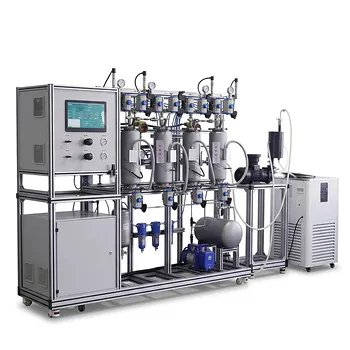
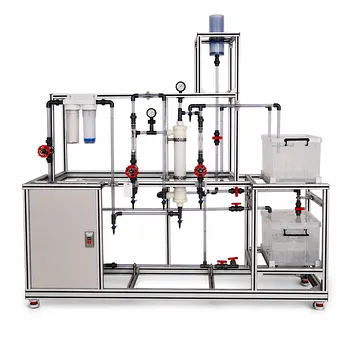
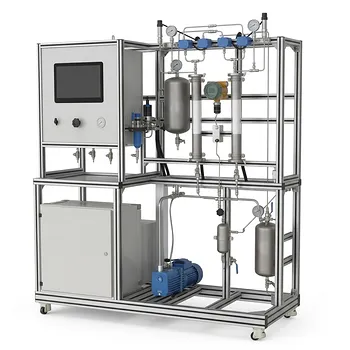
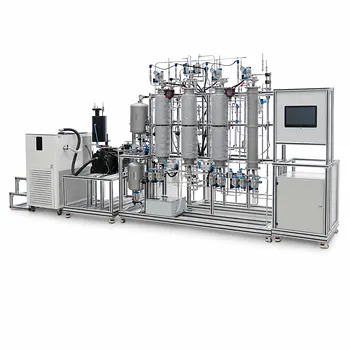
Offshore separation demands precision where space and time are enemies. Conventional mechanical separation equipment—gravity settlers, hydrocyclones, and centrifugal separators—simply cannot shrink enough to fit on a platform. They demand enormous vessel volumes and days of liquid residence time to achieve clean oil-water splits. Modern unit operations pilot plants close this critical training gap by teaching process intensification. They compress multiple separation mechanisms into a single, compact, continuous-flow system, letting trainees manipulate temperature, electric fields, and adsorbent media to achieve rapid demulsification in a footprint that mirrors field realities.
The core of the offshore separation problem is not poor performance, but impossible logistics. Conventional equipment is too large, too slow, and too expensive for the weight- and space-constrained topside. Modern pilot plants flip the training paradigm, moving from size-dependent gravity separators to integrated, multi-mechanism units where chemical, electrostatic, and adsorption forces do the heavy lifting in a fraction of the space and time.
The Space and Time Trap of Conventional Offshore Separation
The Irreconcilable Footprint Constraint
A typical gravity settling tank relies on the slow upward buoyancy of oil droplets. To handle realistic flow rates, this vessel must be meters wide and long. On a production platform, every square meter counts—sometimes costing over $100,000 in structural steel alone.
Hydrocyclones and centrifuges reduce volume but still demand heavy, complex support structures. The installed cost and weight of these mechanical systems often make them non-starters for remote, unmanned, or deep-water installations.
Residence Time: Days, Not Seconds
The fundamental limitation is time. Oil-water emulsions with small droplet sizes (<20 microns) can require days of retention in a conventional separator to meet discharge specifications. On an FPSO with a 30-minute skim tank, that performance gap is a non-negotiable failure.
Slow separation also creates a massive buffer volume problem. The equipment must store and process huge slugs of fluid, turning mechanical separation into a logistics headache rather than a physics puzzle.
Why Simple Scale-Down Fails
You cannot just build smaller gravity separators. Buoyancy forces scale with volume, so shortening the vessel reduces droplet rising distance but drastically lowers throughput capacity. The physics enforces a fixed trade-off: smaller equals weaker separation.
This is why training engineers on industrial-scale conventional equipment often misses the point. Students learn principles that apply to refineries, not to the constrained, dynamic environment offshore.
How Modern Pilot Plants Reframe the Training Challenge
Process Intensification at Educational Scale
Modern oil-water separation pilot plants deliberately abandon the idea of passive settling. They showcase compact, intensified unit operations where multiple driving forces work in unison. Instead of demonstrating a 10-meter settling tank, they use a bench-scale vessel that integrates chemical injection, electrostatic grids, and adsorbent media.
Trainees see that effective separation is not about vessel size; it is about manipulating droplet behavior—coalescing tiny droplets into fast-settling large particles through applied energy and surface chemistry.
Multi-Mechanism Demulsification in a Single Unit
These pilot plants combine chemical, electrostatic, and adsorption methods into a continuous-flow train. A stream of stabilized oil-water emulsion first encounters a tailored demulsifier that weakens interfacial films. It then passes between insulated electrodes where an electric field forces water droplets to collide and coalesce. Finally, it flows through a bed of sulfonated micro-porous polymer granules that capture residual water with high specificity.
This integration achieves extremely rapid separation rates—often in minutes rather than hours—within a very small equipment footprint. For a trainee, it demystifies how offshore compact separators actually work, moving beyond abstract theory to tangible, measurable performance.
Real-Time Observation and Sensor Integration
A critical training advantage is the pilot plant’s ability to reveal what is happening inside the process. Online turbidity meters, conductivity probes, and cameras (with backlighting) let operators watch droplet growth and oil clarity evolve in real time.
Students learn to interpret sensor data, recognize the onset of emulsion inversion, and adjust dosing rates immediately. This real-time feedback loop mirrors the modern industrial shift toward automated quality monitoring and transforms the pilot plant from a static demonstration into an active learning laboratory.
Bridging Theory to Practice with Hands-On Variable Manipulation
Controlling Temperature and Viscosity
The settling velocity of a water droplet is proportional to the oil’s specific gravity difference and inversely proportional to its viscosity. Heating the emulsion lowers oil viscosity and widens the density gap, accelerating separation.
In a pilot plant, trainees can dial in hot-fluid delivery, measure inlet and outlet temperatures, and directly correlate a 20°C rise with a halving of retention time. This tangible cause-and-effect cements the transport equations students learn from textbooks.
Electrostatic Coalescence in Action
Electrostatic treatment is one of the most powerful yet poorly understood intensification methods. When a pulsed DC field is applied, polarized water droplets align and rapidly migrate toward one another. The pilot unit lets learners vary field strength, frequency, and waveform.
They can then measure the resulting droplet size distribution with inline particle analyzers, directly validating the electrocoalescence models. Instead of memorizing that a 3000 V/cm field accelerates coalescence, they see a milky emulsion turn clear in seconds as the field is energized.
Validating Scale-Up Models with Measured Data
All process intensification ultimately depends on predictive models. In the pilot plant, students collect mass balance data, separation efficiency versus flow rate curves, and exit water-cut profiles.
They use these numbers to fit empirical constants and verify the mathematical sizing equations they will apply to full-scale designs. This closes the loop between educational abstraction and the real-world engineering decision: “Will this compact separator handle 50 m³/h on the platform without exceedance?”
Understanding the Trade-Offs of Pilot Plant Training
The Gap Between the Benchtop and the North Sea
A pilot plant runs on a prepared, consistent feedstock. Offshore, the emulsion quality changes hourly—from light, heat-affected crudes to heavy, solids-laden slops. Training cannot replicate the fouling, sloshing, and transient upsets of a real FPSO in storm conditions.
Learners must recognize that a pilot plant proves a principle; it does not guarantee identical field performance. The challenge remains to translate the observed rapid demulsification into robust operating envelopes that survive external disturbances.
The Complexity of Real Emulsions vs. Idealized Training Streams
Educational units often use model oils and synthetic brines with tightly controlled droplet sizes. Real production fluids contain asphaltenes, waxes, and fine solids that form rigid interfacial skins resistant to chemical and electrostatic attack.
The risk is overconfidence. Trainees who have only seen rapid separation with model fluids may underestimate the need for pre-treatment chemicals or the interplay with produced sand, requiring further operational learning in the field.
Operational Costs of Advanced Separation Methods
Process intensification is not free. The consumable cost of specialty demulsifiers, the electrical power for high-voltage grids, and the eventual replacement of saturated adsorbent media all add to the operating expense.
A well-designed pilot plant curriculum makes these trade-offs visible by requiring students to calculate the cost per barrel of treated water. This fosters a habit of evaluating economic as well as technical performance—a critical mindset for any offshore team tasked with both production and profitability.
The Risk of Over-Reliance on Single-Unit Demonstrations
A single compact separator demo can inadvertently suggest a “silver bullet” solution. In reality, offshore oil-water treatment is almost always a cascade of stages: primary gravity knockout, secondary hydrocyclone, tertiary polishing by adsorption or membrane.
Modern pilot plants should therefore be modular, allowing reconfiguration so trainees understand that process intensification must be integrated into an overall separation scheme, not used in isolation.
Making the Right Choice for Your Training Goal
- If your primary focus is bridging the offshore skills gap for experienced operators: Select a pilot plant that emphasizes the multi-mechanism operation (electrostatic + chemical + adsorption) and includes realistic sensor suites. This trains the troubleshooting reflex needed when a compact separator’s performance drifts.
- If your primary focus is preparing graduate engineers for next-generation compact separation design: Choose a system that makes variable manipulation explicit—flow rate, temperature, electric field strength, and demulsifier type—so they can validate the underlying transport equations and build scale-up confidence.
- If your primary focus is teaching fundamental separation science with immediate industrial relevance: Opt for a modular pilot plant that can first demonstrate a simple gravity settler, then apply intensification one mechanism at a time. This reveals why each enhancement matters before integrating them, creating a richer, long-lasting conceptual map.
The ocean does not tolerate oversized equipment or theoretical guesswork. By training on modern unit operations pilot plants that mirror the compact, multi-force reality of offshore separation, we produce engineers who think in terms of intensification, not enlargement—and who are ready to solve the field’s toughest fluid challenges from day one.
Summary Table:
| Feature | Conventional Mechanical Separation | Modern Unit Operations Pilot Plants |
|---|---|---|
| Mechanism | Gravity settling, centrifugal force | Integrated chemical, electrostatic, & adsorption |
| Footprint & Time | Large footprint, days of retention | Compact, rapid separation in minutes |
| Training Focus | Large-scale passive operations | Hands-on process intensification & variable control |
| Key Variables | Fixed design parameters | Temperature, electric field, chemical dosage |
Empower Your Engineers with Advanced Process Training
Ready to bridge the gap between classroom theory and real-world offshore engineering? LABPARK provides premium Educational and Vocational Unit Operations Pilot Plants in chemical engineering, bioprocess & biotech, and environmental & water treatment. Designed for universities, research institutes, and enterprises, our modular systems enable hands-on training in process intensification, variable control, and real-time data analysis.
Contact us today to find the perfect pilot plant for your training goals!
Related Products
- Multi-Functional Membrane Separation Educational Pilot Plant for Unit Operations Lab
- Bench Scale Dual Column Gas Separation and Capture Educational Pilot Plant
- Gas-Solid Heterogeneous Separation Demonstration Educational Unit Operations Pilot Plant
- Photocatalytic Membrane Separation and Degradation Unit Operations Pilot Plant
- Multifunctional Membrane Separation Educational Pilot Plant with Ultrafiltration, Nanofiltration, Reverse Osmosis
People Also Ask
- What are the key differences in membrane configurations? Choose the Right Unit Operations Pilot Plant
- How Do Pervaporation, Vapor, and Gas Permeation Differ in Pilot Plants? Key Comparison
- What are the advantages of membrane separation pilot plants? Energy-saving process intensification.
- Pervaporation vs. Vapor Permeation: Handling Suspended Solids in Membrane Pilot Plants
- How do PEI, PVDF, and PSU membranes compare in pilot plants? Find the best fit.