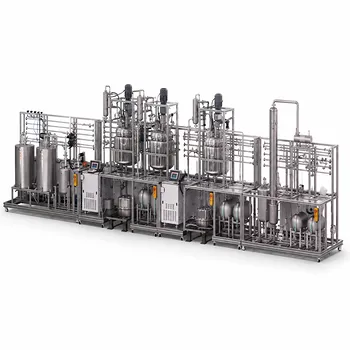
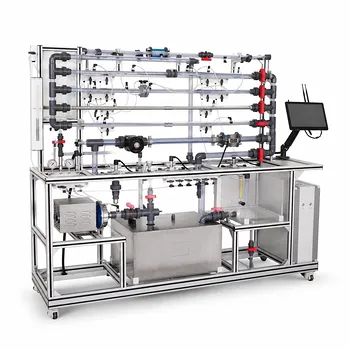
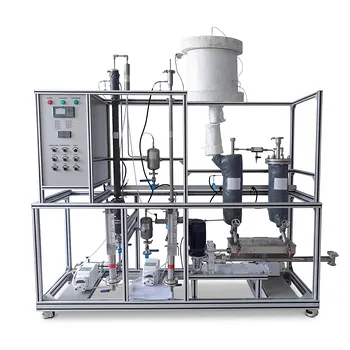
The fundamental technical operations are identical. Basic chemical manufacturing and API synthesis share the exact same physical and chemical processing steps. Both rely on a deliberate sequence of reaction, separation, and purification—typically handling liquids or slurries in batch vessels. To demonstrate this duality, a chemical engineering pilot plant must be configured around core unit operations (reactors, distillation columns, dryers) while offering the flexibility to add high-purity isolation and continuous-flow modules. This single setup can then simulate the full journey from commodity chemical production to regulated pharmaceutical synthesis.
The core engine of both worlds is identical: batch reaction, separation, and drying. The difference lies not in the underlying unit operations, but in the purity specifications, regulatory oversight, and the optional integration of intensified continuous processing. A well-designed pilot plant makes this entire spectrum teachable in one place.
The Overlapping DNA of Chemical and Pharmaceutical Manufacturing
Before exploring the hardware, it’s essential to recognize why the same pilot plant can serve both domains. The primary reference clarifies that API manufacturing is fundamentally a branch of fine chemical synthesis, built on the same batch processing logic.
The Shared Sequence of Unit Operations
Both fields progress through a near-identical sequence: component charging, reaction, work-up (extractions, distillations), isolation (crystallization/precipitation), filtration, and drying. Whether you’re making a bulk intermediate or a life-saving API, you will move material through these stages.
The physics and chemistry inside each step remain unchanged. Heat transfer, mass transfer, mixing intensity, and residence time govern the outcome regardless of the final product label. A distillation column separates based on boiling points, not on whether the molecule is destined for a polymer or a patient.
The Dominance of Batch Processing
Traditional chemical manufacturing and API synthesis are overwhelmingly batch-centric. Both handle liquids and slurries in stirred tanks, executing reactions and work-ups sequentially. This shared batch heritage means that a pilot plant centered on modular stirred tank reactors immediately provides the fundamental platform needed for both worlds.
The only difference is that API batch processing eventually layers on higher containment, more rigorous cleaning validation, and significantly tighter impurity control. But the underlying fluid dynamics and heat transfer challenges do not change.
Configuring a Pilot Plant to Demonstrate Both Realities
To serve as a dual-purpose training and research tool, the pilot plant must combine the universal core with specific add-ons that distinguish pharmaceutical processing. The following configuration, drawn from both the primary and supplementary references, achieves that.
The Non-Negotiable Core: Reaction, Separation, Drying
Start with batch reactors equipped with robust temperature control and agitation. These are the heart of both processes. Add a separation column (for distillation or stripping) to handle work-up and solvent recovery—a staple in bulk chemical and API purification alike. Finally, integrate a dryer (tray or conical) because solid product isolation ends nearly every chemical and pharmaceutical batch.
Training on just these three units already teaches the essential sequence: react, separate, dry. Students and researchers can study batch optimization, process control strategies, and the impact of mixing—skills directly transferable between industries.
Incorporating Continuous Flow Modules
While the batch core is essential, modern API process R&D often turns to continuous setups for fast, highly exothermic reactions. Integrating a tubular reactor or inline static mixer allows the same pilot plant to demonstrate intensified processing.
The addition of a continuous extraction or continuous crystallization module further bridges the gap. This lets users analyze residence time distribution, heat transfer limitations, and the integration of downstream separation trains—key considerations for industrial scale-up that apply to both high-volume chemicals and low-volume APIs where yield and safety are critical.
Downstream Processing: Crystallization and Filtration as the Bridge
In API synthesis, isolation and purification are where pharmaceutical rigor becomes most visible. A dedicated crystallization system with controlled cooling and seeding capabilities allows the pilot plant to dictate final crystal form and particle size—a critical quality attribute for APIs that rarely matters for basic chemicals.
Similarly, offering multiple filtration options (pressure filter, filter dryer, centrifuge) teaches how upstream reaction conditions directly influence downstream processing. The same fundamental unit operation of filtration, when combined with scalability studies in the 50–4,000 L range, shows students the real-world constraints of pilot-scale vs. manufacturing-scale operation.
Understanding the Trade-offs and Pitfalls
No pilot plant can perfectly replicate every real-world condition. Acknowledging these limitations builds a realistic educational environment.
Batch vs. Continuous: Neither Is a Panacea
Batch processes offer flexibility and are familiar, but they can hide heat transfer dangers when scaling up exothermic reactions. Continuous flow provides superior mixing and thermal control for fast reactions, yet it complicates work-up and solid handling.
A pilot plant equipped with both teaches the most critical lesson: the process must dictate the equipment, not the other way around. Trying to force a batch process into a continuous setup can be just as harmful as refusing to consider continuous options for dangerous chemistry.
The Purity Trap
The unit operations are the same, but the acceptance criteria are dramatically different. What counts as a minor impurity in a bulk chemical may be a critical genotoxic impurity in an API. The pilot plant must therefore be configurable to demonstrate cleaning validation, solvent swap distillations, and multiple recrystallizations—steps often omitted in basic chemical demonstrations but essential to simulating pharmaceutical reality.
Scale-Up Constraints Are Real
Supplementary references highlight that pilot-scale operations typically run 5 days a week with flexible, sequential setups, while manufacturing runs 24/7 with standardized, parallel lines. Students must experience this disconnect firsthand: longer analytical turnaround times, varying automation levels, and the constant need to adapt parameters when moving from lab-scale grams to pilot-scale kilograms.
Making the Right Choice for Your Training or Research Goal
How you configure and use the pilot plant ultimately depends on which aspect of the chemical–API continuum you need to emphasize. Prioritize your primary objective.
- If your primary focus is teaching fundamental chemical engineering principles: Keep the plant simple: batch reactor, distillation column, and dryer. This clearly illustrates the universal sequence of unit operations and allows students to study heat/mass transfer without the noise of regulatory complexity.
- If your primary focus is bridging toward API process R&D: Add crystallization and filtration modules, and include at least one continuous flow reactor. This unlocks studies on polymorphism, impurity purging, and the safe scale-up of hazardous chemistry—the skills that directly translate to Phase I/II development.
- If your primary focus is industrial scale-up and manufacturing readiness: Operate the plant under realistic timeline and shift constraints, and ensure you can reach the 10–100 kg batch size. Focus on identifying critical process parameters, evaluating heat transfer limitations, and defining powder attributes, mirroring the pilot-plant mission that precedes commercial launch.
The same physical building blocks of chemical engineering carry you from bulk manufacturing all the way to the high-stakes world of pharmaceutical synthesis. A thoughtfully configured pilot plant makes that invisible continuity tangible, empowering the next generation of engineers to move confidently between domains.
Summary Table:
| Unit Operation / Module | Role in Basic Chemical Mfg | Role in API Synthesis |
|---|---|---|
| Batch Reactors | Bulk reactions, heat/mass transfer study | Synthesis control, precise heating/cooling |
| Distillation Columns | Bulk separation & solvent recovery | High-purity purification & solvent swapping |
| Crystallization Systems | Standard solid precipitation | Crystal form & particle size control (CQAs) |
| Continuous Flow Modules | Process intensification demo | Safe scale-up of fast, exothermic reactions |
| Filtration & Dryers | Final product separation & drying | Regulated solid isolation & cleaning validation |
Bring Industry-Grade Scaling and Synthesis Into Your Lab
LABPARK provides state-of-the-art Educational and Vocational Unit Operations Pilot Plants in chemical engineering, bioprocess & biotech, and environmental & water treatment. Engineered for universities, research institutes, and enterprises, our highly flexible and modular systems allow you to seamlessly bridge the gap between basic chemical manufacturing and API synthesis in a single training environment.
Ready to enhance your teaching or research capabilities? Contact our technical experts today to configure your custom pilot plant solution!
Related Products
- Fixed Bed Gas Solid Catalytic Reaction Educational Pilot Plant
- Carbon Dioxide Hydrogen Methanol Synthesis Educational Unit Operations Pilot Plant
- Ethyl Acetate Synthesis Unit Operations Pilot Plant for Practical Training
- Natural Product Extraction Unit Operations Training Pilot Plant
- Green Anhydrous Ethanol Refining Practical Training Pilot Plant
People Also Ask
- How do reactor pilot plants safely study gas-solid reactions? Master kinetics with thermal & flow control.
- How does the Mears criterion evaluate transport resistance? Key Guide to Intrinsic Kinetics
- Fluidized vs. Fixed Bed Reactors: Comparing Heat & Complexity in Pilot Plants
- Why is a multibed configuration necessary for exothermic reactions? Optimize your pilot plant trajectory.
- What are the differences between pseudohomogeneous and heterogeneous models in pilot plants?