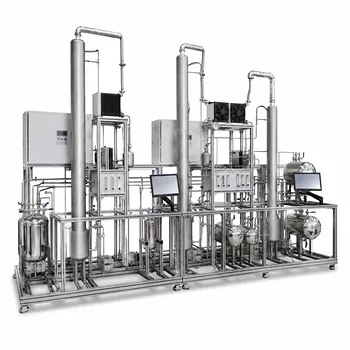
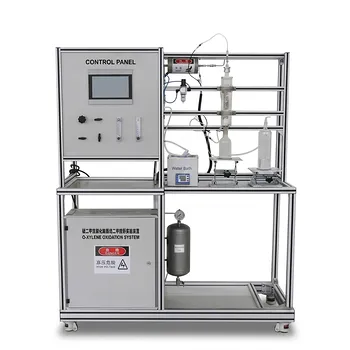
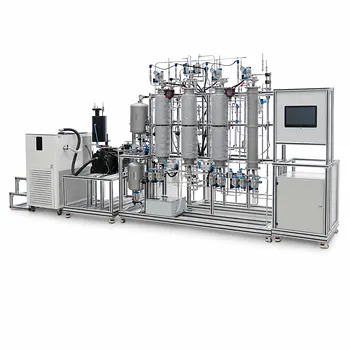
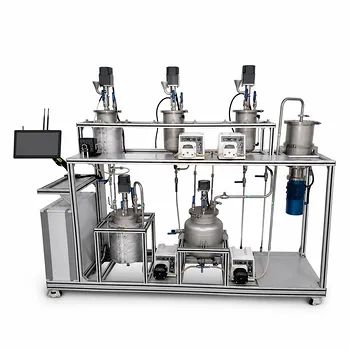
Controlling the direct esterification of PET is a masterclass in precise thermodynamic and kinetic management. In a pilot plant, the key process control considerations center on three imperatives: maintaining a razor-sharp temperature profile across multiple reaction zones, engineering a staged vacuum system that can pull from moderate pressures down to near-absolute vacuum, and deploying agitation capable of handling a dramatic increase in melt viscosity—all while efficiently stripping the byproduct water to drive the reversible reaction to completion.
Demonstrating PET synthesis in a pilot plant is not just about turning monomers into polymer; it’s about proving you can control a dynamic, viscosity-building reaction under extreme conditions. The true challenge lies in synchronizing temperature, pressure, and mixing to move cleanly from a pressurized slurry into a deep-vacuum, high-viscosity melt phase without stalling the reaction or degrading the product.
Understanding the Direct Esterification Process
A successful demonstration hinges on replicating the industrial stages exactly. You are not just running a single batch reaction; you are navigating a physical and chemical transformation that demands completely different control strategies at each step.
The Staged Journey from Monomer to Polymer
Direct esterification begins with an esterification stage where purified terephthalic acid (PTA) and ethylene glycol (EG) are mixed into a slurry and heated to 257–269°C.
This initial reaction forms the monomer bis(2-hydroxyethyl) terephthalate (DGT) and water under moderate pressure, typically above 0.1 MPa, to keep the volatile EG in the liquid phase.
As the reaction progresses, the system transitions to a pre-polycondensation stage, where the pressure is gradually reduced through a high-temperature vacuum (around 27.5–5.07 kPa) near 273°C.
The final polycondensation stage pushes conditions to the extreme: an ultra-low vacuum of around 100 Pa and temperatures up to 285°C. This drives the continuous removal of water and excess glycol, shifting the equilibrium to build long polymer chains.
Critical Process Control Considerations
Every piece of equipment and every control loop serves the singular purpose of managing this staged progression. Failing to control any one of these parameters will either shut down the reaction or yield a low-quality product.
Multi-Zone Temperature Precision
Heat is your primary energy input, and it must be delivered with surgical precision across the entire reactor jacket and internal surfaces.
The viscosity of the reacting mass can increase by several orders of magnitude, which drastically changes heat transfer coefficients. A single-zone temperature control system will inevitably create hot spots that cause thermal degradation and yellowing of the polymer, or cold spots that stall the reaction.
You must implement multiple independent heating zones with tight control loops, often using cascade control, to maintain a uniform and precise temperature profile from the preheating of the slurry to the final melt phase at 285°C.
Staged Vacuum Management
Vacuum is the engine of molecular weight. This is the most critical and demanding control challenge in a PET pilot plant.
The process starts at positive pressure and must smoothly transition through a pre-polycondensation vacuum (about 5-27 kPa) down to a deep molecular distillation vacuum (below 100 Pa). A sudden application of full vacuum will violently boil off monomers, clogging the vapor line and destroying the reaction stoichiometry.
Your vacuum system must be robust, integrating a vacuum pump with condensers and cold traps to protect it from volatile glycols. The control system must enable a carefully ramped vacuum profile that matches the increasing melt viscosity, continuously stripping byproduct water without entraining valuable reactants.
High-Viscosity Agitation
Your agitator isn’t just mixing; it’s enabling mass transfer and surface renewal. As the polymer chain grows, the melt becomes extremely viscous, quickly overwhelming a standard impeller.
You must use a variable-speed drive coupled to a specialized high-torque agitator—often an anchor, helical ribbon, or twin-shaft design. The control system must monitor motor torque continuously.
Torque is a direct proxy for viscosity and, therefore, molecular weight. A drop in torque without a corresponding change in heating or vacuum suggests mechanical failure, while a rapid spike could indicate impeller stalling, risking a motor burnout and a ruined batch.
Byproduct Removal and Reflux Control
The equilibrium reaction must be pushed forward by the continuous removal of water.
In a pilot plant, this is managed through a heated vapor line leading to a partial condenser or distillation column. The temperature of this column is precisely controlled to act as a selector switch: it allows the lower-boiling water to pass through to a collection receiver while condensing the higher-boiling glycol and returning it to the reactor as reflux.
Losing this selectivity means losing your raw material. Poor reflux control will either fail to remove water (stalling the reaction) or strip out too much ethylene glycol (disrupting the stoichiometric ratio and halting chain growth). A decanter or phase separator in the condensate loop allows you to measure water removal rate, a direct real-time indicator of reaction progress.
Common Pitfalls and Trade-offs
Objectively, the path from a blueprint to a functional demonstration is littered with potential failures. Recognizing these trade-offs will build credibility in your operation.
- Vacuum Integrity vs. Reactor Design: Deep vacuum requires a perfectly sealed system, but dynamic seals on agitator shafts are a notorious leak point. You are forced to invest in a complex mechanical seal with a buffer fluid system, accepting higher capital cost and maintenance complexity.
- High-Temperature Stability vs. Reaction Rate: Operating at the upper temperature limit (285°C) accelerates the reaction but dramatically increases the risk of thermal degradation, producing acetaldehyde and color bodies. You must balance the need for a fast cycle with the absolute requirement for product quality by not pushing the top thermal boundary.
- Melt Handling vs. Sampling: You need process samples to track acid value and intrinsic viscosity, but extracting a representative sample from a vessel under extreme vacuum and high temperature without breaking the seal or cooling the material in the dip leg is a significant engineering challenge. You trade off real-time analytical data against the risk of process contamination.
Making the Right Choice for Your Pilot Plant Goal
The specific control philosophy you emphasize depends entirely on the purpose of your demonstration.
- If your primary focus is on education and unit operations training: Prioritize a highly instrumented reactor with multiple sight glasses and a user-friendly SCADA interface. The goal is to visualize the staged vacuum ramp and link the torque curve to viscosity theory, so a robust data logging system is more valuable than a purely high-throughput configuration.
- If your primary focus is on process development and scale-up: Invest heavily in a multi-zone temperature control and a cascade vacuum system with independent PID loops for each stage. Focus on generating scalable engineering data by controlling the thermodynamic and kinetic path identically to a full-scale vessel, even if it means slower batch turnarounds.
- If your primary focus is on demonstrating product quality and material science: Focus your controls on the extreme end of the process. Implement a high-accuracy vacuum gauge and a rapid-response heating system for the final polycondensation stage, allowing you to precisely target end-point parameters like intrinsic viscosity by manipulating the balance of temperature and vacuum at the melt.
Ultimately, a successful demonstration is defined by your ability to choreograph this staged physical transformation, proving that you can gracefully manage the transition from a simple slurry to a high-performance polymer melt.
Summary Table:
| Stage | Temperature (°C) | Pressure / Vacuum | Key Control Focus |
|---|---|---|---|
| Esterification | 257–269°C | > 0.1 MPa (Pressurized) | Keeping EG in liquid phase & starting the reaction |
| Pre-polycondensation | ~273°C | 27.5–5.07 kPa (Moderate Vacuum) | Gradual pressure reduction & vapor control |
| Polycondensation | Up to 285°C | ~100 Pa (Ultra-low Vacuum) | High-viscosity mixing & driving reaction completion |
Scale Up Your Polymerization Processes with LABPARK
Achieving precise control over complex thermodynamic reactions like PET synthesis requires highly reliable, specialized equipment. LABPARK provides high-performance Educational and Vocational Unit Operations Pilot Plants in chemical engineering, bioprocess & biotech, and environmental & water treatment.
Designed specifically for universities, research institutes, and enterprises, our pilot plants deliver the multi-zone temperature precision, robust vacuum management, and advanced torque-monitoring agitation necessary to safely demonstrate and scale your chemical processes.
Ready to elevate your research or training capabilities? Contact us today to discuss your project requirements!
Related Products
- Ethyl Acetate Synthesis Unit Operations Pilot Plant for Practical Training
- Polymerization Granulation and Pellet Processing Educational Unit Operations Pilot Plant
- Bio-fermentation Ethanol Production Practical Training Unit Operations Pilot Plant
- Ethylbenzene Dehydrogenation Educational Unit Operations Pilot Plant
- Green Anhydrous Ethanol Refining Practical Training Pilot Plant
People Also Ask
- How do pilot plants demonstrate esterification? Visualizing Chemical Engineering Equilibrium
- When to transition from PID to adaptive control in pilot plants? Key process indicators.
- Why is the chemical plant startup schedule crucial? De-risk scale-up with pilot plants.
- Why Use PTFE & Hastelloy in Chemical Pilot Plants? Prevent Corrosion & Ensure Safety
- How to study gasification in pilot plants? Compare exit gas composition & efficiency