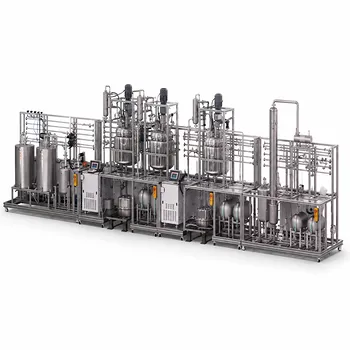
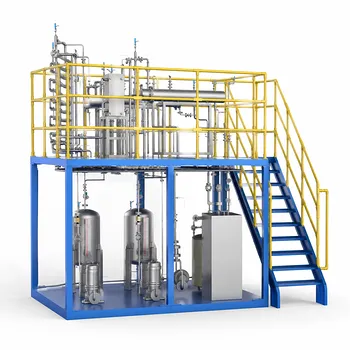
To configure a chemical engineering unit operations pilot plant capable of reliable temperature-programmed desorption (TPD) and temperature-programmed reduction (TPR) experiments, you must integrate a carrier gas purification train, a reactor with a furnace that can execute a precise linear temperature ramp, a thermocouple inside the catalyst bed, a thermal conductivity detector (TCD) placed directly at the reactor exit, and a quadrupole mass spectrometer (MS) with a dedicated atmospheric-to-vacuum inlet for advanced effluent identification. These five components form the irreducible instrumentation backbone; omitting any one degrades the quality, accuracy, or completeness of the kinetic and surface-chemical data you can collect.
While the specific hardware can be adapted for teaching, research, or development work, the functional chain—clean carrier gas, accurate bed temperature, fast TCD response, and optionally mass-selective detection—remains non-negotiable. Pilot plants that satisfy these requirements transform TPD/TPR from simple demonstrations into rigorous measurements of adsorption energetics, active site counts, and metal reducibility.
Why Instrumentation Defines the Quality of Your TPD/TPR Data
Temperature-programmed methods probe catalyst surfaces by tracking how a gas adsorbs, desorbs, or reacts as the temperature changes linearly with time. Every instrumentation choice directly affects the sensitivity, resolution, and interpretability of the resulting desorption or reduction profile. In a unit operations pilot plant, the goal is not just to produce a trace, but to ensure that trace faithfully represents the catalyst’s behavior—not the system’s artifacts.
The Surface Need vs. the Deep Need
Your surface need is a checklist of parts. The deeper need is data fidelity—the confidence that a desorption peak’s area truly reflects the number of active sites, or that a TPR reduction temperature is displaced not by thermal lag but by genuine metal–support interactions. The instrumentation you select either amplifies or buries that fidelity.
The Five Non‑Negotiable Instrumentation Pillars
1. Carrier Gas Purification
All TPD/TPR experiments rely on a steady stream of high‑purity carrier gas (often helium or argon). Trace oxygen, moisture, or hydrocarbons in the carrier will react with or contaminate the catalyst surface, creating spurious signal changes indistinguishable from real events. A dedicated purification system—typically comprising oxygen and moisture traps—must be installed upstream of the reactor. This ensures that any detected change in effluent composition originates from the catalyst, not from a dirty gas line.
2. Linear Temperature Programming with Bed‑Level Feedback
The heart of the method is a linear temperature ramp. A simple furnace controller that drifts or overshoots will smear kinetic features and shift peak temperatures. The furnace must be able to execute ramps on the order of 5–20 K·min⁻¹ with minimal deviation from linearity.
Equally critical is where you measure the temperature. A thermocouple placed anywhere outside the catalyst bed—such as in the furnace wall—will report a temperature that lags the true bed temperature by tens of degrees. The primary reference explicitly requires a thermocouple placed directly within the catalyst bed. This placement captures the actual thermal environment driving desorption or reduction, enabling accurate calculation of activation energies and reliable comparison between samples.
3. Thermal Conductivity Detection at the Reactor Exit
As the temperature ramps up, desorbing molecules or consumed hydrogen must be detected in the effluent. A thermal conductivity detector (TCD) is the workhorse for these experiments. It continuously measures the difference in thermal conductivity between the pure carrier gas and the reactor effluent.
Mounting the TCD near the reactor exit minimizes dead volumes and delay times, preventing peak broadening and keeping desorption features sharp. A TCD placed far downstream, after long transfer lines, will blur the temporal response, making it impossible to resolve overlapping peaks or determine correct desorption temperatures.
4. Quadrupole Mass Spectrometry for Species Identification
Although a TCD can tell you that something desorbed, it cannot tell you what unless you already know the composition. For complex catalyst formulations or multi‑gas TPR studies, a quadrupole mass spectrometer is indispensable. It ionizes the effluent and separates ions by their mass‑to‑charge ratio, providing a real‑time fingerprint of multiple species simultaneously—e.g., distinguishing CO₂ from CO or tracking H₂O alongside H₂ consumption.
5. The Bridge from Atmosphere to Vacuum: The MS Inlet System
A quadrupole MS operates under high vacuum, yet your reactor effluent is at atmospheric pressure. You cannot simply connect a tube. A well‑designed inlet system—typically a heated capillary coupled to a pressure‑reduction stage—must be used to transport a representative sample into the ion source without condensing heavy molecules or creating a pressure burst that kills the detector. A poor inlet manifests as memory effects, lag, and non‑linear signal response, rendering quantitative TPD/TPR impossible.
Understanding the Trade‑offs
Simplicity vs. Chemical Detail
Relying only on a TCD keeps the system straightforward, inexpensive, and easy to maintain—ideal for teaching basic TPD/TPR concepts where the probe gas identity is known and spectral simplicity is guaranteed. However, you lose all speciation ability. If your TPR experiment generates both CO and CO₂ from side reactions, the TCD trace will be a composite envelope, not a resolved story.
Adding a quadrupole MS gives you chemical specificity and the ability to deconvolute complex effluent mixtures. The trade‑off is increased cost, operational complexity, and the necessity of maintaining a clean, high‑vacuum sampling line. For research‑grade pilot plants that need to quantify active metal surface areas or unravel multi‑step reduction mechanisms, the MS is not a luxury—it’s a requirement.
Thermocouple Placement: Accuracy vs. Practicality
Placing a thermocouple inside the catalyst bed can be intrusive in small reactors, and it requires careful sealing to prevent gas bypass. Yet any attempt to infer bed temperature from an external sensor introduces a systematic error that grows with heating rate. Accept the minor mechanical complexity; your kinetic parameters depend on it.
How to Configure Your Pilot Plant for Specific Goals
A well‑instrumented TPD/TPR pilot plant adapts to the depth of analysis required. Use the following goal‑based guidance to finalize your equipment list.
- If your primary focus is undergraduate teaching of gas–solid interactions: A robust TCD‑centric setup with a simple, easily maintained inlet and a single‑channel recorder will demonstrate peak shift, active site counting, and reduction behavior without overwhelming students with mass spectra. Include the bed‑level thermocouple to teach the importance of accurate temperature measurement.
- If your primary focus is research on metal–support interactions and bimetallic catalysts: Invest in a quadrupole mass spectrometer with a heated, multi‑port inlet. This enables you to simultaneously monitor H₂, CO, CO₂, and H₂O during TPR, revealing reduction stoichiometry and metal phase separation that a TCD alone would obscure.
- If your focus is bridging surface science with reactor engineering: Design the MS inlet to also accept a second sample stream for calibration gases, allowing you to quantify desorbed amounts precisely and calculate activation energies using multiple heating rate methods.
A TPD/TPR pilot plant that faithfully answers the questions you ask of it is built from the ground up on clean carrier gas, true bed‑temperature feedback, and a detection chain that resolves the effluent in both time and identity.
Summary Table:
| Pillar | Key Component | Critical Function |
|---|---|---|
| 1. Gas Purification | Carrier gas purification train | Prevents carrier contamination & spurious signals |
| 2. Temp Control | Bed-level thermocouple & linear ramp | Eliminates thermal lag for accurate kinetics |
| 3. Basic Detection | Thermal Conductivity Detector (TCD) | Minimizes dead volume to keep peak response sharp |
| 4. Species ID | Quadrupole Mass Spectrometer (MS) | Enables real-time chemical speciation |
| 5. MS Interface | Heated atmospheric-to-vacuum inlet | Preserves sample representation under vacuum |
Elevate Your Chemical Engineering Research & Training
Designing a high-fidelity pilot plant requires precision engineering and seamless instrumentation integration. LABPARK provides state-of-the-art Educational and Vocational Unit Operations Pilot Plants in chemical engineering, bioprocess & biotech, and environmental & water treatment, specifically designed for universities, research institutes, and enterprises.
Whether you need a robust TCD system for hands-on teaching or an advanced MS-coupled system for cutting-edge catalysis research, our technical experts will help you configure the perfect setup to ensure maximum data fidelity.
Contact LABPARK today to discuss your specific requirements and get a customized solution for your lab!
Related Products
- Tubular Reactor Flow Characteristics Determination Educational Unit Operations Pilot Plant
- Multi Pump Fluid Transport Process Piping Unit Operations Training Pilot Plant
- Ethyl Acetate Synthesis Unit Operations Pilot Plant for Practical Training
- Dual-Mode Rectification Pilot Plant for Practical Training Unit Operations
- Multi-Modal Distillation Unit Operations Training Pilot Plant
People Also Ask
- How do educational unit operations pilot plants address safety and waste management when scaling up?
- How do educational unit operations pilot plants bridge theory and design? Bridge the Engineering Gap
- What are the formulas for single-pass vs overall conversion in pilot plants? Master reactor mass balances
- Why are implicit numerical methods preferred for stiff kinetics? Optimize Reactor Simulation
- How Do Pilot Plants Teach Limiting Reactants, Yield, & Selectivity? Real-World ChE Practice