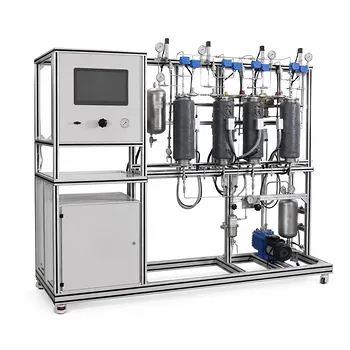
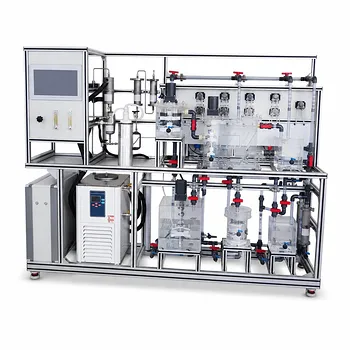
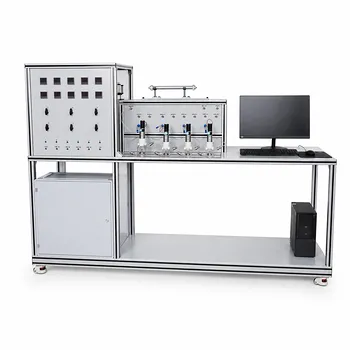
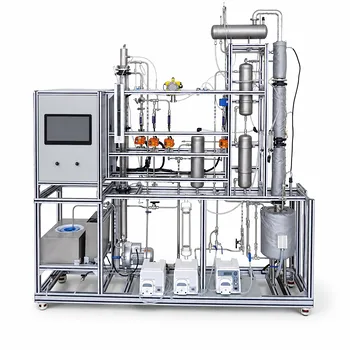
The core challenge is not simply removing acid gases—it’s replicating the intricate dance of multi-phase chemistry at a scale where every assumption counts.
Designing a unit operations pilot plant for cleaning retort gas or syngas laden with hydrogen sulfide (H₂S) and ammonia (NH₃) forces you to confront the simultaneous modeling of chemical equilibrium, mass transfer, and heat transfer in a condensing, reactive, multi-component polar mixture. As the gas cools, water condenses and dissolves volatile weak electrolytes that immediately undergo acid–base reactions, creating a fluid system that can separate into gas, aqueous liquid, hydrocarbon liquid, and even solid phases. Every design decision—from column internals to instrument placement—must grapple with this tightly coupled reality.
The central difficulty is that aqueous condensation triggers reactive absorption of weak electrolytes, forming a four‑way coupling between phase equilibrium, chemical reaction kinetics, interphase mass transfer, and heat effects. Standard ideal‑stage models break down in this environment, making the pilot plant both a validation tool for rigorous thermodynamic models and a demanding exercise in scaling reactive, multi‑phase hydrodynamics.
The Thermodynamic Landscape: When Phase Change Meets Chemical Reaction
The first and most fundamental challenge is that the gas stream does not behave like a simple mixture—it is a polar, multi‑component system where equilibrium cannot be decoupled from chemical reactions.
Condensation-Driven Reactive Absorption
In a retort gas or raw syngas, H₂S and NH₃ coexist with steam, CO₂, and hydrocarbons.
As the temperature drops, water condenses and immediately creates a liquid phase capable of acid–base dissociation.
NH₃ dissolves and raises the pH, while H₂S dissociates into HS⁻ and S²⁻, and CO₂ forms carbonate species.
These reactions shift the driving force for absorption, meaning the amount of gas that dissolves is not just a function of partial pressure—it depends on the liquid‑phase composition that you are simultaneously trying to predict.
The Need for Rigorous Electrolyte Models
The primary reference stresses that educational and research pilot plants must demonstrate simultaneous chemical equilibrium, mass transfer, and heat transfer across three- or four‑phase systems.
This is because industrial design correlations for acid‑gas removal often fail when applied to such complex, condensing streams.
A pilot plant therefore must be instrumented to validate thermodynamic models (e.g., e‑NRTL, Pitzer) that account for ion speciation, mutual solubility of water and hydrocarbons, and solid‑fines interactions.
Without this model‑driven approach, the pilot plant becomes a black box rather than a tool for scale‑up.
Mass Transfer and Hydrodynamics at a Smaller Scale
Translating full‑scale column performance to a pilot unit exposes a second layer of difficulty: preserving realistic interphase mass transfer while operating with reduced diameters and flows.
Scaling Down Column Internals Without Losing Realism
Absorption and stripping columns in industrial syngas cleanup rely on specific packing or tray geometries to generate interfacial area.
When scaled down, liquid distribution, wetting, and pressure drop behave differently, and wall effects can dominate.
Supplementary references highlight the importance of analyzing solvent circulation rates, gas flow rates, and pressure drops across columns.
In a pilot plant, you must carefully select internals that deliver comparable mass‑transfer coefficients despite the smaller scale, often requiring structured packing with high surface‑to‑volume ratios and carefully designed liquid distributors.
Managing Residence Time and Interfacial Area
The reaction‑enhanced absorption of H₂S into an aqueous phase is sensitive to local residence time and interfacial area.
At pilot scale, maintaining the correct ratio of surface area to liquid holdup is critical; otherwise, the degree of chemical conversion—and thus the apparent absorption efficiency—can deviate significantly from the industrial case.
This demands that the pilot plant be designed with multiple sampling points and, ideally, transparent sections or online analysis to track axial composition profiles.
Integrating Heat Effects – The Silent Complication
Absorption of acid gases is exothermic, and the condensation that drives reactive absorption also releases latent heat.
A pilot plant must capture these thermal dynamics to avoid misrepresenting the process.
Exothermic Absorption and Solvent Regeneration Energy Demands
When H₂S and CO₂ dissolve and react, they release heat that can raise the liquid temperature, altering equilibrium and reducing absorption driving force.
The supplementary references show that in foul‑water stripping pilot plants, steam injection is used to regenerate the solvent, and thermal energy demand is a key optimization parameter.
For syngas cleaning, the pilot plant must incorporate accurate heat‑transfer surfaces (internal coils, jacketed sections, or precise inter‑stage cooling) to reproduce the temperature profiles observed in industrial units, especially when the feed gas enters hot and condensation begins mid‑column.
Three‑ or Four‑Phase Thermal Coupling
The primary reference notes that pilot plants must handle up to four phases: gas, water, liquid hydrocarbons, and solid fines.
Each phase has its own heat capacity and thermal transport properties, and phase‑change energy flows (condensation of water and hydrocarbons) can dominate the local heat load.
A pilot‑scale column that ignores this thermal coupling will produce misleading performance data, because the temperature profile directly controls which phases exist and how reactive absorption proceeds.
Understanding the Trade‑offs
Every pilot‑plant design is a balancing act, especially when the primary purpose is educational or early‑stage research.
Fidelity vs. Operability
A fully instrumented, multi‑phase pilot column that mirrors an industrial unit can become too complex to operate or maintain in a teaching lab.
Simplifying the system (e.g., using a synthetic gas stream, eliminating hydrocarbons) makes the thermodynamics easier to handle but detaches the experiment from the real‑world complexity that the plant is meant to explore.
The designer must consciously choose which phenomena to preserve—reaction‑equilibrium coupling or multi‑phase hydrodynamics—and ensure that the resulting data still answer the intended research or teaching questions.
Educational Value vs. Industrial Replication
For educational pilot plants, the goal is often to teach fundamental principles of gas‑liquid absorption and reactive mass transfer, not to replicate a plant exactly.
This trade‑off allows the use of idealized systems (e.g., NH₃/air/water) as stepping stones before introducing real syngas.
However, it also means that students may not directly experience the mutual solubility and solid‑fines challenges that define industrial retort‑gas cleanup unless the curriculum deliberately advances to multi‑phase, reactive‑equilibrium experiments.
Making the Right Choice for Your Goal
The design of an H₂S‑ and NH₃‑cleaning pilot plant must be driven by the specific learning or research objective. Tailor your approach to the need.
- If your primary focus is industrial process validation: Build a high‑fidelity unit that handles actual multi‑phase feeds, uses rigorous electrolyte thermodynamic models, and is instrumented to measure temperature, pressure, and composition at every column section. This plant must sacrifice simplicity for realism.
- If your primary focus is student understanding of core absorption principles: Start with a binary gas‑liquid system (e.g., CO₂/water/NaOH) and gradually introduce the complexity of volatile electrolytes and condensation. Use transparent columns and manual sampling to make the coupling of mass transfer and reaction visible.
- If your primary focus is thermodynamic model development: Design a highly instrumented, small‑scale cell or single‑stage contactor that allows precise measurement of vapor‑liquid‑liquid equilibrium under condensing conditions, isolating the reactive phase behavior from the complexities of column hydrodynamics.
- If your primary focus is solvent regeneration and energy efficiency: Incorporate a stripping column with controlled steam injection and acid‑dosing capability, mirroring foul‑water stripper designs, and equip it with energy‑flow measurement to study regeneration energy demands and pH effects on ammonia separation.
Every successful pilot plant for retort‑gas cleaning starts with an honest acknowledgment that multi‑phase, reactive thermodynamics cannot be bypassed—but with the right focus, that complexity becomes the very thing that delivers deeper insight.
Summary Table:
| Challenge Area | Key Difficulty | Design/Mitigation Strategy |
|---|---|---|
| Thermodynamics | Condensation-driven reactive absorption of H₂S and NH₃ | Use rigorous electrolyte models (e-NRTL, Pitzer) |
| Mass Transfer | Maintaining realistic interphase transfer at small scale | High surface-to-volume structured packing & wall-effect control |
| Heat Effects | Exothermic reaction heat & multi-phase thermal coupling | Jacketed columns or precise inter-stage cooling |
| Scale-up/Design | Balancing system fidelity with operational simplicity | Tailor design to educational goals vs. industrial validation |
Bring Industrial Realism to Your Lab with LABPARK
Overcoming complex multi-phase thermodynamic challenges requires highly specialized equipment. LABPARK provides state-of-the-art Educational and Vocational Unit Operations Pilot Plants in chemical engineering, bioprocess & biotech, and environmental & water treatment.
We help universities, research institutes, and enterprises bridge the gap between theory and industrial reality with reliable, highly-instrumented pilot units tailored to your specific teaching or research goals.
Ready to elevate your engineering curriculum or research capabilities? Contact LABPARK today to build your custom pilot plant solution!
Related Products
- Fixed-Bed Chemical Reaction and Gas Dust Tar Removal Unit Operations Pilot Plant
- Dual-Mode Gas Absorption and Desorption Unit Operations Training Pilot Plant
- Bench Scale Carbon Dioxide Capture Educational Unit Operations Pilot Plant
- Thermal Desorption Exhaust Gas and Tail Water Treatment Educational Pilot Plant
- Fluidized Bed Gas Solid Catalytic Reaction Educational Pilot Plant
People Also Ask
- When to transition from PID to adaptive control in pilot plants? Key process indicators.
- How do deviations in estimating latent heat impact pilot plant thermal systems? Avoid hardware mis-sizing.
- Why Compare Predicted and Experimental Excess Enthalpy? Key to Accurate Pilot Plant Scale-up
- How to study gasification in pilot plants? Compare exit gas composition & efficiency
- Why Use PTFE & Hastelloy in Chemical Pilot Plants? Prevent Corrosion & Ensure Safety