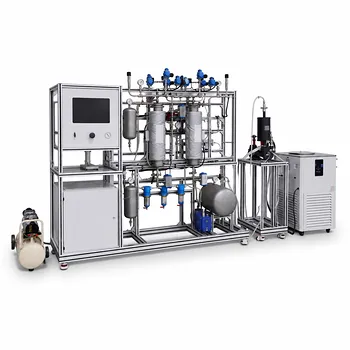
The promise of first-principles prediction breaks down exactly where real-world fluid behavior begins. Predicting transport coefficients—viscosity, thermal conductivity, and diffusion—from pure theory becomes fundamentally limited when a fluid departs from equilibrium. In that nonequilibrium state, the very statistical mechanics formulations that work well at equilibrium must integrate over distances of the molecular mean free path rather than over short-range intermolecular potentials. For dense fluids and liquid mixtures, evaluating these integrals with realistic potentials is extraordinarily difficult and often lacks the necessary quantitative data, making pure theory an unreliable tool in the hands of an engineer.
Pure theory struggles to predict transport properties of nonequilibrium fluids because it must account for molecular dynamics over large length scales using complex, often unobservable potentials. For educational pilot plants, this limitation isn’t a failure—it becomes the entire pedagogical point: students must learn to navigate empirical methods, dimensional analysis, and direct experimentation to handle real fluid flow and heat transfer.
The Gap Between Equilibrium Theory and Nonequilibrium Reality
Transport coefficient prediction works cleanly only in a narrow, idealized world. Understanding why requires looking at how molecular theory operates in equilibrium versus nonequilibrium.
Why Equilibrium Models Fall Short
In a fluid at equilibrium, molecular interactions are described over very short distances comparable to the range of the intermolecular potential. This local view is sufficient because there is no net flux of momentum, heat, or mass.
When a fluid is flowing or experiencing a temperature gradient, it enters a nonequilibrium state. Now the relevant dynamics span the molecular mean free path—the average distance a molecule travels before colliding. That distance can be orders of magnitude larger than the potential’s range, demanding a description that links microscopic collisions to macroscopic gradients.
The shift in length scale breaks the mathematical simplicity of equilibrium approaches. Integrals that were once tractable become highly dependent on the detailed collision dynamics over these longer paths, and closed-form solutions rapidly disappear.
The Challenge of Realistic Intermolecular Potentials
Even if we accept the larger length scale, the integrals still require a mathematical model for how molecules interact—the intermolecular potential. For simple molecules like nitrogen or methane, idealizing their behavior with a Lennard-Jones potential can yield reasonable predictions.
However, for dense fluids and liquid mixtures, the potentials become complex and multi-parameter. Evaluating the necessary integrals with these realistic potentials is not just hard mathematically; it often confronts a wall of missing quantitative data. Without precise potential parameters, the theoretical machinery spins without traction.
Why Complex Fluids Amplify the Problem
The theoretical limitations are not just a matter of degree—they change in kind when we move from simple gases to liquids and mixtures.
The Data Deficit for Liquid Mixtures
Kinetic theory and statistical mechanics can describe transport coefficients for simple fluids like oxygen or light hydrocarbons with some success. However, these methods are frequently unsatisfactory for complex liquid mixtures.
The reason is simple: there isn’t enough experimental data to construct and validate the interaction potentials for multi-component liquids at nonequilibrium conditions. As a result, approximate theories like the corresponding states principle become essential, but they introduce their own uncertainties.
Implications for Educational Pilot Plant Experiments
These theoretical shortcomings directly shape how fluid flow and heat transfer experiments should be designed and taught in a chemical engineering pilot plant. The focus pivots from proving theory right to learning how to work around theory’s limits.
Shifting Focus from Theory to Empiricism
Given that pure theory cannot reliably predict transport properties, an educational pilot plant must instead teach the empirical methods that practicing engineers actually use. That means students learn to apply dimensional analysis, dimensionless groups like the Reynolds and Prandtl numbers, and experimentally derived correlations.
The pilot plant becomes a laboratory for measuring, not just confirming. Students experience firsthand how viscosity and thermal conductivity are often obtained from direct measurement or from well-established empirical databases rather than calculated from first principles.
The Viscosity Correction: A Concrete Example
A tangible illustration of these limitations appears in convective heat transfer. Fluid viscosity directly affects the Reynolds number and the Prandtl number, which in turn dictate the convective heat transfer coefficient. For situations with large temperature gradients or highly viscous fluids, a simple constant-property correlation fails.
Engineers apply a viscosity correction factor, $(\frac{\mu}{\mu_w})^{0.14}$, where $\mu$ is the bulk fluid viscosity and $\mu_w$ is the viscosity at the wall temperature. This empirical correction exists precisely because theoretical prediction of the near-wall viscosity distribution is intractable for complex fluids.
In an educational pilot plant, students can run trials with fluids of different viscosities or at varying temperature differences. They measure the actual heat transfer rate using, for example, the Kern method, and compare it to predictions with and without the correction. This teaches them to analyze when the correction becomes significant and when a simpler model suffices—an engineering judgment no theory can replace.
Understanding the Trade-offs
Relying on empirical methods in the pilot plant is not a concession of failure; it’s a deliberate trade-off with clear educational and practical implications.
- Loss of generality: Empirical correlations are developed from specific datasets. They break down if extrapolated to fluids or conditions far outside their original range. Students must learn the discipline of staying within the validity envelope.
- Hidden physics: Using a dimensionless group or a correction factor can obscure the molecular-level physics. The pilot plant must balance the “how” (using the correlation) with the “why” (understanding why the correction is needed in the first place) to avoid turning engineering into a recipe book.
- Design conservatism: Because transport property predictions are uncertain, equipment sizing often includes safety factors. An educational pilot plant can demonstrate the cost of this uncertainty, linking it directly to the theoretical limitations.
How to Apply This Insight in the Lab
To build effective experiments that capitalize on—rather than suffer from—these theoretical limitations, align your approach with your educational goals.
After defining the learning objectives, use these guiding principles:
- If your primary focus is fundamental understanding: Design experiments around simple fluids (gases, simple hydrocarbons) where kinetic theory gives decent predictions. Let students see where and why the agreement breaks down as conditions move away from ideal.
- If your primary focus is practical engineering skill: Create trials with complex fluids and temperature gradients. Require students to source viscosities from literature or measure them, apply empirical correlations, and explicitly document the limitations of their predictions in a design context.
- If your primary focus is critical thinking about models: Compare heat transfer results with and without the $(\frac{\mu}{\mu_w})^{0.14}$ viscosity correction factor. Have students explain not just the mathematical difference, but what physical reality the correction factor compensates for when the equilibrium-based model fails.
The fundamental inability of pure theory to predict transport coefficients in nonequilibrium fluids isn’t a dead end—it’s the starting point for an education that bridges physics and engineering judgment.
Summary Table:
| Challenge | Theoretical Limitation | Educational / Practical Solution |
|---|---|---|
| Scale of Interactions | Limited to short-range molecular potentials; fails over mean free path | Apply dimensional analysis & empirical correlations (Re, Pr) |
| Complex Liquid Mixtures | Lack of quantitative data for multi-parameter interaction potentials | Focus on direct measurement and utilization of empirical databases |
| Convective Heat Transfer | Inability to predict near-wall viscosity distribution | Implement empirical correction factors like $(\mu/\mu_w)^{0.14}$ |
Bridge the Gap Between Fluid Theory and Engineering Reality
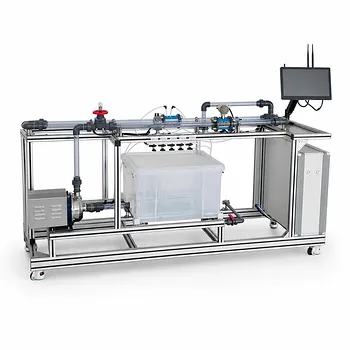
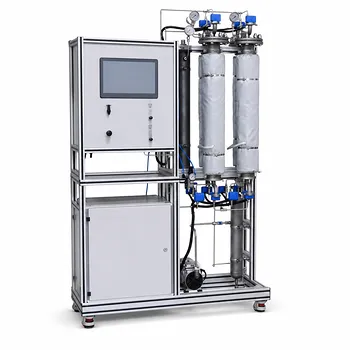
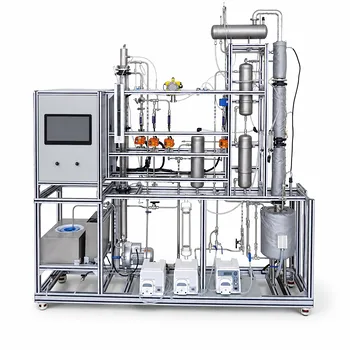
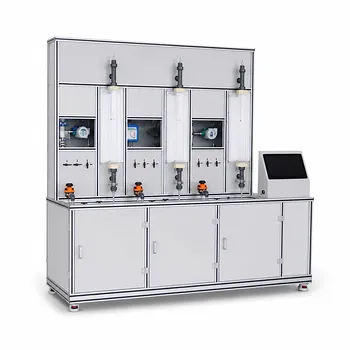
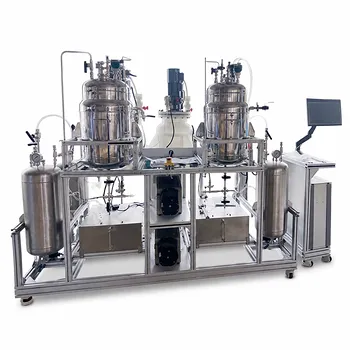
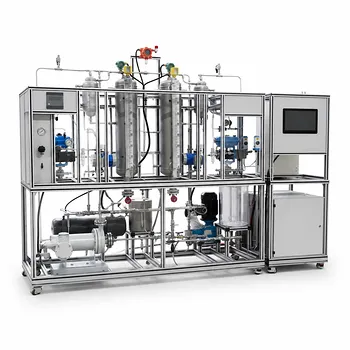
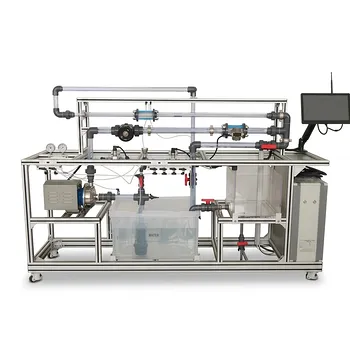
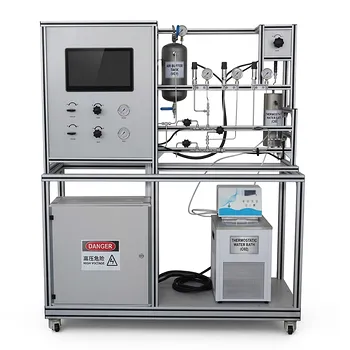
Teaching students to navigate the limitations of theoretical physics requires robust, hands-on training tools. LABPARK provides state-of-the-art Educational and Vocational Unit Operations Pilot Plants in chemical engineering, bioprocess & biotech, and environmental & water treatment.
Designed specifically for universities, research institutes, and enterprises, our pilot plants empower future engineers to master empirical methods, run precise heat transfer experiments, and gain critical troubleshooting skills.
Ready to upgrade your laboratory with industry-grade pilot plants? Contact us today to discuss your curriculum and equipment needs!
Related Products
- Multi-Reactor Educational Pilot Plant for Reaction Engineering Unit Operations
- High-Gravity Emulsification and Mass Transfer Educational Pilot Plant
- Multi-Functional Membrane Separation Educational Pilot Plant for Unit Operations Lab
- Orifice and Venturi Flowmeter Calibration Educational Pilot Plant for Fluid Mechanics Laboratory
- Micro-Scale Gas-Solid Catalytic Reaction Educational Pilot Plant
People Also Ask
- How do educational unit operations pilot plants address safety and waste management when scaling up?
- How do educational unit operations pilot plants bridge theory and design? Bridge the Engineering Gap
- Why Compare Predicted and Experimental Excess Enthalpy? Key to Accurate Pilot Plant Scale-up
- Why Use PTFE & Hastelloy in Chemical Pilot Plants? Prevent Corrosion & Ensure Safety
- How to study gasification in pilot plants? Compare exit gas composition & efficiency