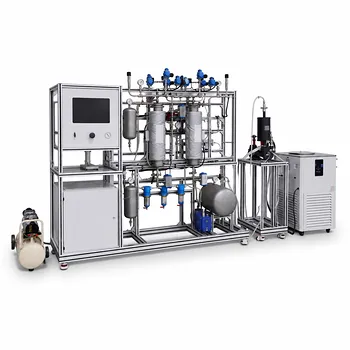
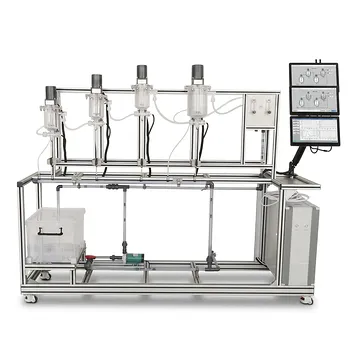
For a unit operations laboratory, the fundamental design trade-off between a bubble column reactor and a sparged stirred tank reactor comes down to where you source your mixing energy — from the gas flow itself or from a mechanical impeller. A bubble column gives you a nearly maintenance-free vessel with no moving parts, where liquid circulation and mass transfer are driven solely by rising gas bubbles. The sparged stirred tank adds a motor-driven agitator, which lets you process viscous fluids and actively control the mixing intensity, but it introduces higher capital cost, mechanical complexity, and power consumption.
The bubble column offers an elegant, low-cost design for reactions with low-viscosity fluids where the gas flow can provide sufficient mixing. The sparged stirred tank, however, becomes indispensable when you must handle viscous media, manage large heat effects, or precisely manipulate the volumetric mass transfer coefficient — at the price of moving parts and higher operational overhead.
Understanding the Operating Principles
The Bubble Column: Mixing by Buoyancy
A bubble column is an empty cylindrical vessel with a gas sparger at the bottom. The only source of energy for liquid mixing is the upward buoyant force of the gas bubbles. This simplicity eliminates shafts, seals, and motors, making the reactor extremely robust and low-maintenance.
In this design, the gas phase tends to behave in a plug-flow-like manner, while the liquid phase can experience significant backmixing depending on the superficial gas velocity. The entire hydrodynamics — from bubble size to circulation loops — is governed by the gas flow rate and the column geometry.
The Sparged Stirred Tank: Mechanical Control
A sparged stirred tank adds an impeller system driven by an external motor. Gas is introduced through a sparger, but the impeller breaks the gas into smaller bubbles, disperses them throughout the vessel, and creates strong mechanical backmixing in both the liquid and gas phases.
This mechanical agitation decouples mixing from the gas flow, giving you independent control over bubble size, gas holdup, and liquid circulation. It also allows the same vessel to operate effectively across a much wider range of fluid properties.
The Core Design Trade-offs
Mechanical Complexity and Maintenance
The most immediate trade-off is one of hardware. A bubble column is an empty shell with a gas line — no moving parts, no seals, no bearings, and essentially no maintenance. A sparged stirred tank requires an agitator shaft, impellers, a motor, and a mechanical seal, all of which add cost and potential failure points.
In a teaching laboratory, this difference is not just financial. A bubble column can run unsupervised with minimal risk of mechanical breakdown, while a stirred tank demands more careful setup and ongoing attention.
Mixing Behavior and Phase Flow Patterns
The mixing patterns differ in ways that directly affect reaction performance. In a bubble column, the gas flows largely in plug fashion, meaning the gas composition changes progressively from the sparger to the headspace. This can be beneficial for reactions where you want a defined concentration gradient in the gas phase.
A sparged stirred tank, by contrast, provides strong backmixing in both phases. The gas composition tends toward that of the well-mixed vessel, and the liquid phase composition is uniform. This is ideal when you need to avoid local concentration gradients or want to replicate continuous stirred-tank behavior.
Fluid Compatibility and Viscosity Limitations
This is often the deciding factor. A bubble column cannot effectively process viscous fluids. High viscosity dampens turbulence, slows liquid circulation, and causes gas to channel straight to the surface without dispersing. The result is poor mass transfer and dead zones.
A sparged stirred tank, however, can aggressively mix even highly viscous or non-Newtonian fluids. The mechanical impeller can maintain the necessary shear to disperse gas and keep the entire contents moving, making it the go-to choice for biological fermentations, polymerizations, or any system with a thick liquid phase.
Heat Management Capabilities
Reactions with significant exothermic or endothermic heat effects present a thermal challenge. Bubble columns have limited heat transfer surface area — typically only the vessel wall or a simple jacket. For reactions generating large amounts of heat, this can be a critical bottleneck.
Sparged stirred tanks are far more versatile. They can be equipped with internal cooling coils, jacketed designs, or external pumped loops, providing the high heat transfer area necessary to safely manage large heat effects. In industrial pilot-plant education, demonstrating this capability is often a key learning objective.
Mass Transfer and Gas Holdup Characteristics
Both systems teach gas-liquid mass transfer, but the knobs you turn are different. In a stirred tank, you directly adjust the agitation speed and power input per volume to manipulate the volumetric mass transfer coefficient (k_La). This gives precise, reproducible control.
In a bubble column, (k_La) is a function of superficial gas velocity, bubble size distribution, and column dimensions. You change it not by turning a motor dial, but by altering the gas flow rate or modifying the sparger design. Smaller bubbles increase interfacial area but have different residence times, creating a bubble segregation effect that becomes a fascinating — and challenging — hydrodynamic study.
Common Pitfalls and Hidden Complexities
The Hidden Cost of Simplicity
A bubble column may have no moving parts, but it is not a “just add gas” solution. Its hydrodynamic design can be surprisingly delicate. You must carefully select the superficial gas velocity to avoid flow regime problems — too low, and you get poor mixing; too high, and you enter a churn-turbulent or slugging regime where mass transfer can actually deteriorate.
You also face challenges with axial dispersion, liquid-head pressure gradients, and bubble coalescence. Designing an effective bubble-column pilot plant for a lab course often requires more upfront fluid-dynamic engineering than a stirred tank, even if the hardware is simpler.
Mismatching Reactor to Reaction Kinetics
A subtle but important trap is selecting a reactor based on hardware cost rather than reaction need. Slow reactions that require high liquid holdup can work in either configuration, but if the key component is in the liquid phase and mechanical agitation is not strictly necessary, a bubble column is more economical. However, if the same slow reaction generates even moderate heat, the stirred tank’s superior cooling may become indispensable for safety and consistency.
Conversely, using a stirred tank for a clean, low-viscosity system where a bubble column would work simply adds cost and maintenance with no performance benefit.
Teaching Both to Illuminate the Trade-off
In educational unit operations labs, the pair is often taught together for a reason. Running the same gas-liquid reaction in both a bubble column and a sparged stirred tank forces students to confront the real costs of mechanical agitation versus hydrodynamic complexity. They learn that a stirred tank gives direct (k_La) control but at the expense of power, while a bubble column forces them to master flow regime diagrams, axial dispersion models, and sparger design. This dual experience builds a far deeper engineering intuition than either system alone.
Making the Right Choice for Your Lab’s Goals
Your decision should be driven by what you need the reactor to demonstrate, not just by equipment catalog comparisons.
- If your primary focus is minimal maintenance and capital cost for low-viscosity systems: Choose the bubble column and invest time up front in sparger design and flow regime optimization.
- If your primary focus is handling viscous fluids, biological cultures, or reactions with large heat effects: Choose the sparged stirred tank, as its mechanical agitation and optional cooling surfaces are non-negotiable.
- If your primary focus is teaching direct, repeatable (k_La) control and stirred-tank versatility: The stirred tank, with its adjustable impeller speed, provides a more intuitive and responsive system.
- If your primary focus is demonstrating hydrodynamic design challenges and the cost of agitation: Run both — a bubble column to explore buoyancy-driven mixing and a stirred tank to measure the true power cost of impeller-driven mass transfer.
The right laboratory configuration doesn’t just answer a design question; it prepares engineers to ask the right questions when they scale up.
Summary Table:
| Feature | Bubble Column Reactor | Sparged Stirred Tank Reactor |
|---|---|---|
| Mixing Source | Gas buoyancy (no moving parts) | Mechanical impeller (motor-driven) |
| Complexity & Maintenance | Low (no seals, motor, or bearings) | High (shafts, seals, motor maintenance) |
| Fluid Compatibility | Low-viscosity fluids only | Low to high-viscosity & non-Newtonian |
| Heat Management | Limited (vessel wall/jacket only) | High (internal coils, jackets, & external loops) |
| Mass Transfer ($k_La$) Control | Indirect (via gas velocity & sparger design) | Direct (via impeller speed & power input) |
Configure the Perfect Unit Operations Lab with LABPARK
Choosing the right reactor configuration is essential for delivering impactful training and reliable research. LABPARK provides state-of-the-art Educational and Vocational Unit Operations Pilot Plants in chemical engineering, bioprocess & biotech, and environmental & water treatment.
We help universities, research institutes, and enterprises build robust, safe, and highly educational setups—whether you need low-maintenance bubble columns or versatile, mechanically agitated stirred tanks.
Ready to upgrade your lab's capabilities? Contact LABPARK today to discuss your curriculum requirements and request a custom quotation!
Related Products
- Plate Column Hydrodynamics Tray Demonstration Educational Pilot Plant
- Educational Rotary Disc Liquid-Liquid Extraction Pilot Plant
- Multi-Functional Special Distillation Educational Pilot Plant
- Absorption and Desorption Educational Unit Operations Pilot Plant
- Dual-Mode Rectification Pilot Plant for Practical Training Unit Operations
People Also Ask
- How to update chemometric calibration models in pilot plants? Best practices for process engineers.
- How does nuclear yield inefficiency translate to chemical engineering education? Optimize kinetics with pilot plants.
- How can educational pilot plants be used to teach process safety and risk assessment in chemical engineering curricula?
- Why Correct Sig Figs & Rounding Matter in Educational Pilot Plants: Ensure Data Accuracy
- Why Calculate Sieve Tray Pressure Drop? Optimize Distillation Pilot Plant Performance