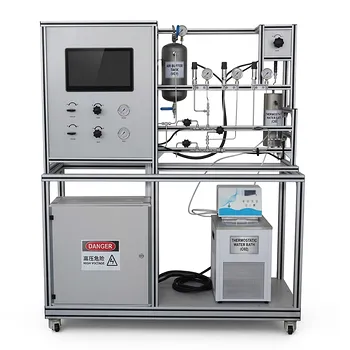
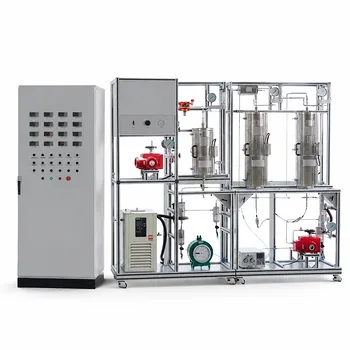
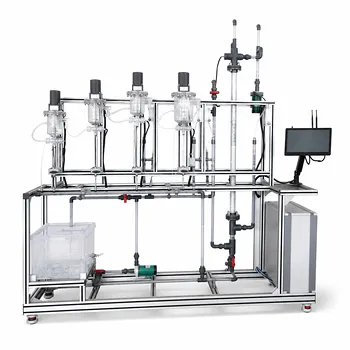
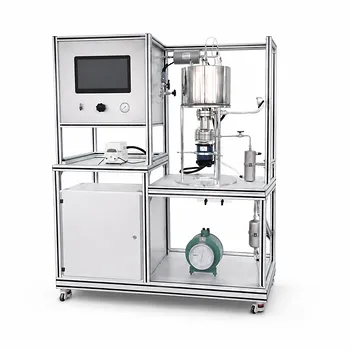
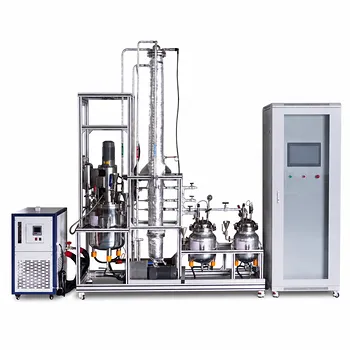
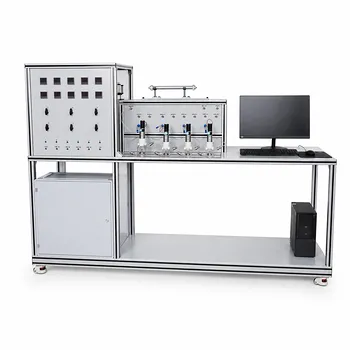
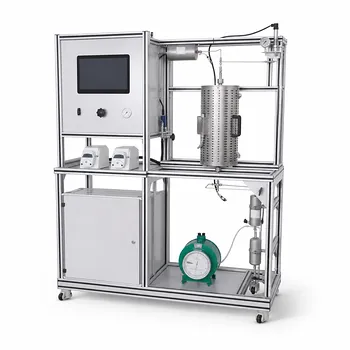
The core trade-off is clear: interstage cooling maximizes reaction yield by preserving reactant concentration, while raw gas quenching sacrifices yield for dramatic process simplification. In multi-stage adiabatic reactors for chemical engineering training plants, an interstage cooling configuration uses external heat exchangers between catalyst beds to lower the gas temperature without changing its composition. A raw gas quench setup injects a portion of cold feed gas directly between the stages, cooling the stream but diluting the reactants. The first approach teaches the thermodynamic ideal; the second forces students to grapple with the real-world tension between capital cost and conversion efficiency.
The fundamental choice is not merely about cooling—it is a decision on how much conversion potential you are willing to trade for a simpler, less expensive plant. Interstage cooling preserves the chemical driving force, while raw gas quenching deliberately weakens it to eliminate heat exchangers. This single trade-off makes these twin configurations one of the most powerful teaching tools in a unit operations pilot plant.
The Thermodynamic Imperative: Why Cooling Between Stages Matters
In any exothermic, equilibrium-limited reaction—such as the water-gas shift reaction—temperature plays a dual role. Higher temperatures speed up kinetics but push the equilibrium towards reactants, capping the achievable conversion. A single adiabatic bed sees a rapid temperature rise that quickly hits this equilibrium ceiling.
The Adiabatic Reactor and the Temperature-Conversion Ladder
An adiabatic reactor follows a path of increasing temperature and limited conversion. Without intervention, the exit composition is constrained by the adiabatic temperature rise. To push the reaction further, you must remove heat between stages and reset the thermodynamic driving force. This is why multi-stage reactors are standard in industrial practice.
Why Direct Heat Exchange Preserves Reactant Potential
An interstage cooling design passes the partially converted gas through a shell-and-tube or plate heat exchanger before it enters the next catalyst bed. The composition remains exactly as it left the previous stage. Consequently, when the cooled gas meets the next catalyst load, it starts with the full concentration of unconverted reactants, allowing successive beds to approach equilibrium at lower, more favorable temperatures. The outcome is the maximum possible overall conversion for a given number of stages.
How Raw Gas Quenching Dilutes the Driving Force
Raw gas quenching takes a different path. Instead of an external exchanger, a slipstream of cold, unconverted feed gas is injected directly into the hot process stream between beds. This injection drops the temperature efficiently, but it simultaneously lowers the partial pressure of the remaining reactants. The next catalyst bed now sees a leaner mixture. While the temperature is right, the reduced reactant concentration means the equilibrium is shifted to a lower conversion ceiling, and the reaction rate slows. The quench acts like a built-in penalty on per-pass efficiency.
Comparing the Hardware and Operational Complexities
The operational landscape of a pilot plant changes dramatically depending on which interstage strategy is chosen.
Interstage Cooling Adds Cost but Maximizes Purity
Interstage cooling demands external heat exchangers, additional piping, instrumentation, and often a separate cooling utility loop. In a training plant, this hardware gives students tangible experience with heat integration, temperature control loops, and pressure drop management. The cost is higher capital and more potential leak points. Operationally, the process is stable, but start-up and shut-down are more involved because of the need to manage thermal gradients across the exchangers.
Raw Gas Quenching Simplifies Design at a Conversion Penalty
Raw gas quenching eliminates interstage heat exchangers entirely. You need only a bypass line, a control valve, and a mixing zone. This slashes piping complexity and makes the pilot plant visibly simpler. Students quickly grasp that for every percent of cold gas injected to cool the stream, they lose roughly the same fraction of reactant driving force. The operational trade-off is clear: easier construction and lower cost against a slower, less complete reaction that may require a larger catalyst volume to meet a given production target.
The Educational Value in a Training Plant
These configurations are not just about running a reaction—they are living demonstrations of core chemical engineering principles.
Teaching the Principles of Thermodynamic Optimization
With interstage cooling, students can measure the temperature and composition after each stage, plot the path on a conversion-temperature diagram, and see how the reaction follows the maximum conversion envelope. They learn to perform detailed energy balances, calculate approach to equilibrium, and appreciate why thermodynamic optimization requires such hardware. This setup solidifies the concept that heat management is inseparable from chemical conversion efficiency.
Demonstrating the Real-World Engineering Trade-off
A raw gas quench configuration forces students to confront capital versus operating cost. They quantify the dilution effect by performing a component mass balance around the quench point, directly calculating the drop in reactant partial pressure. They then see how this affects the final conversion. The lesson is immediate: engineering is the art of acceptable compromise. Industry often chooses quenching for large-scale, low-margin processes because the savings in equipment outweigh the cost of lost conversion. Training plants use this contrast to teach that the best technical solution is not always the most economically viable.
Understanding the Trade-offs and Common Pitfalls
The choice between configurations is not binary and comes with nuanced challenges that a training plant must highlight.
- Catalyst volume penalty: Quenching lowers reactant concentration, so to achieve the same overall conversion as a cooling-based system, you may need significantly more catalyst or additional stages. This spatial inefficiency is a key operating cost trade-off.
- Temperature control and staging: Interstage cooling permits precise temperature dropping to an optimal inlet temperature for the next bed. Quenching is simpler but can cause uneven mixing and temperature stratification if not designed with proper distribution devices—a valuable practical lesson.
- By-product formation: In some reactions, the local high concentration of quench gas can shift selectivity if side reactions are sensitive to reactant ratios. This adds a layer of complexity that a training plant can use to discuss kinetic versus thermodynamic control.
- Utility and energy integration: Interstage cooling generates a heated utility stream (steam or hot water) that could be integrated elsewhere, a teachable moment in process synthesis. Raw gas quench rarely offers such energy recovery opportunities.
Making the Right Choice for Your Training Goal
The ideal configuration depends entirely on the educational objective you want to emphasize in the pilot plant or laboratory course.
- If your primary focus is teaching process thermodynamics and equilibrium limits: Select an interstage cooling reactor. The data it produces will elegantly map the theoretical maximum conversion path, reinforcing the importance of temperature in reversible reactions.
- If your primary focus is illustrating capital versus operating cost trade-offs: Build a raw gas quench system alongside a cooling-based system, or run the same plant in both modes. Students can directly measure how much conversion is lost per unit of cold gas injected and calculate the economic break-even point.
- If your primary focus is giving hands-on experience with industrial hardware: Choose the interstage cooling configuration. The heat exchangers, control valves, and associated instrumentation offer a richer operational challenge and mimic a broader range of real plants.
Ultimately, the best training plant might incorporate both configurations—not as a permanent design, but as a reconfigurable skid that students can switch between, cementing the lesson that every engineering choice is a deliberate balance between purity and pragmatism.
Summary Table:
| Feature / Parameter | Interstage Cooling Configuration | Raw Gas Quench Configuration |
|---|---|---|
| Reaction Yield | Maximized (preserves reactant concentration) | Sacrificed (dilutes reactant concentration) |
| Hardware Complexity | High (external heat exchangers, utility loops, extra piping) | Low (bypass line, control valve, and mixing zone) |
| Capital Cost | Higher initial investment | Lower initial investment |
| Operational Learning | Heat integration, temperature control loops, pressure drops | Mass balances, dilution effects, capital vs. operating cost trade-offs |
| Catalyst Volume | Optimized (higher efficiency per stage) | Higher (requires more catalyst to offset dilution) |
Enhance Your Chemical Engineering Curriculum with LABPARK
Bridge the gap between thermodynamic theory and industrial reality in your laboratory. LABPARK provides state-of-the-art Educational and Vocational Unit Operations Pilot Plants in chemical engineering, bioprocess & biotech, and environmental & water treatment.
We help universities, research institutes, and enterprises build hands-on training environments—including custom, reconfigurable multi-stage adiabatic reactor systems—designed to teach critical engineering trade-offs and process control.
Ready to upgrade your lab's capabilities? Contact LABPARK today to discuss your project requirements!
Related Products
- Multi-Stage Stirred Tanks in Series Residence Time Distribution and Mixing Performance Determination Educational Pilot Plant
- Throttling Effect Determination Educational Unit Operations Pilot Plant
- Multi-Reactor Educational Pilot Plant for Reaction Engineering Unit Operations
- Multi Functional Catalytic Reaction and Reactor Evaluation Educational Unit Operations Pilot Plant
- Micro-Scale Gas-Solid Catalytic Reaction Educational Pilot Plant
People Also Ask
- How does MRF model impeller rotation in CFD? Key Boundary Conditions Explained
- How can a CSTR pilot plant demonstrate reactor staging? Visualize volume savings.
- How does steady-state multiplicity affect the operation and safety of exothermic reactions within a CSTR pilot plant? - Guide
- What parameters to monitor transitioning from Batch to CSTR? Master Pilot Plant Setup
- Why is temperature regulation via a cooling jacket a critical feature in CSTR pilot plants used for laboratory training?