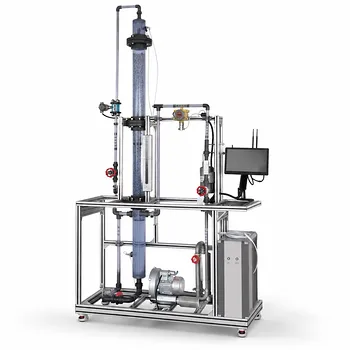
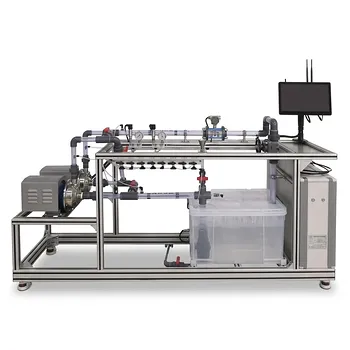
If you’re setting up or studying a sedimentation thickener for a pilot system, the mechanical support design you’ll encounter almost exclusively is the bridge support mechanism. In this configuration, a beam spanning the tank’s diameter holds the drive motor and central shaft, which slowly rotates rake arms along the floor to push settled solids toward a center discharge.
Core Takeaway: For pilot-scale sedimentation thickeners in water and chemical engineering, the bridge support is the standard mechanical design. It directly answers your surface question while also representing a scalable model to understand how support requirements evolve with tank diameter and solids load in larger industrial systems.
The Bridge Support: The Standard Design for Pilot Systems
In pilot plants and laboratory settings, the bridge support dominates for practical and educational reasons. It offers a clear, visible demonstration of the fundamental raking action without the added complexity of larger designs.
Why It’s the Default Choice for Small-Scale Units
The primary reference identifies the bridge support as the go-to for installations under 40 meters in diameter, which comfortably covers all pilot-scale vessels. It’s simply the most straightforward and cost-effective way to suspend a slow-turning rake mechanism above a cylindrical tank.
A structural beam crosses the tank’s top, holding the gear drive and motor in the center. The entire rake assembly hangs from this central point, eliminating underwater bearings or support columns that would complicate cleaning and observation during a pilot trial.
How the Raking Action Operates
The drive motor, mounted on the bridge, turns a vertical shaft attached to one or more rake arms. These arms sweep gently along the tank floor, moving settled solids toward a conical central underflow nozzle. The low rotational speed (often below 0.1 rpm) prevents re-suspension while steadily conveying the slurry.
Simultaneously, clarified water rises and overflows a peripheral weir. The bridge support keeps all drive equipment above the liquid level, accessible for ongoing adjustments to speed, chemical dosing rates, or feed well height.
Understanding the Scale-Up: Pillar and Traction Drives
While your pilot system likely uses a bridge, you may also encounter two other mechanical designs in advanced training modules or scale-up planning. They directly illustrate how support requirements shift with diameter.
Center Pillar Support for Medium-Scale Units
In this design, a stationary column sits at the tank’s center, replacing the overhead bridge. The rake arms pivot around this pillar. It suits tanks around 30 meters in radius where a spanning bridge would become too heavy or costly. For a pilot engineer, seeing this design reinforces how structural loads change when tanks grow beyond the bridge’s practical limit.
Traction Drive for Large Industrial Installations
For the largest thickeners (up to 60 meters radius), a motorized trolley rides on the tank’s perimeter wall, pulling the rake arm around like a clock hand. The central shaft becomes only a pivot point. Pilot training often includes this concept to show how torque demands and wall construction become the primary engineering concerns at full scale.
Understanding the Trade-offs
No single design is universally superior. Recognizing the limits of each support type is key to credible scale-up.
Bridge Support: Observation vs. Scale Limits
The bridge provides unmatched access and simplicity for pilot work. However, its structural members encroach on the free surface, and for diameters exceeding 40 meters, the required beam depth and weight can become impractical. It teaches the classic trade-off of small-scale convenience versus large-scale structural economics.
Center Pillar: Support vs. Maintenance Access
The center pillar eliminates the need for a heavy bridge and is often a cost-efficient step between pilot and full-scale. Yet, it introduces an underwater bearing and a central column that can obstruct sludge movement if not designed carefully. Pilot trainees learn that maintenance access becomes more challenging as the support moves from overhead to inside the tank.
Traction Drive: Heavy-Duty Torque vs. Complex Geometry
The traction drive handles enormous torque from dense sludge beds in the largest plants. Its downside is the need for a perfectly circular, robust wall track. For pilot-scale understanding, this design is purely conceptual—it demonstrates how industrial engineers decouple drive force from the fragile center mechanism when diameter and solids load demand it.
Making the Right Choice for Your Pilot Program
Your specific learning or project goal will determine which designs deserve the most attention.
- If your primary focus is building or operating a working pilot unit: Concentrate entirely on the bridge support design. Its simplicity, accessibility, and direct demonstration of raking, flocculant feed, and underflow density control are exactly what you need.
- If your primary focus is teaching or understanding full-scale process scale-up: Use the bridge support as a baseline, then explicitly compare its diameter limits to the center pillar and traction drive. This reveals how mechanical complexity grows with vessel size.
- If your primary focus is troubleshooting sludge handling issues: Remember that the support design dictates where torque is applied. Ensure your pilot’s bridge-mounted drive can deliver enough turning force for the thickest sludges you’ll test without stalling.
A pilot sedimentation thickener’s mechanical design is a deliberate simplification of an industrial principle, and mastering the bridge support gives you the clearest possible window into how controlled raking turns dilute slurry into dense underflow.
Summary Table:
| Support Design | Typical Scale / Diameter | Key Characteristics | Best Suited For |
|---|---|---|---|
| Bridge Support | < 40 meters (Pilot scale) | Overhead drive/motor; no submerged bearings; easy access. | Pilot trials, labs, and small-scale operations |
| Center Pillar | ~30m radius (Medium scale) | Stationary center column; rake pivots around the central pillar. | Intermediate systems transitioning to larger scales |
| Traction Drive | Up to 60m radius (Large scale) | Perimeter wall trolley pulls the rake arm; handles heavy torque. | Full-scale heavy-duty industrial installations |
Optimize Your Engineering Lab with LABPARK Pilot Plants
Are you looking to enhance your training or research capabilities? LABPARK provides state-of-the-art Educational and Vocational Unit Operations Pilot Plants in chemical engineering, bioprocess & biotech, and environmental & water treatment. Designed specifically for universities, research institutes, and enterprises, our systems help students and researchers master critical industrial processes like sedimentation and solid-liquid separation.
- Hands-on Learning: Equip your lab with real-world mechanical configurations, from bridge supports to advanced process controls.
- Scalable Insights: Empower your team to easily bridge the gap between bench-top trials and industrial scale-up.
- Custom Solutions: Get tailored pilot plants built to meet your specific curriculum or research objectives.
Ready to elevate your department's capabilities? Contact LABPARK today to discuss your project!
Related Products
- Hot Filtration Educational Unit Operations Pilot Plant Laboratory System
- Constant Pressure Filtration Educational Unit Operations Pilot Plant
- Multi-Stage Stirred Tanks in Series Residence Time Distribution and Mixing Performance Determination Educational Pilot Plant
- Gas-Solid Heterogeneous Separation Demonstration Educational Unit Operations Pilot Plant
- Rising and Falling Film Evaporation Educational Unit Operations Pilot Plant
People Also Ask
- How to Determine Specific Cake (r) & Filter Medium (Rm) Resistance Using Filtration Pilot Plant Data
- How to select solid-liquid separation equipment for pilot plants? A Step-by-Step Guide
- How can researchers identify and resolve filter medium blinding? Optimize Your Pilot Plant Runs
- Why Demo Constant-Rate to Constant-Pressure Filtration on a Pilot Plant? Key Practical Insights
- Why Analyze Filtration Flux & Cake Compressibility in Pilot Plants? Master Solid-Liquid Separation