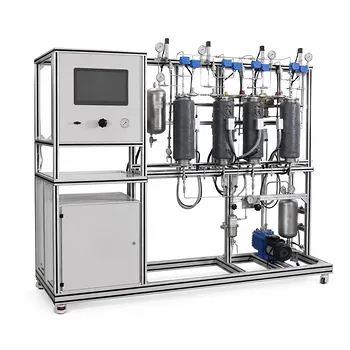
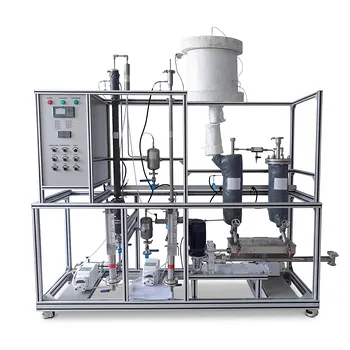
The core advantage is that a modular fluidic backbone fundamentally transforms a pilot plant from a collection of delicate, handcrafted glassware into a reconfigurable, scalable, and data-rich chemical "circuit board." This approach eliminates the primary source of performance failure—custom, dead-volume-prone connections—while enabling the rapid assembly of complex, multi-step continuous processes. It allows researchers and students to focus on chemical phenomena, not on fighting leaks and inconsistent flow paths.
Standardized interfaces in a modular system solve the critical problem of experimental inconsistency driven by physical setup errors. The real value is not just flexibility, but the guarantee of reproducible fluidic integrity across every experiment. This creates a reliable platform where the baseline performance is a constant, enabling the true comparison of reaction chemistry and process parameters without hardware-induced noise.
Eliminating Performance Bottlenecks at the Connector
In micro-scale flow chemistry, the connector is not just a fitting; it is the most critical performance bottleneck. A poorly designed interface can completely cancel out the benefits of a high-precision pump or a sophisticated microreactor.
The Hidden Cost of Dead Volumes
Self-made connections, like flangeless fittings using ferrules, inherently create unswept volumes. The primary reference correctly identifies these dead volumes as a direct cause of performance degradation.
These volumes disrupt the precise residence time control that defines a continuous microchemical system. Instead of a sharp, predictable reaction time, fluid stagnates in these pockets. This causes tailing in the residence time distribution, leading to over-reaction, byproduct formation, and inaccurate kinetic data. In an educational setting, it teaches bad habits and obscures the true principles of flow chemistry.
Data Integrity Through Mechanical Precision
A standardized interface ensures a zero-dead-volume connection every time. This transforms the fluidic path into a predictable mathematical model. Because the physical setup's baseline is constant, any change in the output—purity, yield, pressure drop—can be confidently attributed to the chemistry or process parameters, not a leaky fitting. This single advantage makes modular, standardized systems non-negotiable for publishing credible research.
The Miniaturized Circuit Board Principle
The deep need in research and education is not just to run one reaction, but to build a holistic understanding of chemical process integration. A modular backbone makes this possible on a benchtop.
Three-Dimensional Process Synthesis
Standardized components are not limited to linear, two-dimensional layouts. The primary reference highlights the ability to create three-dimensional configurations.
This allows a pilot plant to occupy a cubic footprint on a lab bench, stacking heat exchangers above reactors or routing flows in three axes. It replicates the spatial reality of a multi-story industrial plant, providing an unmatched educational tool for process design logic. Researchers can explore thermal integration, putting an exothermic reactor output directly through a compact heat exchanger module without long, heat-losing transfer lines.
Converging Electronics and Fluidics
The integration of an electronic bus is a paradigm shift. Sensors for temperature, pressure, and pH are not afterthoughts clipped to glassware; they are native components of the backbone. This creates a single source of truth for all process data, automatically time-stamped and correlated. For students, this demystifies the Industrial Internet of Things (IIoT) and process control, showing them how a "smart" plant is built from the component level up, not via external retrofit.
A Safer and More Sustainable Laboratory
The advantages extend beyond process performance into operational safety and environmental responsibility, key metrics for modern institutions.
Inherent Safety Through Process Intensification
Standardized, enclosed microreactor modules possess superior heat and mass transfer characteristics compared to batch glassware. A reaction that historically required dangerous cryogenic cooling at -60°C to control a thermal runaway can, as noted in the references, be run safely at room temperature in a microfluidic module. This eliminates the most hazardous utility in the lab, simplifying infrastructure and making advanced chemistry accessible to undergraduate students. You are not merely containing a hazard; you are engineering it out of existence through process intensification.
Rapid, Low-Waste Screening
Connecting a feed module, a reactor module, and an analytical module creates a single, automated screening loop. Researchers can test dozens of catalyst or solvent conditions per hour, each consuming microliters of material. This directly supports the rapid pathway screening mentioned in the supplementary references, generating a digitally-rich dataset while producing minimal waste. The modular design means you reuse the core infrastructure and only change the chemistry within the microreactors.
Bridging the Gap from Theory to Industrial Practice
The ultimate goal of any educational or vocational pilot plant is to mirror the industrial landscape. Modular fluidic backbones directly replicate the architecture of modern GMP pharmaceutical manufacturing.
From Batch to Continuous in a Single Lab Session
Students can first operate a single reactor module as a batch vessel, then reconfigure the exact same hardware into a continuous flow reactor. They physically build the continuity equation and Bernoulli validation setup described in the references, measuring pressure drops across Venturi modules themselves. This hands-on translation of abstract fluid dynamics and thermodynamics into a tangible, reconfigurable system is a pedagogical breakthrough. They see, measure, and feel the difference between laminar flow characteristics and the complete mixing of a batch tank.
Understanding Utility and Infrastructure
A modular pilot plant is a microcosm of a full-scale installation. It forces students to manage the standard process design base. They must plan connections for cooling water modules, electrical power buses, and process drainage—all in a compact, non-hazardous footprint. They learn that a process isn't just the reactor; it's the total system, a lesson that traditional glassware assemblies fail to teach.
Understanding the Trade-offs
To provide a complete picture, true objectivity requires acknowledging the limitations of this approach when compared to fully custom, bespoke glass setups.
Higher Initial Capital Cost
The primary barrier is investment. Precision-machined, standardized fluidic blocks are significantly more expensive upfront than a set of flasks, tubing, and ferrule fittings. The value proposition is operational, not capital.
Ecosystem Lock-in and Flexibility Limits
Adopting one manufacturer's standardized interface means committing to that ecosystem. While tremendously flexible within the system, you lose the absolute, unconstrained freedom of a custom-blown glass part. If your research requires a truly novel, one-off reactor geometry not offered as a module, a standardized backbone may become a constraint. You must evaluate if the penalty of custom fabrication outweighs the loss of plug-and-play standardization.
Making the Right Choice for Your Goal
Your decision to adopt this technology should be driven by your primary operational goal. Use the following guide to make the final call:
-
If your primary focus is reproducible, publishable research and rapid chemical screening: The modular, standardized backbone is a strategic requirement, not an option. The guarantee of zero-dead-volume connections and integrated data acquisition pays back its higher cost through experimental validity and speed.
-
If your primary focus is modern vocational and engineering education: This is the new gold standard. The ability to safely demonstrate process intensification, build continuity principle experiments, and teach batch-to-continuous transition in a single platform provides a multi-generational return on investment.
A reconfigurable, data-integrated platform not only answers your surface question of "what are the advantages," but directly solves the deep need for a robust, future-proof foundation where chemical insight, not plumbing, dictates success.
Summary Table:
| Feature | Modular Fluidic Backbone | Traditional Glassware |
|---|---|---|
| Fluidic Connections | Zero-dead-volume, leak-proof standard interfaces | Custom-made, prone to unswept pockets and leaks |
| Configuration | Reconfigurable, space-saving 3D layouts | Rigid, linear, and difficult to modify |
| Data Integration | Native sensors and built-in electronic bus | External, complex, manual sensor retrofits |
| Safety & Heat Transfer | Superior heat transfer, safe micro-flow chemistry | Batch thermal hazard risks, complex cooling needs |
Accelerate Your Research & Education with LABPARK
Are you looking to replace fragile, custom setups with highly precise, reproducible, and safe chemical engineering systems?
LABPARK provides cutting-edge Educational and Vocational Unit Operations Pilot Plants in:
- Chemical Engineering (including modular micro-scale flow chemistry)
- Bioprocess & Biotechnology
- Environmental & Water Treatment
Specifically engineered for universities, research institutes, and enterprises, our solutions eliminate hardware-induced experimental errors and bring industrial-grade process integration to your benchtop.
Contact LABPARK today to find the perfect pilot plant solution for your lab!
Related Products
- Micro-Scale Gas-Solid Catalytic Reaction Educational Pilot Plant
- Multi Functional Membrane Crystallization Educational Unit Operations Pilot Plant
- Bench Scale Carbon Dioxide Capture Educational Unit Operations Pilot Plant
- Methanol Synthesis and Catalyst Performance Evaluation Educational Unit Operations Pilot Plant
- Multifunctional Membrane Separation Educational Pilot Plant with Ultrafiltration, Nanofiltration, Reverse Osmosis
People Also Ask
- Why is a multibed configuration necessary for exothermic reactions? Optimize your pilot plant trajectory.
- Fluidized vs. Fixed Bed Reactors: Comparing Heat & Complexity in Pilot Plants
- Why is thermal management a major challenge in methane oxidative coupling? Reactor Solutions for Pilot Plants
- How does the Mears criterion evaluate transport resistance? Key Guide to Intrinsic Kinetics
- How do reactor pilot plants safely study gas-solid reactions? Master kinetics with thermal & flow control.